
The other day I watched a warehouse robot stop for a second before turning.
Nothing broke. Nothing crashed. It just… paused.
And honestly, that tiny delay felt more real than any polished robotics demo I’ve ever seen.
You could almost hear the question in the air.
Did the sensor glitch? Did the software hesitate? Did the machine just want to be sure it wasn’t about to do something stupid?
That’s the part people don’t talk about enough.
Building machines that move isn’t the hard problem anymore.
Building systems you can actually trust when those machines move… that’s where things get tricky.
For a long time everyone assumed trust comes from control.
Company owns the servers. Company owns the robots. Company owns the data.
So everything should work, right?
Yeah… I’ve seen that story before. It never holds up.
Sensors wear out.
Data gets messy.
Networks drop at the worst possible moment.
And when something goes wrong, nobody argues about the bug first.
They argue about the truth.
Who’s right?
Which log is real?
Whose version do you believe?
That’s exactly where Fabric Protocol starts to make sense, and honestly, not for the reason most people expect.
It doesn’t try to make machines perfect.
It assumes they won’t be.
Instead, it builds around verification.
Every action, every piece of data, every bit of computation goes through a public ledger so anyone can check what actually happened instead of trusting whoever runs the system.
Not trust the company.
Trust the record.
And look, if you’ve ever traded in a messy market, you already know why that matters.
I’ve had trades where I was sure my strategy was right… until I checked the history and realized I misread the data.
Confidence didn’t save me.
Logs did.
Same idea here.
Robots don’t live in clean environments.
Sensors drift.
Models get outdated.
Conditions change faster than anyone admits.
So you don’t build perfection.
You build something you can audit when things go wrong.
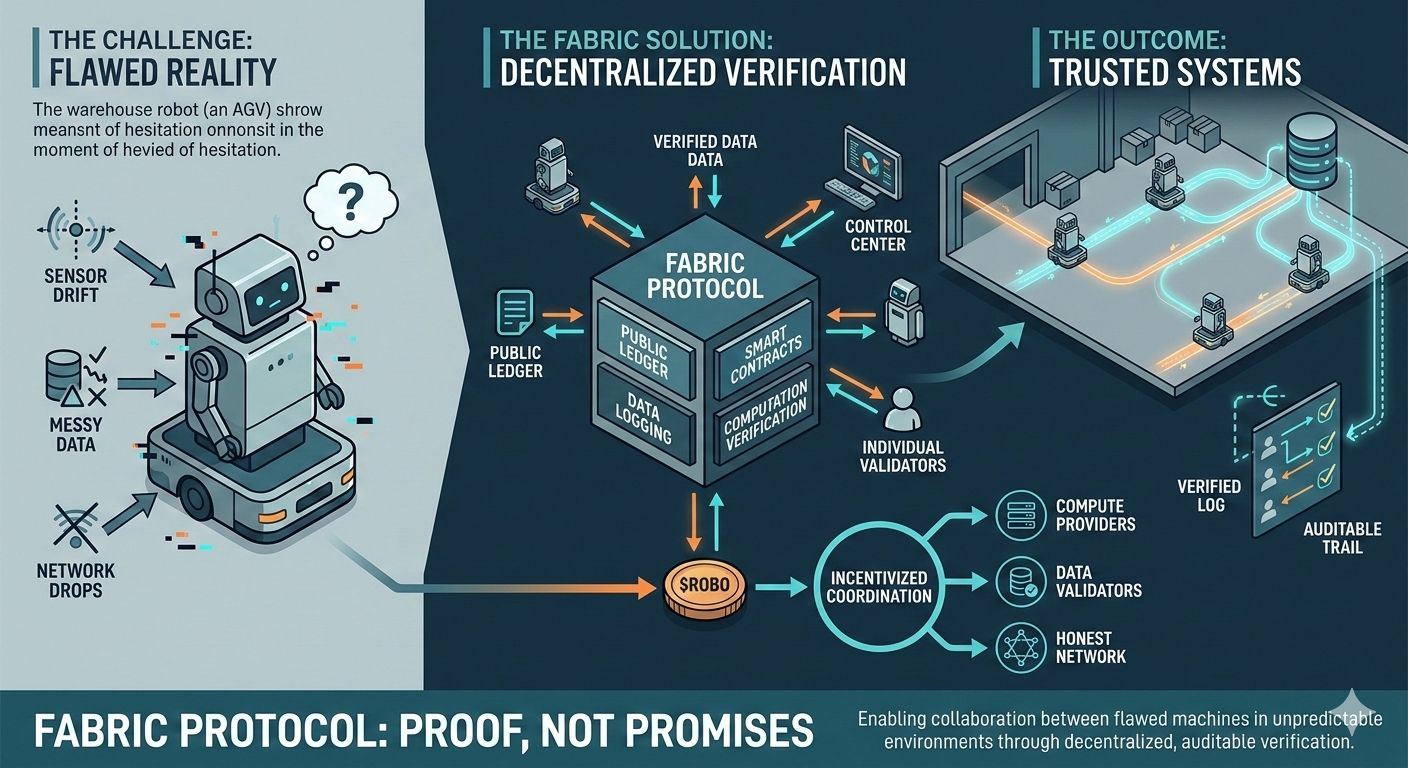
That’s also why the token layer exists, and yeah, people love to skip this part or turn it into hype.
$ROBO isn’t there to make the chart look exciting.
It’s there because verification systems need incentives or they fall apart.
Someone has to provide compute.
Someone has to validate data.
Someone has to keep the network honest.
Without incentives, coordination breaks.
With incentives, people show up.
Fabric isn’t trying to build flawless robots.
That would be fantasy.
It’s trying to build a system where flawed machines, noisy data, and unpredictable environments can still work together…
because every action leaves proof behind.
And honestly, I trust proof a lot more than I trust promises.
@Fabric Foundation #ROBO $ROBO
