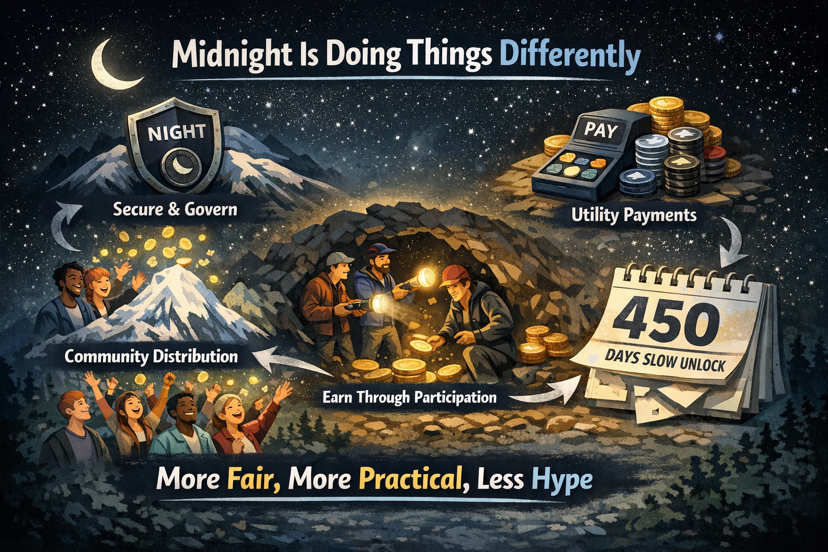
One thing I genuinely like about Midnight is that it doesn’t follow the usual crypto playbook.
Most projects try to make one token do everything. It becomes the governance token, the fee token, the speculative asset — basically the center of the whole system. On paper, that sounds efficient. In reality, it usually creates confusion, high fees, and a network that feels like it was built more for traders than for actual users.
Midnight feels different.
What stands out to me is how clearly it separates roles. The token used for securing the network and participating in governance is not treated the same way as the mechanism for using the network itself. That might sound like a small design choice, but I think it changes a lot.
It shows maturity.
To me, this is one of the smartest things a project can do: stop forcing utility and speculation into the same box. When those two things get mixed, the user experience usually suffers. Midnight seems to understand that if you want real adoption, the network has to work for people who are actually there to use it, not just trade around it.
The distribution side also feels more thoughtful than what we usually see.
A lot of projects talk about community, but when you look closely, most of the supply still ends up heavily tilted toward insiders, early funds, and private allocations. Midnight at least gives the impression that it is trying to do things differently by pushing a major share into the community.
That matters.
Because distribution is not just about numbers. It tells you who a network is really being built for. And when users across different ecosystems are included, it makes the project feel more open and less like a closed club.
I also like that participation seems to matter.
Instead of rewarding people just for showing up and waiting for free tokens, the design encourages activity. That creates a different kind of culture. It pushes people to engage, explore, and contribute rather than just farm and disappear. In my opinion, that is a much healthier way to build a community.
Another thing that stood out to me is the slower redemption schedule.
In crypto, everything is usually rushed. Fast launches, fast hype, fast unlocks — and then fast sell pressure. Midnight taking a slower route feels intentional. It gives the system more breathing room and makes the whole process feel less like a short-term event and more like something meant to last.
That kind of pacing builds trust.
It tells me the project may actually care about long-term participation instead of chasing short-term attention.
I also think the idea of letting people access services without forcing them to completely switch into one ecosystem is a big plus. That lowers friction. And lowering friction is important, because most people are not looking for another complicated process just to use one feature.
If privacy tools are going to matter, they have to be easy to reach.
That is probably the biggest takeaway for me.
Midnight does not come across like a project trying to sell privacy as an exclusive feature for a small group of insiders. It feels more like it is trying to make privacy infrastructure practical, usable, and sustainable for normal users.
And honestly, that is refreshing.
In a space where so many projects are built around hype cycles, token pumps, and short attention spans, Midnight feels like it is at least aiming for something more grounded. Whether it fully delivers or not will depend on execution, of course. But from a design and philosophy point of view, it already feels more thoughtful than most.
That is what makes it interesting to me.