
I’ve spent a fair amount of time digging into Midnight Network, and what stands out to me is how it positions itself around privacy without sounding abstract or far off. Midnight Network is, in my view, a privacy focused layer that aims to keep user data from being exposed on public blockchains while still enabling verifiable, trust-minimized interactions. It’s not just about hiding a transaction history; it’s about making certain data points, like amounts or identifiers, usable for governance or app logic without leaking everything to the world. In practical terms, it tries to give developers a way to build dApps that require privacy by default, rather than treating privacy as an afterthought or a premium feature.
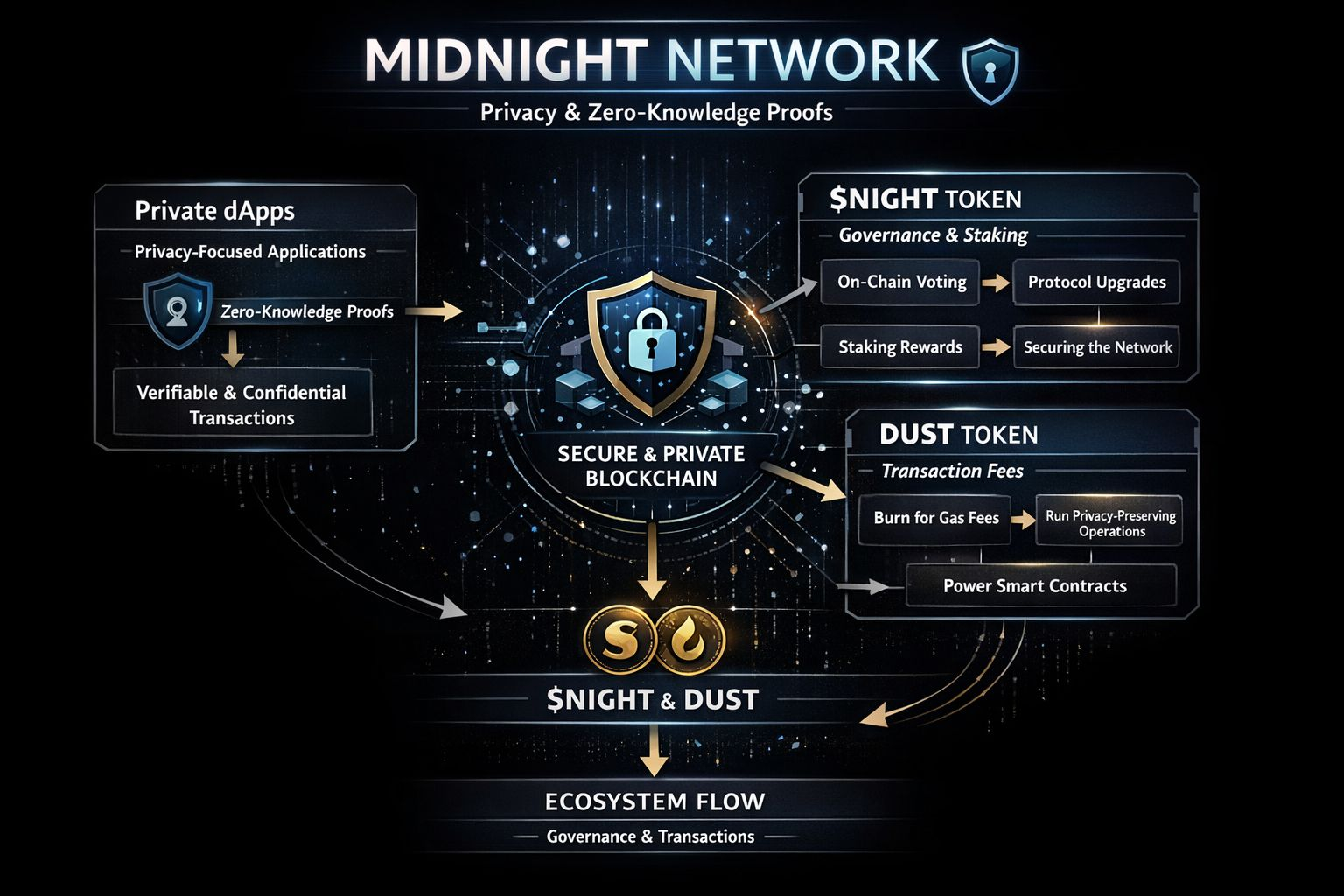
Privacy matters in blockchain because the default transparency can be a liability for everyday users. When you’s transacting, interacting with DeFi protocols, or sharing analytics with a product, the visibility of personal patterns can invite profiling, front-running, or even regulatory overreach in ways that don’t align with what people expect from their finances. Midnight Network leans into the idea that you should be able to prove a statement without revealing the underlying data. In other words, you can demonstrate that you’re eligible for a grant, or that you held a certain amount of stake, without revealing who you are or the full history behind it. That balance privacy with provable integrity feels essential to me when observing user centric blockchain design.
Central to that balance are zero-knowledge proofs, and I’ve found their role in Midnight Network to be illuminating. ZK proofs let someone show that a claim is true (like “this transaction is valid or this user has sufficient balance without exposing the private data behind it. It’s a way to keep verification public and trustworthy while keeping sensitive inputs hidden. In practice, that means the network can validate blocks, enforce rules, and maintain security properties without leaking detailed information about who did what. The elegance, to my eye, is in reducing the need to trust external privacy corridors or centralized custodians the math does the heavy lifting to keep data confidential by design.
When I look at the ecosystem’s economics and governance, the Midnight token, $NIGHT, plays a pivotal role. From what I’ve observed, $NIGHT isn’t just a monetary unit; it’s the glue for governance decisions within the network. Holders can participate in on chain voting to shape protocol upgrades, fee structures, or parameter changes, which aligns incentives with long term network health. At the same time, block rewards tethered to $NIGHT rewarding validators or block producers help reinforce security and participation. This dual function governance and incentives reflects a thoughtful attempt to align community input with the economics of secure, private computation.
Another piece of the puzzle that caught my attention is how $NIGHT interacts with DUST to power transactions. DUST acts as a utility layer that participants can burn or spend to cover transaction costs, finalize privacypreserving operations, or enable certain privacy-preserving features in smart contracts. In practice, the pairing of $NIGHT and DUST creates a two token dynamic where routine operations are made affordable and privacy enhanced processes aren’t bottlenecked by one asset’s scarcity. The design feels deliberate: you don’t rely on a single token for everything, but rather a complementary duo that supports both governance and day to day transaction flow. It’s a pattern I’ll be watching as the network matures.
