
I keep thinking about this moment we’re in with AI and robotics, and honestly, it feels a bit strange when you slow down and look at it closely.
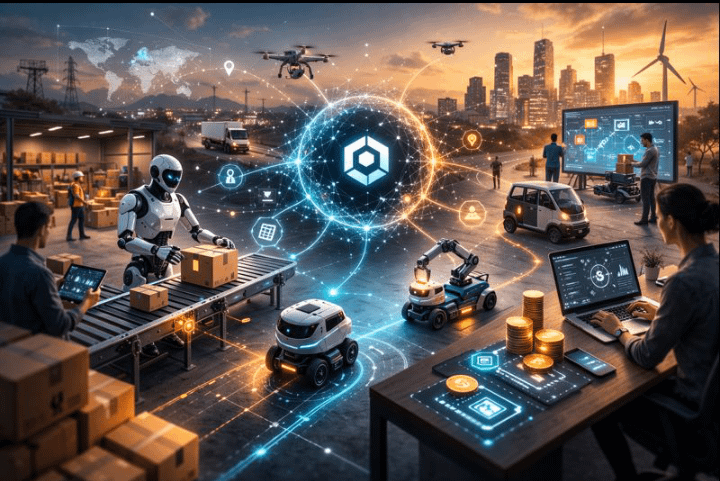
A few years ago, most of this stuff lived on screens. You’d open an app, type something, maybe automate a workflow, and that was it. Now you’ve got robots packing orders in warehouses, self-checkout systems replacing cashiers, delivery bots rolling down sidewalks in some cities. It’s no longer just software it’s starting to touch the real world in a physical way.
And that’s where things get messy.
Because when software makes a mistake, it’s annoying. When a robot makes a mistake, it can break something, lose money, or even hurt someone. The stakes are just different. And yet, the systems we use to manage all this ownership, accountability, coordination still feel like they belong to an earlier era.
That’s kind of the space where Fabric Protocol is trying to step in. Not loudly, not in a flashy “this will change everything” way, but more like it’s quietly asking a question most people aren’t really thinking about yet: if machines are going to act more independently in the world, how do we actually organize that?
Think about something simple. Let’s say you order food through an app. Today, there’s a company in the middle coordinating everything the restaurant, the driver, the payment, the tracking. If something goes wrong, you know who to blame. There’s a clear chain of responsibility.
Now imagine a slightly different version of that scenario. A robot picks up your food. Another system routes it. Payment happens automatically between systems. Maybe the robot isn’t even owned by the delivery platform it’s leased, or shared across multiple services.
Suddenly, things aren’t so clear anymore.
Who’s responsible if the delivery fails? Who gets paid if the robot completes the job? How do you even trust that the task was done properly?
Fabric Protocol is basically trying to build a shared system where those questions don’t rely on a single company sitting in the middle. Instead, it uses a public ledger something like blockchain—to keep track of actions, payments, and identities.
Now I know, the moment people hear “blockchain,” they either get excited or immediately tune out. And to be fair, most of the skepticism is deserved. We’ve seen years of overpromises, projects that never shipped, and ideas that sounded good on paper but didn’t survive real-world use.
So it’s worth being careful here.
What makes Fabric at least interesting is that it’s not trying to sell you on speculation first. It’s trying to solve a coordination problem. The idea is that robots and AI agents could exist in a shared network where their actions are recorded, verified, and rewarded.
For example, imagine a warehouse with dozens of robots from different manufacturers. Right now, those systems are usually closed. One company builds the robots, runs the software, and controls everything.
Fabric is imagining a more open setup.
A robot could have a kind of digital identity not like a human identity, but more like a profile that tracks what it has done. How many tasks it completed, how reliably it performed, what kind of work it’s good at. Over time, that builds something like a reputation.
If you’ve ever used a ride-hailing app, it’s a bit similar to driver ratings. You trust a driver more if they’ve completed thousands of trips successfully. Now apply that idea to machines.
Let’s say there’s a cleaning robot in a large office building. Instead of being tied to one company, it could take on tasks from different clients. One company might need overnight cleaning, another might need weekend maintenance. The robot logs its work, gets verified, and gets paid automatically.
It sounds efficient. Maybe even obvious.
But then you start asking the uncomfortable questions.
How do you actually verify that the robot did its job properly?
It’s easy to say “record the data,” but data can be misleading. Sensors fail. Systems can be manipulated. Even humans disagree on what “a good job” looks like. Anyone who’s argued with a service provider knows that.
Fabric talks about something like “proof of work,” but not in the crypto mining sense in the sense of proving real-world activity. A robot doesn’t just say it cleaned a room; it provides evidence that can be checked.
In theory, that’s powerful.
In practice, it’s hard.
Take something like a delivery robot. It might log GPS data, timestamps, maybe even camera footage. But GPS can drift. Cameras can be obstructed. Data can be tampered with if the system isn’t secure end-to-end.
So now you’re not just building robots you’re building a trust system around robots. And that trust system has to be strong enough that people are willing to rely on it without a central authority.
That’s a big ask.
Then there’s the money side of it, which is where things get even more interesting.
Fabric introduces a token basically a digital asset used for payments and incentives inside the network. Robots complete tasks, they get paid. People who provide data or infrastructure get rewarded. Governance decisions are made collectively.
Again, on paper, it sounds balanced. Everyone participates, everyone benefits.
But if you’ve watched crypto for a while, you know things rarely stay that clean.
Early adopters tend to accumulate more influence. Speculation creeps in. People start focusing more on the token price than the actual utility. Governance can quietly shift toward those who hold the most assets.
And here’s the subtle part: robots don’t care about incentives. People do.
A robot isn’t going to cheat the system on its own. But the person deploying or controlling that robot might. If there’s a way to game the system to fake activity, exaggerate performance, or exploit loopholes someone will probably try.
So the real challenge isn’t just technical. It’s behavioral.
Fabric is trying to design a system where honest behavior is the most rewarding path. That’s incredibly difficult to get right, especially in an open network where anyone can participate.
Still, there are glimpses of where this could actually make sense.
Look at logistics. Companies are already experimenting with autonomous delivery in controlled areas. In places like parts of the US and China, you’ll see small robots delivering groceries or packages over short distances.
Right now, those systems are tightly controlled. One company owns the robots, the software, the data.
But imagine if those robots could operate across platforms. A single robot could handle deliveries for multiple services. Payments could be automatic. Performance could be transparent.
That kind of interoperability is where Fabric is aiming.
Or think about something like agriculture. Autonomous machines are already being used for planting, monitoring crops, and harvesting. Farmers could, in theory, share access to these machines instead of each owning their own. A network could coordinate usage, track performance, and handle payments.
It’s not a wild idea it’s just not fully built yet.
And then there’s the bigger question sitting in the background: do we actually need all of this to be decentralized?
Because sometimes, a simple centralized system works better. It’s faster, easier to manage, and more predictable. Companies like Amazon didn’t build their logistics networks by decentralizing everything—they did the opposite.
So Fabric is betting that, over time, openness and shared infrastructure will matter more than control and efficiency.
That might be true. But it’s not guaranteed.
There’s also the timing issue.
A lot of this vision depends on robots being common enough to justify a global coordination layer. We’re getting there, but we’re not quite there yet. Most robots today still operate in controlled environments warehouses, factories, specific delivery zones.
Building a big coordination system before the ecosystem fully matures can go either way. It can put you ahead of the curve, or it can leave you solving problems that don’t exist at scale yet.
And then there’s regulation, which nobody really has figured out.
If a robot earns money, who owns that income? If it causes damage, who is legally responsible? The operator? The manufacturer? The network?
Different countries will answer those questions differently, and that creates friction for any global system.
Fabric seems to assume that these things will get figured out over time. Maybe they will. But it’s not a small detail it’s one of the biggest unknowns.
Still, even with all the uncertainty, there’s something about this direction that feels worth paying attention to.
Because whether it’s Fabric or something else, we’re clearly moving toward a world where machines are doing more than just assisting us. They’re acting, deciding, coordinating.
And once that happens, you can’t just treat them like tools anymore.
You need systems that define how they interact, how they’re trusted, how they’re held accountable. Not just technically, but economically and socially.
That’s really what Fabric is trying to explore.
Not just “how do we build better robots,” but “how do we build a system where robots, humans, and software can work together without everything depending on a single controlling entity.”
It’s a big idea. Maybe too big, at least for now.
But even if it doesn’t fully work the way it’s imagined, it points to a question that’s going to become harder to ignore:
When machines start participating in the real world alongside us, who sets the rules and who do those rules actually serve?
#robo $ROBO @Fabric Foundation
