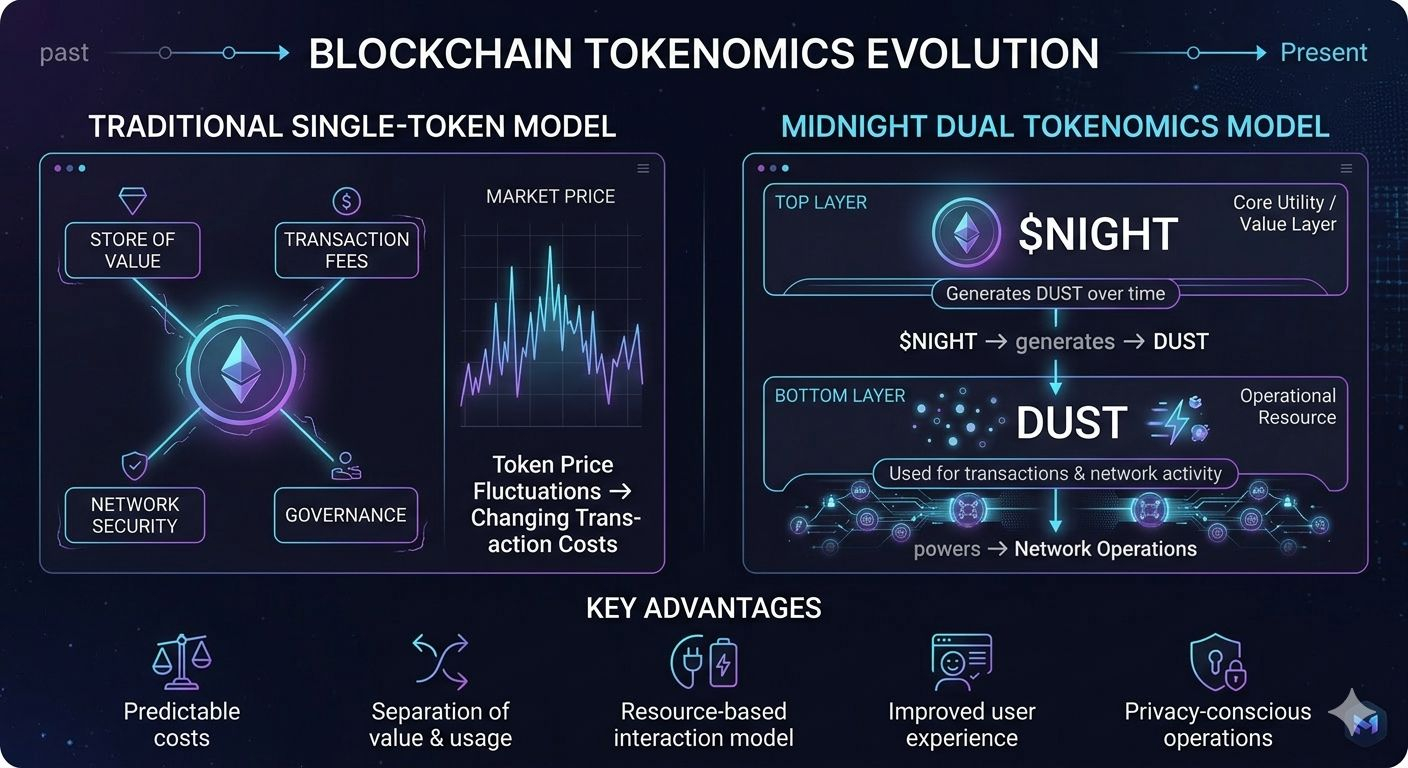
When I look at different blockchain systems, one pattern appears again and again. Most networks rely on a single token to handle everything. It stores value, pays transaction fees, secures the network, and sometimes even plays a role in governance.
At first, this design feels simple and efficient. But over time, the limitations become more noticeable. The cost of using the network becomes directly tied to the price of the token. When the market moves, transaction costs can become unpredictable, making it harder for both developers and users to plan ahead.
Midnight introduces a different structure.
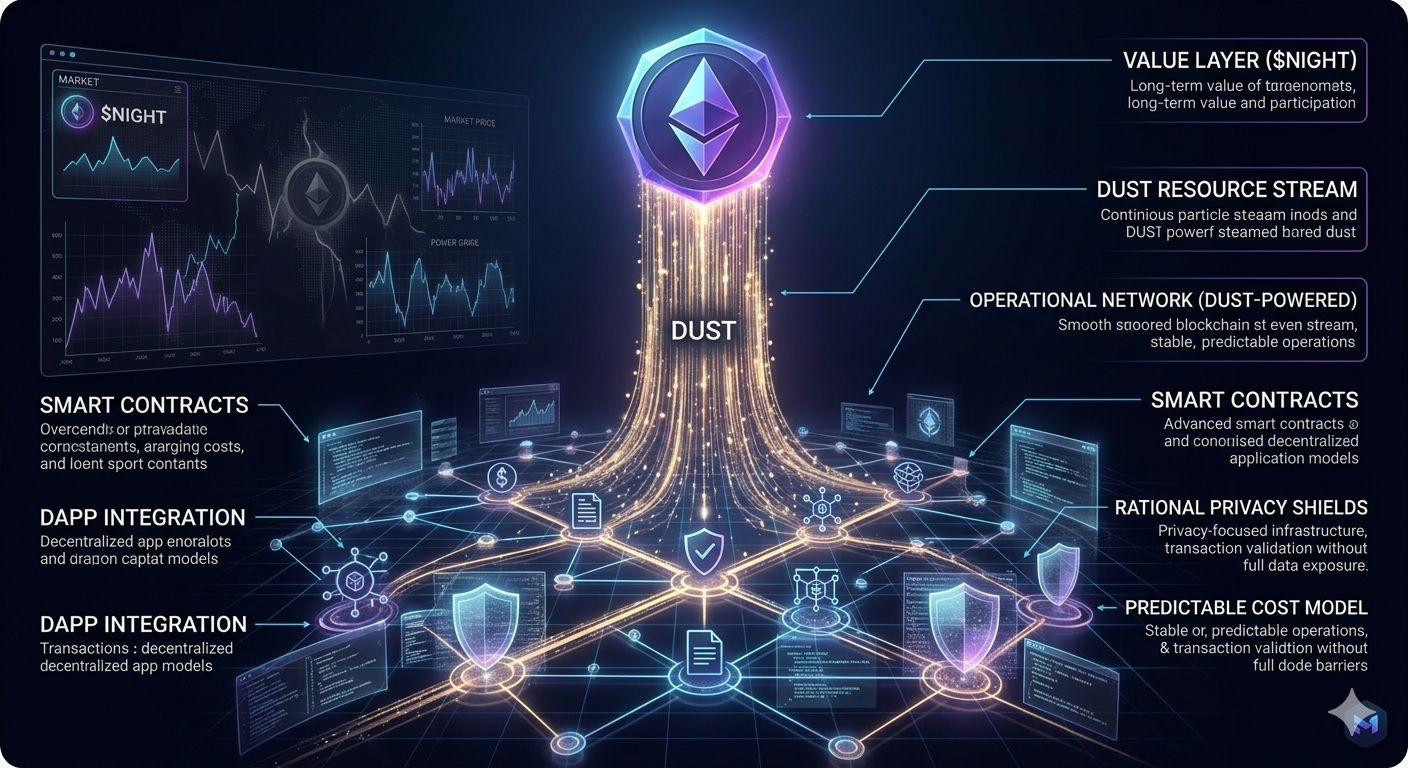
Instead of forcing one token to handle every function, the network is built around a dual tokenomics model involving $NIGHT and DUST. In this system, $NIGHT acts as the core utility token, but it is not directly consumed when users interact with the network.
Its main role is to generate DUST.
DUST serves as the operational resource that powers transactions, smart contract interactions, and overall network activity. This separation creates a clear distinction between long-term value and day-to-day usage within the ecosystem.
What I find interesting about this model is how it changes the way people interact with a blockchain. Holding $NIGHT allows participants to generate DUST over time, which can then be used to operate within the network. Instead of repeatedly spending the main token, users rely on a renewable resource to manage their activity.
From a practical perspective, this design can make the system more predictable. Developers can think in terms of resource generation and capacity planning rather than constantly adjusting to token price volatility. This could lead to more stable applications and a better overall user experience.
There is also a privacy dimension built into this structure. Since DUST functions as a shielded resource, many interactions can take place without exposing unnecessary transaction metadata. This aligns with Midnight’s broader idea of rational privacy, where actions remain verifiable without revealing more data than necessary.
In my view, the dual tokenomics model is not just a technical feature. It represents a different way of thinking about blockchain economies. By separating the asset that holds value from the resource that powers activity, Midnight aims to create a more balanced and usable system.
Whether this model becomes widely adopted will depend on real-world usage and developer adoption. But as a concept, it offers a thoughtful alternative to the traditional single-token approach that dominates most blockchain networks today.
$NIGHT #night @MidnightNetwork