

I’m spending time looking into Midnight Network, and I keep coming back to one big idea.
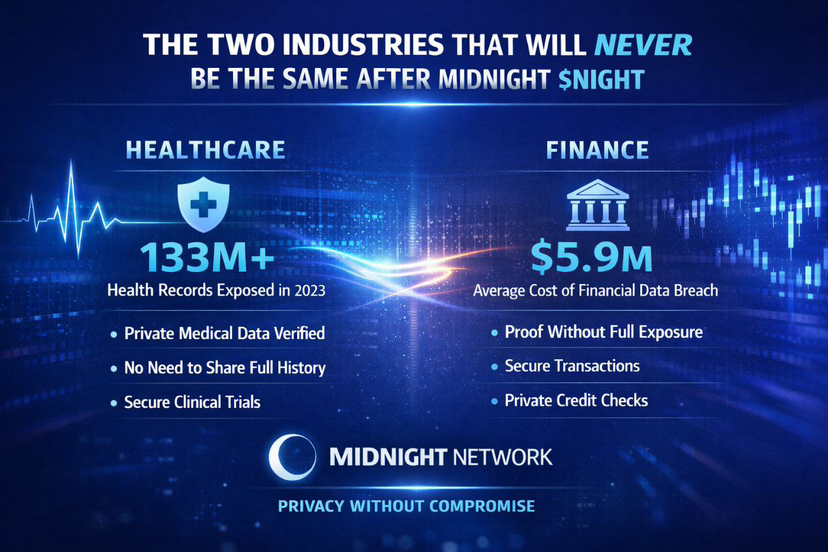
I’m thinking about how it could seriously change two industries that deal with the most sensitive data we have—healthcare and finance.
And honestly, the more I think about it, the harder it is to ignore.
I’m Starting With Healthcare Because This One Feels Real
I’m looking at what’s been happening in healthcare, and it’s honestly uncomfortable.
In just one year, over 100 million health records were exposed in the U.S. alone. I’m thinking about what that actually means. That’s not just names and emails. That’s people’s diagnoses, medications, mental health history, and deeply personal information.
I’m asking myself why does this keep happening?
And the answer I keep coming back to is simple.
I’m realizing these systems have to store sensitive data just to function. Hospitals, insurance companies, researchers—they all need access to information, so they collect it, store it, and hope nothing goes wrong.
But things do go wrong.
That’s where Midnight starts to feel different to me.
I’m looking at how it works, and I’m seeing something interesting. Instead of sharing the actual data, it focuses on sharing proof.
So I’m thinking about a real situation.
I’m imagining a doctor needing to confirm a patient’s blood type before surgery. Normally, that means accessing a full medical record. But with this model, I’m seeing a system where the doctor can confirm the blood type without seeing everything else.
I’m seeing the same idea apply to insurance.
I’m thinking about how an insurance company could approve a claim without building a full profile of someone’s health history. Or how a researcher could confirm that someone qualifies for a clinical trial without ever seeing their personal identity.
That shift feels important.
I’m not just seeing it as an upgrade. I’m seeing it as removing the need to expose data in the first place.
And that changes the risk completely.
I’m thinking about people in places where health data can actually be used against them. Where insurance can be denied based on history. Where employers might get access to things they shouldn’t.
I’m realizing this isn’t just about efficiency.
It’s about safety.
And that’s why I keep coming back to it.
Now I’m Looking at Finance, and It Gets Personal
I’m switching over to finance, and this one hits differently.
I’m thinking about how crypto originally pushed transparency as a strength. Everything open. Everything visible. The idea was that if everything is public, fraud becomes harder.
And I get that.
But I’m also thinking we might have taken that too far.
I’m imagining what it would feel like if every transaction I’ve ever made was public forever. Every payment. Every salary. Every transfer to family. Every donation.
That doesn’t feel like freedom to me.
That feels like exposure.
I’m realizing most people wouldn’t be comfortable with that if they really thought about it.
That’s where Midnight starts to stand out again.
I’m looking at how it handles transactions, and I’m seeing a different approach.
I’m seeing a system where transactions can still be verified, but the details don’t have to be exposed to everyone.
So I’m thinking about real examples.
I’m imagining a business proving it paid its taxes without revealing all of its revenue to competitors.
I’m imagining someone proving they passed KYC without sending their passport to multiple platforms.
I’m imagining a bank checking creditworthiness without storing a permanent record of someone’s financial struggles.
That feels more practical.
I’m not seeing it as hiding everything. I’m seeing it as controlling who gets to see what.
And that’s a big difference.
I’m Noticing the Bigger Pattern
As I’m thinking about both healthcare and finance, I’m starting to see the connection.
These are the two industries where data matters the most.
And they’re also the ones where things go wrong in the worst ways.
I’m thinking about what happens when data leaks.
A crypto wallet leak is bad, sure.
But I’m realizing that a leaked medical record combined with financial data is on a completely different level.
That can affect someone’s job, their insurance, their relationships.
In some places, it can even affect their safety or freedom.
That’s serious.
And I’m noticing that the current model doesn’t really handle this well.
I’m seeing a system where we collect everything, store everything, and just hope nothing breaks.
That doesn’t feel sustainable.
I’m Starting to See What Midnight Is Really Trying to Do
The more I look at it, the more I feel like Midnight isn’t just adding privacy as a feature.
I’m seeing it as trying to rebuild how systems handle data from the ground up.
I’m thinking about the original idea behind crypto control over your own information.
And I’m realizing that somewhere along the way, that got lost.
We ended up with systems that are open, but not necessarily private.
Transparent, but not always safe.
Midnight feels like a correction to that.
I’m seeing a model where you don’t have to share everything to prove something.
Where you don’t have to expose your data just to participate.
And that feels closer to what people actually need.
I’m Still Asking Questions
At the same time, I’m not blindly trusting it.
I’m thinking about the challenges.
I’m asking myself whether systems like this will be easy to use. Whether companies will adopt them. Whether regulators will accept this kind of proof as valid.
Because those things matter.
I’m also thinking about how people feel about privacy.
Some people say they want it, but when systems become less visible, they start to feel uncertain.
So I’m asking myself a bigger question.
If a system gives full privacy, does that make people more comfortable—or less?
That’s not a simple answer.
Where I’m At Right Now
Right now, I’m just watching.
I’m not treating this like a guaranteed success.
But I am seeing something that feels more grounded than most of what’s out there.
I’m seeing a project trying to solve a real problem in two industries where the stakes are high.
Healthcare and finance aren’t just about data.
They’re about people’s lives.
And I’m thinking that if something can improve how those systems handle sensitive information, it’s worth paying attention to.
So I keep coming back to Midnight.
Not because it’s loud.
Not because it’s trending.
But because I’m seeing a different way of thinking about privacy one that might actually work in the real world.
And honestly, that’s enough to keep me watching.