I have been in this industry long enough to know when something is mostly recycled hype.
Every few years, a new coin shows up, a new narrative gets packaged, and in the end it is usually the same old idea dressed in better language. That was my first reaction to Fabric too. I did not find the robotics angle especially convincing at first. It felt like another polished promise. Another “future of machines” pitch. Another story we have heard before.
But then I noticed something that, in my view, matters far more than the robots themselves.
Fabric is not just trying to connect machines.
It is trying to create rules for them.
And that is where this stops being a standard tech story and starts becoming a serious infrastructure question.
The biggest problem in robotics is not capability. It is accountability.
Robots already do useful work. That is no longer the impressive part.
The real problem is that they do not operate inside a shared system of accountability. They are usually trapped inside company walls, deployed in closed environments, and governed by private logic. When something goes wrong, there is rarely a clear framework for responsibility.
What happens instead is what always happens.
Emails.
Support tickets.
Internal confusion.
Blame shifting.
That is the messy truth of modern automation: machines are already acting in the world, but the systems around them are still structurally immature.
We have software.
We have commands.
We have execution.
What we do not really have is a serious framework that defines what a machine was supposed to do, under which rules it was operating, what happens if it fails, and how that failure gets enforced without turning into human chaos.
To me, that is the real bottleneck.
A lot of people think robotics needs better hardware, better coordination, or better AI.
Maybe.
But I think the deeper problem is simpler: we have given machines work, but we have not given them a real rule system.
Fabric’s bold idea is that machines should not just act. They should be bound.
This is where Fabric starts to look different.
It does not just seem interested in making robots interoperable. It appears to be trying to build digital guardrails around machine behavior itself.
That is not a small distinction.
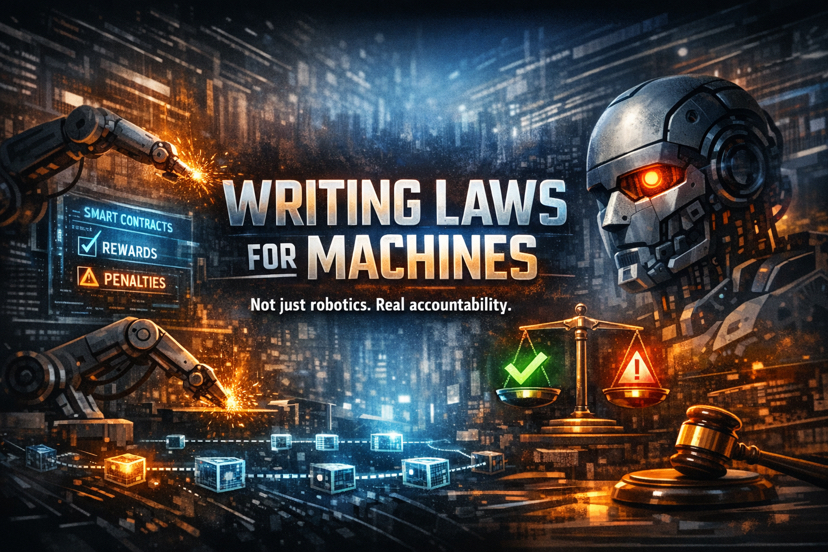
If the system can define duties through smart contracts, make conditions explicit, and make outcomes enforceable, then we are no longer just talking about automation. We are talking about machine discipline.
That is a much more important shift.
A machine is not simply being assigned a task. It is being placed inside a system that imposes expectations on how that task must be performed.
And honestly, that is what robotics has been missing.
So far, most of the focus has been on making machines productive.
The next stage, in my opinion, is making them accountable.
Human oversight does not scale. Rules do.
A lot of people still assume that as machines become more autonomous, humans will simply stay in the loop and manage the exceptions.
I do not think that scales.
At a certain point, human supervision becomes a fantasy. You cannot manually review every edge case. You cannot handle every failure through support workflows. You cannot build a serious machine economy on top of endless human intervention.
Eventually, the management layer collapses under complexity.
What remains are rules.
That is why I think the future infrastructure of robotics will not be defined by dashboards. It will be defined by rule engines.
And if Fabric is genuinely building in that direction, then it is not just another robotics product. It is experimenting with something much bigger: the base layer for machine behavior.
Rules without incentives are just slogans
One of the reasons Fabric feels more serious than most of the usual narratives is that it ties rules to incentives.
You stake value to participate.
If you perform correctly, you earn.
If you fail or violate the terms, you lose.
That is harsh. But it is also what makes it real.
No emotional negotiation.
No vague accountability.
No “we’ll sort it out later.”
No soft enforcement.
Because in the real world, the only rules that matter are the ones with consequences.
Everything else is guidance.
Fabric, at least in principle, is saying that machine behavior should not be optional. If a machine wants to participate in the network, then it has to operate under conditions that can actually be enforced.
That is a serious shift.
This feels less like a product and more like a machine contract system
I do not really see Fabric as a normal tech product.
To me, it looks more like an embedded contract system for machines.
We already know how to write contracts between people.
That part is old.
The harder question is this: when machines interact with each other, coordinate tasks, exchange value, and execute work autonomously, what is the contract structure between them?
If there is no answer to that, then the idea of an autonomous machine economy is still mostly fiction.
Fabric seems to be trying to build that missing layer.
Not contracts between people.
Contracts between machines.
Governance is the part people underestimate the most
And then there is governance, which is usually either ignored or buried under buzzwords.
But governance is where the real power sits.
If machines are going to operate at scale, the most important question is not just what the rules are. The more important question is: who gets to change them?
If that power lives inside a private company dashboard, then this is not really infrastructure. It is controlled behavior wearing the language of openness.
That is why I think open governance matters here, even if it is messy. Open systems are slower. They are harder to manage. They create friction.
But closed systems are often worse, especially when they are shaping the behavior of machines that operate in the real world.
So yes, open governance is messy.
It is also probably necessary.
The real test is not the theory. It is whether the system survives reality.
Now for the hard part.
All of this sounds smart on paper. Maybe even necessary.
But reality is not clean.
Sensors fail.
Data gets noisy.
Machines behave imperfectly.
Edge cases multiply.
Environments stop cooperating.
This is where elegant theories usually begin to break.
It is one thing to write rules for machines.
It is another thing to make those rules survive messy, unpredictable, real-world conditions.
That is the gap I keep watching.
Because if Fabric’s digital guardrails only work when the environment is clean, then this becomes just another well-designed theory.
But if they continue to hold under pressure, under noise, under failure, under ambiguity, then we are no longer talking about robots simply getting tasks done.
We are talking about machines operating inside a system that imposes behavior on them in the way laws impose behavior on people.
And that is a very different conversation.
My view
In my opinion, the future question is not whether machines can work.
They already can.
The real question is who or what gets to bind them.
Who writes the rules.
Who enforces them.
Who changes them.
And what happens when those rules collide with reality.
If Fabric can make that layer real, durable, and enforceable, then it is not just building robotics infrastructure.
It is helping define the legal, operational, and economic framework of machine behavior itself.
And to me, that is the actual story.