
I like it when a project makes me think bigger than price, and Fabric Protocol did that for me.
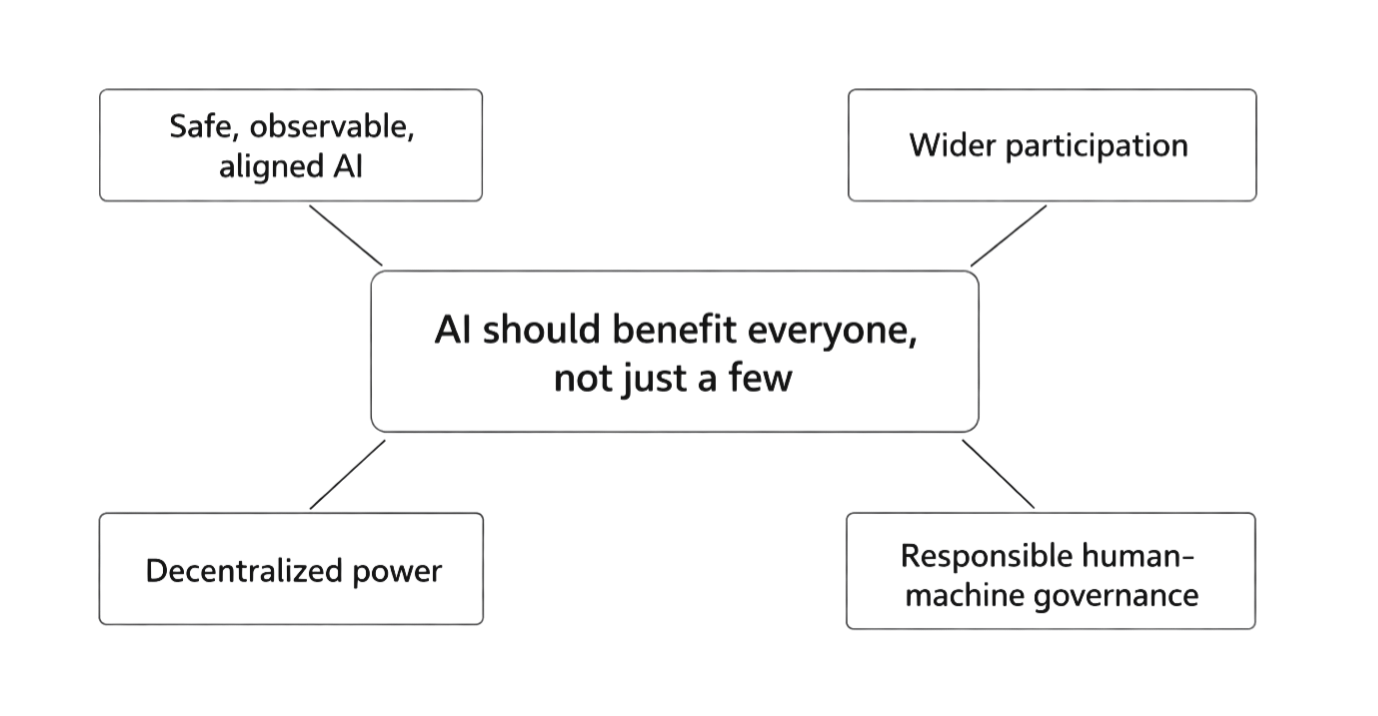
Most AI stories feel predictable now. Faster models, better agents, more automation, more capital chasing the same theme. Fabric comes at the topic from another angle. On its website, the Foundation says success is not only about making intelligent machines more capable. It says success should also mean those systems are safe, observable, aligned with human intent, open to wider participation, and governed responsibly by humans and machines together.
That shift is what caught my attention. It changes the question from “how strong can AI get?” to “who actually benefits if it does?”
The more I read, the more that caught my eye.
Fabric is basically arguing that if robots and autonomous systems are to operate in the real world, they will require more than just software and hardware.
They would need identity.
They would need payment rails.
They would need task settlement.
They would need a system that people can examine.
The Foundation positions itself as a non-profit that is constructing the governance, economic, and coordination infrastructure which makes it possible for humans and intelligent machines to work together in a safe and productive manner. Its official ROBO post says Fabric is building the payment, identity, and capital allocation network for autonomous robots, and that the network starts on Base with a longer-term goal of moving toward its own Layer 1 if adoption grows.
That makes the whole project feel more serious to me. Not risk-free, not proven, but serious.
What stayed with me is simple : AI should benefit everyone, not just a few.
That sounds nice on the surface, but Fabric gives it weight. In the whitepaper, the project warns that automation could concentrate wealth and power in extreme ways, possibly in the hands of one company or even one person. So the real issue is not only whether machines become more useful. It is whether the gains from that usefulness stay narrow or get shared more broadly. I think that is the strongest part of the whole thesis.
Crypto people have seen this pattern before. New infrastructure gets built, access expands later, but ownership often stays tight. Fabric is trying to argue for another path. The whitepaper describes Fabric as an open network to build, govern, own, and evolve general-purpose robots, and says the protocol coordinates data, computation, and oversight through public ledgers so anyone can contribute and be rewarded. That is a much bigger claim than simply launching a token around a trend.
Where ROBO fits into the picture :
ROBO is not presented like a side asset. It is supposed to be the working piece inside the network.
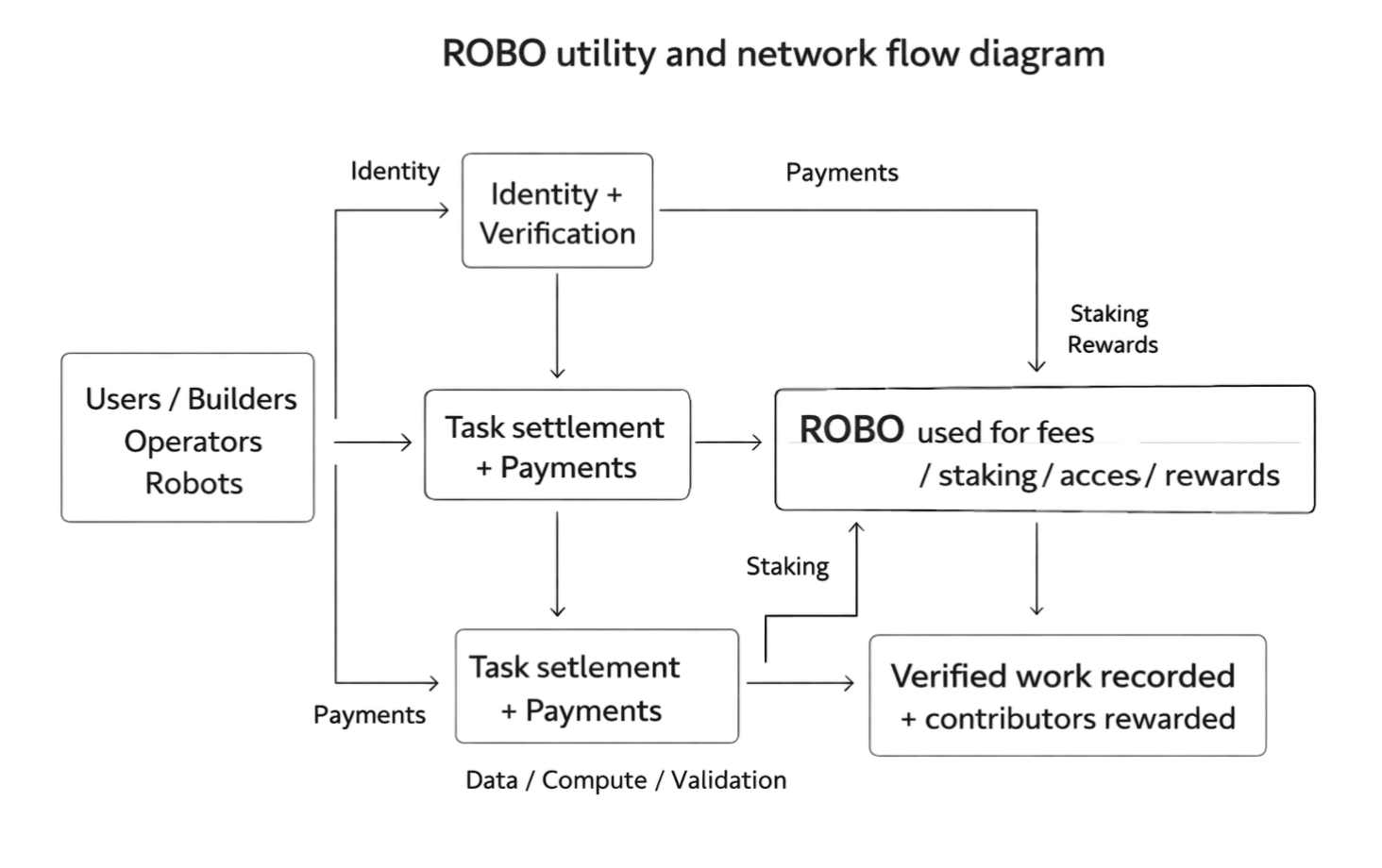
According to Fabric’s official token post, ROBO is used for network fees tied to payments, identity, and verification. It is also used for coordination staking, ecosystem access, and rewards for verified work such as task completion, data contribution, compute, and validation. Another official infrastructure post says ROBO serves as the settlement layer for protocol-level transactions including identity verification, task settlement, coordination staking, and ecosystem access.
The supply numbers matter too. Fabric says total supply is 10 billion ROBO. The official allocation is 29.7 percent for ecosystem and community, 24.3 percent for investors, 20.0 percent for team and advisors, 18.0 percent for foundation reserve, 5.0 percent for community airdrops, 2.5 percent for liquidity and launch, and 0.5 percent for public sale.
To me, that says two things at once.
One, the project clearly wants to talk about community growth and participation.
Two, a large part of supply still sits with investors, insiders, and reserves.
Both of those things can be true together.
One small detail from the whitepaper also stood out because it feels unusually direct. Fabric says someone holding 1,000,000 tokens but doing zero work would receive zero rewards, while a participant with only 100 tokens could still be compensated through real contribution. That tells me the project wants rewards tied to activity, not just passive holding. At least on paper, that is the idea.
Why the crypto part actually makes sense here:
A lot of AI and crypto projects feel forced. This one does not feel completely random to me.
Fabric’s whitepaper says blockchains matter here because they bring immutability, public visibility, global reach, and easier economic coordination. The Foundation turns that into practical language on its site, things like machine and human identity, decentralized task allocation, accountability, location-gated and human-gated payments, and machine-to-machine communication. That is more grounded than the usual “AI plus token” line you see everywhere.
And honestly, the logic is easy to follow. If robots are working across many places, many operators, and many tasks, then someone has to verify performance. Someone has to record what happened. Someone has to settle payments. Someone has to reward useful work. Someone also has to challenge bad behavior. Fabric is trying to put those functions on shared infrastructure instead of leaving them inside private silos. Whether it can actually pull that off at scale is another matter, but the basic argument is coherent.
The roadmap sounds real, but it is still early :
This is not a finished story. It is still the early chapter.
Fabric’s whitepaper lays out a 2026 roadmap in steps. Q1 focuses on robot identity, task settlement, and structured data collection. Q2 expands contribution-based incentives and broader data collection. Q3 moves toward more complex tasks and multi-robot workflows. Q4 is about reliability, throughput, and getting ready for larger deployment. Beyond 2026, the whitepaper points toward a machine-native Fabric Layer 1 shaped by real-world usage.
I like that the roadmap reads like infrastructure work rather than magic. Still, let’s be honest, a roadmap is not adoption. It is not product-market fit. It is not proof that robotics, AI incentives, governance, and real-world operations will all work smoothly together.
Fabric’s own whitepaper also admits there are still open design questions. It says parts of validator selection and sub-economy design still need community input, and it notes that the early validator setup may begin in a permissioned or hybrid form before broader decentralization. So yes, decentralization is part of the long game, but some early control points are still there.
The weak points are real, and I think they should be said plainly.
If I skipped the risk section, this article would feel fake to me.
Fabric’s whitepaper says ROBO does not give holders rights to profits, dividends, or revenue sharing. It also warns that token value may decline sharply, become illiquid, or even fall to zero. The same document points to software bugs, exploits, malicious actors, governance risk, and network failure as real possibilities. Those are not side notes. They matter.
The market data also shows how early and noisy this still is. CoinGecko currently lists ROBO around $0.03658, with a circulating supply of about 2.2 billion, a market cap near $81.5 million, and 24-hour trading volume around $46.0 million. Those numbers show there is clear market interest, but they also show this token is still in price discovery. I would not confuse that with settled value.
What I like about Fabric Protocol is not that it promises an easy future. It is that it asks a harder question than most projects in this space.
Can intelligent machines become useful without making the system more closed, more concentrated, and harder for ordinary people to benefit from?
Can the upside be shared more widely?
Can governance keep up?
Can success mean more than raw technical progress?
That, to me, is the real point of Fabric’s bigger thesis. Fabric is trying to move the conversation away from “how powerful can AI become?” and toward “who benefits, who keeps oversight, and what kind of system are we actually building?” It still has a lot to prove. The execution risk is real. The token risk is real too. But the core idea is stronger than the average AI-crypto pitch, and that is why I think Fabric is worth paying attention to.