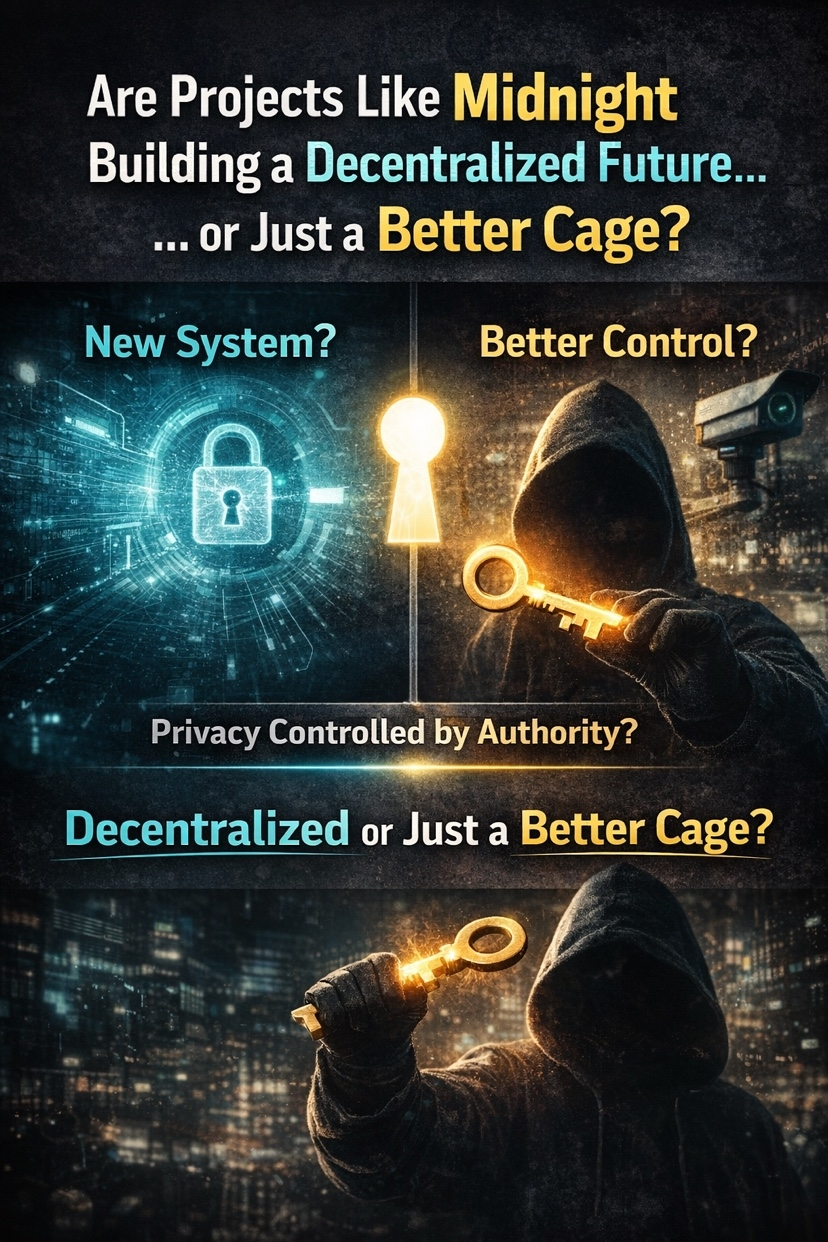
For years, the blockchain space has been stuck with an uncomfortable tradeoff.
On one side, we have fully public ledgers where everything is transparent.
On the other, we have privacy coins that immediately make regulators nervous.
That is why the idea of a new generation of blockchain feels so exciting.
A network that uses zero-knowledge proofs, allows privacy, and still supports disclosure when needed sounds like the perfect middle ground.
On paper, it looks brilliant.
The architecture feels advanced.
The tooling feels powerful.
And from a technical point of view, it genuinely looks like progress.
But the real issue is not the technology itself.
The real issue is the philosophy behind it.
To me, the biggest question is not, “Is this private?”
The real question is:
Private for whom — and not private from whom?
That is where things start to get uncomfortable.
The idea of programmable privacy sounds elegant.
Instead of making everything fully hidden, it gives users and applications more control over who can see what.
For institutions, that sounds perfect.
For regulators, it sounds responsible.
For developers, it sounds like a breakthrough.
But for people who still care about the original spirit of decentralization, it raises a serious concern.
Because if privacy only exists until someone with enough authority asks to see through it, then that is not equal privacy.
That is conditional privacy.
And conditional privacy often serves power better than it serves freedom.
Take a simple example.
Imagine an exchange built on this kind of infrastructure.
A large institutional trader can hide their strategy from bots, competitors, and public observers. They can prove they have the required funds without exposing their full position.
That sounds useful.
Maybe even necessary.
But the moment an audit happens, or a regulator asks questions, the same system allows disclosure through viewing keys or authorized access.
To a traditional financial player, that is a feature.
To someone who believes crypto was supposed to reduce power asymmetry, that feels like a weakness.
Because a backdoor with permission is still a backdoor.
And I think that is the emotional point many people miss.
Crypto was never just about better databases.
It was also about pushing back against a world where a small group of institutions always had more visibility, more control, and more power than everyone else.
So when a blockchain is designed in a way that preserves privacy for the public, but keeps visibility open for authorities or privileged actors, we have to ask a harder question:
Are we building a new system?
Or are we just making the old system more efficient?
That question becomes even more important when you look at the market reality.
A lot of these networks are still driven more by narrative than real adoption.
The hype builds early.
Retail gets interested.
Volume picks up.
But the institutional demand that is supposed to justify the long-term vision often arrives much later, if it arrives at all.
In the meantime, the network is trying to satisfy two very different audiences.
Institutions want privacy that works within regulation.
Crypto-native users want sovereignty.
Those are not the same goal.
And when a project tries too hard to serve both, it can end up losing the trust of both.
That is why I think the biggest risk here is not technical failure.
It is an identity problem.
If the end goal is to build a more private and more manageable financial system for large companies, then we should be honest about that.
And if that is the case, then an uncomfortable question follows:
Do we really need a token economy for that?
Can a system honestly call itself decentralized if its main value comes from helping authorities manage financial activity more efficiently?
Not every blockchain that uses advanced cryptography is automatically aligned with the values that brought people into crypto in the first place.
Sometimes the language sounds decentralized, but the design still concentrates power in familiar hands.
My view is simple.
Projects like Midnight are technically impressive.
They may be useful.
They may even unlock real enterprise adoption.
But if their strongest advantage is that privacy can be switched off for the right people, then we should stop pretending this is purely about freedom.
It may be innovation.
It may be practical.
But it is not the same thing as decentralization in its purest sense.
And that is the real debate.
Are we building a decentralized future?
Or are we just building a better cage?