

i had a data structures paper last month. professor gave us a problem on pipeline design. data coming in from multiple sources at different rates. the question was not how to process it. the question was how to move it reliably without losing anything when the volume spikes unexpectedly. i spent an hour on it and got it mostly wrong.
that problem came back to me three days ago when i was reading the Fabric Protocol roadmap properly for the first time, not just the Q1 and Q2 items everyone writes about.
Q3-Q4 2026 is listed as scaling data pipelines. two words. nobody on the leaderboard has written about what that actually means for the economics. so i tried to figure it out.
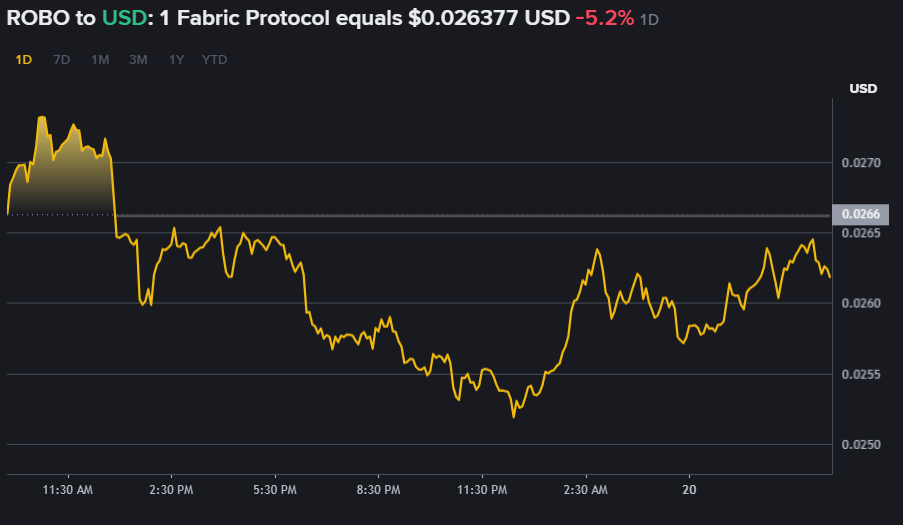
as of today March 20 2026, $ROBO is at $0.026. market cap $58M. 2.23B circulating out of 10B max. ATH was $0.0608 on March 2. 57% below that right now. FDV $260M.today chat Price

here is the part that took me a while to understand. Fabric Protocol's economic model depends on verified robot output moving through the network as data. a robot completes a task. that completion gets logged. the log gets submitted. PoRW validates it. fees get generated. 20% of those fees go to the buyback. the whole chain only fires if the data pipeline between the robot and the protocol is reliable at scale.
right now the network is early. low robot count. low task volume. the pipeline handles it fine because the load is manageable. Q3-Q4 is when Fabric needs to handle a meaningfully larger number of robots submitting task data simultaneously, from different hardware types, across different operator environments. warehouses. logistics. industrial facilities. these are not controlled lab conditions. the data comes in irregular bursts. some robots have connectivity gaps. some operators are in jurisdictions with different network constraints.
scaling data pipelines is not a marketing milestone. it is the engineering work that determines whether the fee generation layer holds up when real adoption arrives. if the pipeline cannot handle volume reliably the buyback mechanism stays thin regardless of how many robots technically join the network.
i cannot verify from outside whether the engineering team has the bandwidth to hit Q3-Q4 while also delivering Q2 contribution incentives on time. both require focused engineering resources. the roadmap lists them sequentially. that does not mean they actually happen sequentially. delays compound.
the supply math is uncomfortable too. only 22.3% of 10 billion tokens circulating right now. investor and team allocations are 44.3% of total supply with a 12-month cliff from February 2026. that cliff hits February 2027. price action between now and then depends entirely on whether real operator adoption grows fast enough to absorb what unlocks.
if Q2 contribution incentives go live and operators actually show up, fees start building, and the Q3-Q4 pipeline scaling lands on time, the economic loop starts becoming real. at $2B market cap ROBO is at $0.20. at $5B it is at $0.50. neither of those needs retail. both need the roadmap to deliver.
if Q2 is thin and Q3-Q4 pipeline work slips, the model stays theoretical through 2026. that puts me back at $0.018 to $0.025 as the realistic range.
thing i keep watching. Q2 milestone update from the team, verified PoRW participant count growing on chain, and any engineering update on data pipeline architecture before Q3.
i got that pipeline problem mostly wrong. i am curious whether Fabric's answer is better than mine was.
what do you think breaks first in Fabric's data pipeline at scale, the submission layer or the validation layer? tell me in comments.