

At first glance, S.I.G.N. looks like another “stack” pitch. You know the type new system, new primitives, new everything. But it’s not really that. It’s more like someone looked at how trust works today (or doesn’t) and decided to rip the whole assumption layer out.
And yeah, that’s a big claim. I’m not fully sold on every piece yet. But the direction? Feels right.
So what is it, actually?
Not an app. Not a chain. Not even a token story, at least not primarily.
It’s infrastructure. The kind that sits underneath things and quietly dictates how they behave.
The core idea is pretty blunt:
If something can’t be verified on demand, it shouldn’t be trusted.
That’s it. Everything else hangs off that.
They break it into three systems money, identity, capital but honestly, those are just surfaces. The interesting part is what flows between them.
Proofs. Evidence. Attestations.
Attestations (this is where it stopped being abstract for me)
Right now, most systems run on “because we said so.”
Banks, platforms, even governments—it’s all database authority. You ask “why am I eligible?” and the answer is basically: our system says you are.
S.I.G.N. flips that.
Instead of trusting the system, you get a signed, verifiable piece of data that explains:
• what happened
• who approved it
• under what rules
And you can check it. Anytime.
No back-and-forth. No hidden logic.
It sounds small. It’s not.
Because once you start thinking in attestations instead of permissions, the whole model shifts. You’re not querying a database you’re verifying state.
(Yeah, very “on-chain mindset,” but applied way beyond chains.)
Money, but with constraints baked in
I was skeptical here at first. “Programmable money” gets thrown around a lot, usually with more hype than substance.
But this is less about programmability for devs, more about enforceability for systems.
Imagine funds that literally cannot be misused—not because someone’s watching, but because the rules are part of the transaction itself.
Disaster relief is the obvious example:
• funds go out
• they’re restricted to certain categories
• auditors can trace everything without digging through layers of reports
No waiting months for audits. No “lost” allocations.
It’s clean. Maybe too clean? (There’s always a tradeoff when control gets this precise.)
Identity… without oversharing everything
This part I like more.
Current identity systems are clumsy. You hand over way too much data just to prove one small thing.
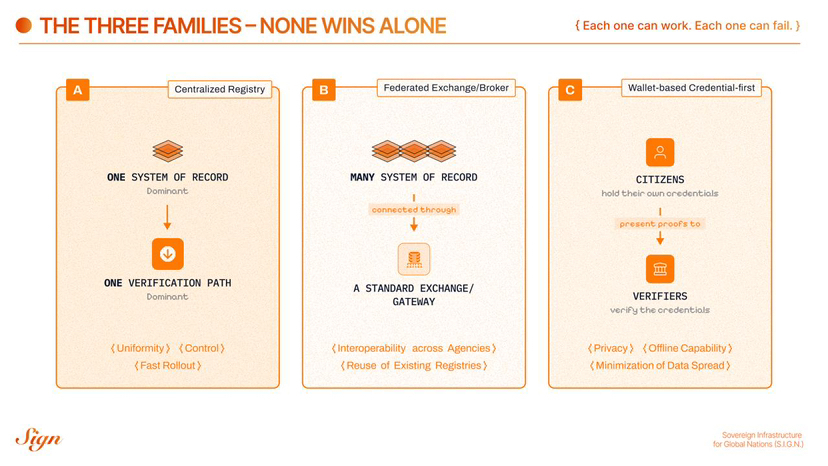
With S.I.G.N., identity becomes composable. You don’t reveal yourself—you reveal proofs about yourself.
You’re over 18? Prove that.
You’re a verified founder? Prove that.
No need to expose anything else.
It’s basically turning identity into modular claims instead of a monolithic profile.
And yeah, this has been talked about for years (DIDs, VCs, all that), but tying it directly into capital and money flows makes it… usable.
That’s the difference.
Capital distribution (this is where it gets real)
This part feels less theoretical and more like “okay, I can see teams actually using this.”
Grants, incentives, airdrops whatever. The usual mess of:
• manual reviews
• fake users
• delayed payouts
Now imagine all of that tied to verifiable conditions.
Not “we think this wallet qualifies,” but:
• identity verified
• criteria met
• milestones proven
Funds unlock automatically when proofs show up.
No committee calls. No spreadsheets. No bottlenecks.
It’s basically turning capital allocation into a rules engine backed by cryptographic evidence.
I like this. A lot.
Under the hood: Sign Protocol
Everything above falls apart without a solid data layer. That’s where Sign Protocol comes in.
It’s not flashy, but it’s doing the heavy lifting.
You define schemas (what data should look like), then issue attestations (signed records that follow those schemas). Simple concept, but very flexible.
What I find interesting:
• it doesn’t force everything on-chain
• you can mix on-chain + off-chain + hybrid
• even plug in ZK when you need privacy
So you’re not stuck choosing between transparency and confidentiality you can tune it.
Also, querying matters more than people think. If data exists but you can’t access it cleanly, it’s useless. The API layer (SignScan, etc.) makes this actually workable.
Without that, this whole thing would just be theory.
Where people might misread this
I can already see the take:
“Feels like government tech. Not really crypto.”
I think that’s lazy.
What’s actually happening is crypto drifting toward infrastructure. Less speculation, more systems.
And systems need:
• auditability
• interoperability
• some level of control (yes, even in decentralized contexts)
S.I.G.N. sits right in that uncomfortable middle ground—between permissionless ideals and real-world constraints.
That’s not a bad place to be. It’s just harder to market.
My take (for what it’s worth)
This isn’t a hype play. There’s no obvious “number go up” angle here.
It’s slower. More structural.
If it works, you won’t even notice it. That’s the point. It’ll just sit underneath things quietly enforcing rules, validating state, moving value based on proofs instead of trust.
And those systems… tend to stick around.
Still watching. Not blindly bullish. But definitely paying attention.
#SignDigitalSovereignInfra @SignOfficial $SIGN
