@MidnightNetwork #night $NIGHT
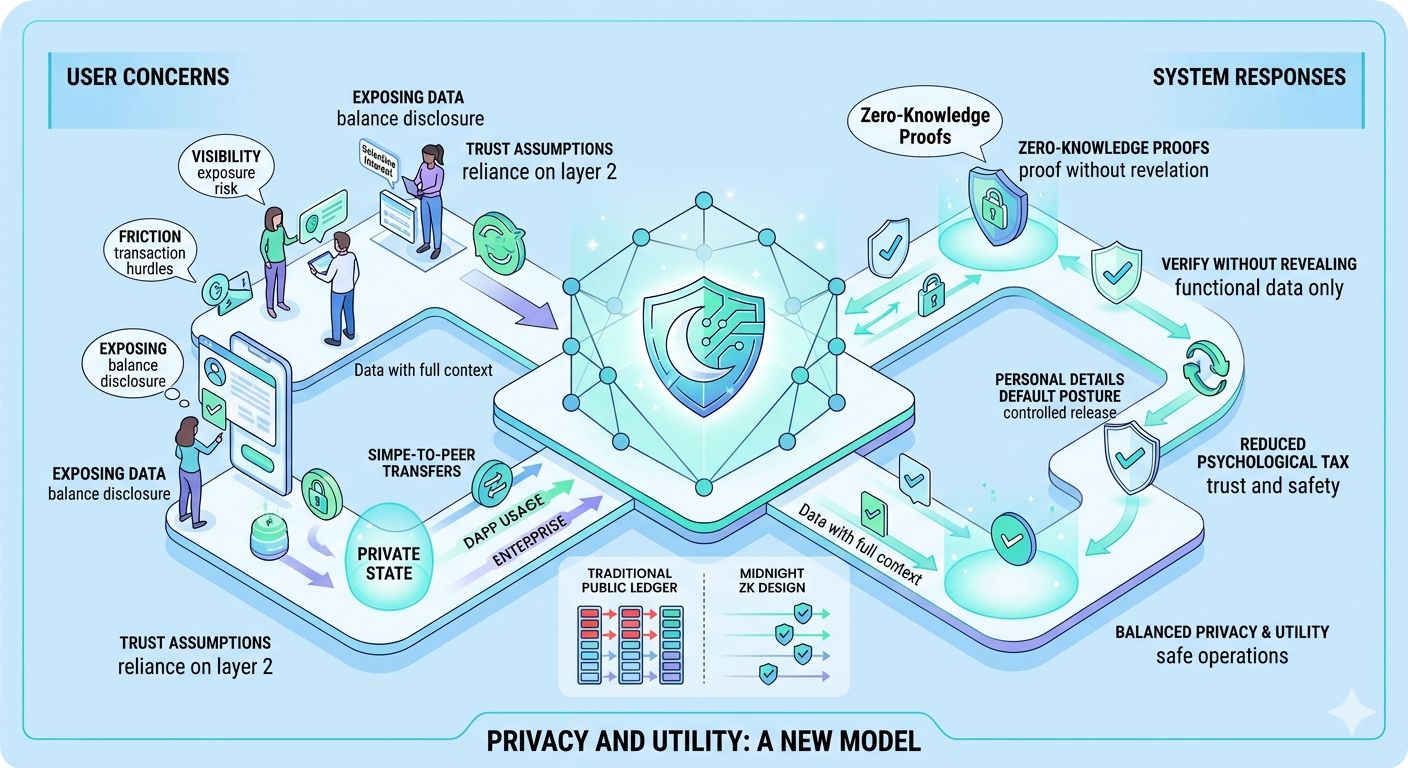
Lately, one of the more revealing habits in crypto is how quickly people stop talking about what a project “is” and start talking about what it lets them avoid. The questions have become more practical. Can I use it without exposing too much? Will I have to trust another layer of assumptions? Does it make the experience simpler, or just more complicated in a different way? That shift sounds small, but it says a lot about where users are mentally. Most people are not chasing abstraction anymore. They are trying to reduce friction, reduce leakage, and reduce the number of things they have to believe at once.
That is why the parts of the market that used to feel like niche infrastructure are getting a different kind of attention now. Not the loud kind. Not the attention that comes from a sharp chart or a meme cycle. More like the attention that shows up when people have been disappointed enough times to become selectively interested. They still care about performance, of course, but they care just as much about whether a system respects the basic realities of how people actually use it. Who can see what. Who controls what. What gets revealed by default. What happens when convenience and privacy pull in different directions.
That tension is where Midnight Network becomes interesting, at least from a user’s point of view. Not because it solves every problem neatly, and not because “privacy” alone is enough to make anything valuable. It is interesting because zero-knowledge proof technology, when applied seriously, changes the shape of what users can do without forcing them to expose everything in the process. In other words, it does not just create a technical feature. It changes behavior. People interact differently when they do not feel like every action becomes permanent public material.
That matters more than many crypto narratives admit. A lot of blockchain design has historically rewarded visibility over discretion. That made sense in the early years, when transparency was almost the whole point. Public ledgers were supposed to prove that systems were open, verifiable, and hard to manipulate. But over time, the market learned that full transparency is not the same thing as healthy transparency. Users may appreciate auditability, yet still not want their balances, counterparties, transaction patterns, or operational behavior sitting out in the open for anyone to inspect. The tradeoff was accepted for a long time because the alternatives looked too complex, too slow, or too theoretical.
ZK-based systems try to change that equation by making proof possible without unnecessary disclosure. That sounds elegant, but the practical meaning is more important than the slogan. If a network can verify something without revealing everything behind it, then the user’s default posture changes. Privacy stops being an add-on and starts becoming part of the system’s assumptions. That can make ordinary behavior feel safer and less exposed. It can also make the network more suitable for activities that are difficult to do on a fully transparent chain without creating discomfort or operational risk.
Still, it would be naive to treat that as a pure advantage. Every privacy-preserving design introduces tradeoffs. The first one is complexity, which users usually forgive only until they have to depend on it. Systems built around ZK proofs are often harder to understand, harder to inspect casually, and harder to explain in a sentence. That does not mean they are worse. It means the burden of trust moves in subtle ways. Users may not need to trust the visible ledger state as much, but they do need to trust that the cryptographic design actually does what it claims, that the implementation is solid, and that the surrounding ecosystem is not making hidden assumptions that will later become painful.
There is also a market-side consequence that gets overlooked in promotional language. Privacy changes incentives, and incentives change who shows up. Some users are drawn to privacy because they genuinely need discretion. Others are drawn because they dislike surveillance by default. Some just want more control over their own data and activity. But the same features that reduce exposure can also make oversight harder, integration trickier, and regulatory discussions more complicated. So a project like Midnight does not simply sit in the “good” or “bad” column of market opinion. It sits in a more realistic zone where utility, compliance concerns, user autonomy, and technical confidence all have to coexist.
That is probably why the strongest reading of a project like this is not “privacy will win” or “privacy will be ignored.” The more measured interpretation is that the market is increasingly aware that people want selective disclosure. They want systems that can prove enough without revealing too much. They want functional utility without turning every interaction into a broadcast. They want ownership to feel meaningful, not just symbolic. Midnight’s framing suggests an attempt to respond to that demand by making privacy and utility less like opposing goals and more like complementary design constraints.
From a user psychology perspective, that is not a small distinction. A lot of crypto fatigue comes from the feeling that participation always costs more than advertised. You open a wallet and immediately inherit risk, visibility, responsibility, and the possibility of mistakes that cannot be undone. You interact with a protocol and wonder who is watching the pattern. You use a chain and realize that “public” means public in ways that are not always obvious at the time. Over time, that creates a kind of low-grade caution that becomes part of the culture. People do not necessarily leave; they just become quieter and more guarded.
A ZK-oriented network can appeal to that mood because it reduces the psychological tax of participation. Users may not consciously articulate it that way, but they feel the difference when a system does not demand unnecessary disclosure. They feel it when ownership is preserved without forcing exposure. They feel it when utility is available without making them negotiate privacy as an afterthought. That does not eliminate risk. It just changes the kind of risk they are taking.
There is a broader design logic here too. In many systems, the most durable form of utility is not the one that performs best in a demo, but the one that survives contact with real habits. Real users forget things. They repeat familiar patterns. They avoid steps that feel intrusive. They prefer tools that help them act without requiring a seminar in the underlying architecture. If a blockchain can deliver useful outcomes while respecting those habits, it has a better chance of becoming something people actually keep using rather than something they admire briefly and move past.
Of course, none of this guarantees adoption. The crypto market has a long memory for ideas that sounded clean in theory and awkward in practice. Privacy tech in particular has to prove itself twice: once in cryptographic soundness, and again in user experience. A system can be intellectually compelling and still fail if it feels cumbersome, opaque, or fragile. It can also fail if the ecosystem around it cannot build confidence that the privacy model is consistent and understandable enough for real use. Those are not minor issues. They are often the whole game.
So when I look at Midnight Network through that lens, I do not see a slogan about secrecy or a generic pitch about next-generation infrastructure. I see a bet on a specific kind of market evolution: users becoming less willing to accept full exposure as the default cost of participation. I see a design choice that tries to make proof and privacy coexist rather than compete. I see a reminder that blockchain systems are ultimately judged not by how much they reveal, but by how well they fit the actual decisions people need to make.
That is what makes this topic matter for everyday crypto participants. Not because it sounds advanced, and not because it promises some grand transformation. It matters because clarity, stability, and good decision-making are easier to maintain in systems that do not force unnecessary exposure. When users can preserve ownership, understand their tradeoffs, and limit what they reveal, they tend to make calmer choices. They also tend to misread themselves less often. In a market that already produces enough noise, that kind of design is not just a technical preference. It is part of how people stay rational over time.