
What if blockchain could keep your data private without breaking transparency?
I’ve been in crypto long enough to remember when the whole pitch was simple: permissionless, transparent, unstoppable. Back in 2017, I was all-in on that vision watching Ethereum experiments blow up and thinking we’d finally escaped banks and middlemen. Fast forward a decade, and I’ve seen the ugly flip side. Every transaction, every wallet balance, every smart contract interaction sits there in plain sight for anyone with a block explorer. Great for verifiability. Terrible for anything that actually touches real life.
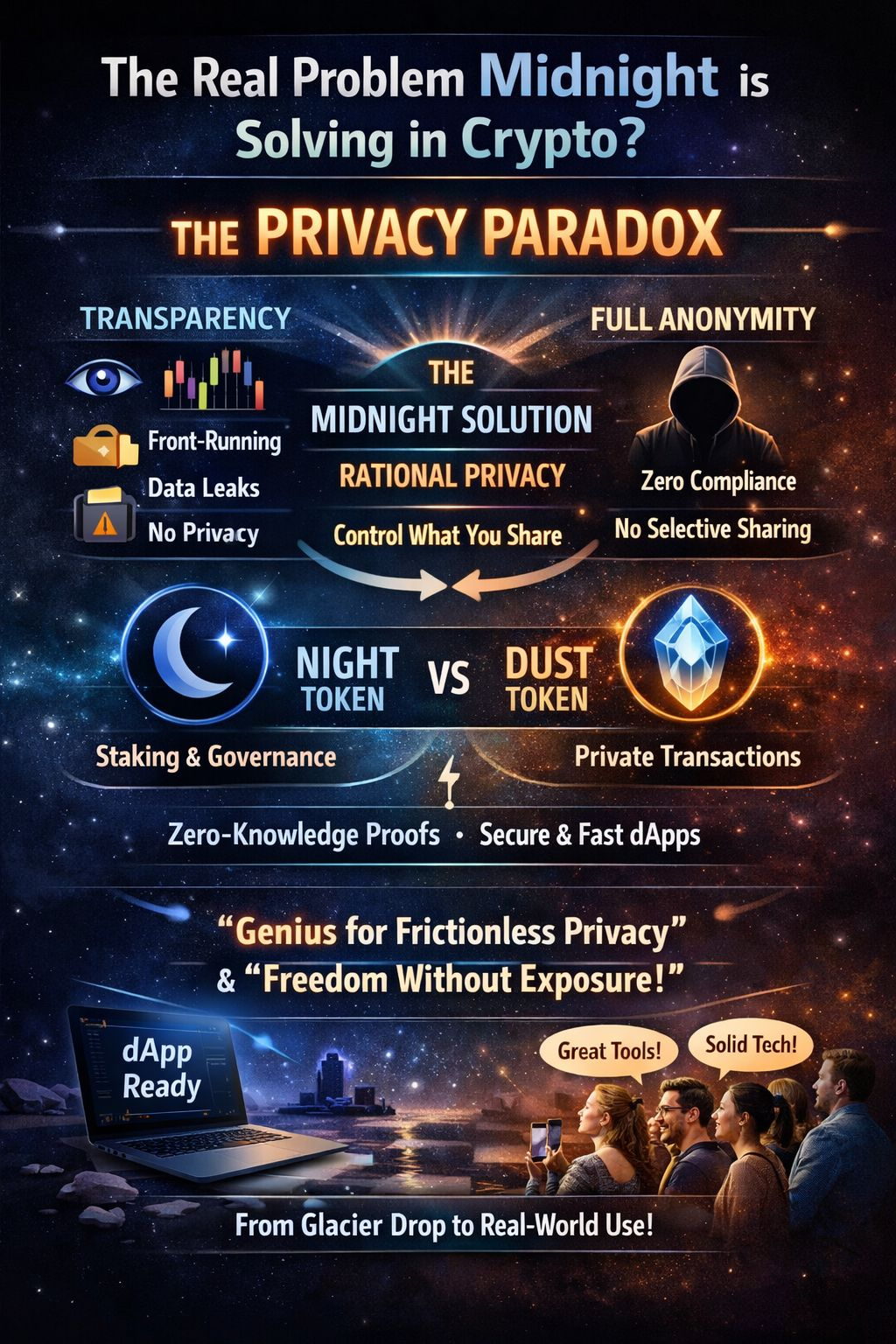
In my experience, that forced transparency is the real killer. Want to build a lending app? Users balk because their collateral is public. Trying to run a supply chain tracker for a pharma company? Regulators love the audit trail until the company realizes competitors can see every shipment detail. I’ve talked to devs who gave up on privacy coins like Monero or Zcash because, while they hide everything beautifully, they also make compliance impossible. Exchanges delist them, institutions run screaming, and adoption stalls. We’re stuck choosing between utility and privacy. Midnight Network is the first project I’ve seen that refuses to accept that binary.
I first stumbled on Midnight while digging through Cardano ecosystem updates late last year. What caught my eye wasn’t hype it was the term they kept repeating: rational privacy.” Not total anonymity. Not full exposure. Just… rational. The team (spun out of Input Output, the same folks behind Cardano) built a Layer-1 partner chain that uses recursive zk-SNARKs so developers can decide, line by line in their smart contracts, what stays hidden and what gets proven. Prove you’re over 21 without showing your birthdate. Prove your wallet holds enough collateral without revealing the exact amount. Prove regulatory compliance to an auditor without leaking customer data. All verifiable on-chain, all without breaking the trust layer.
The architecture is clever. They split the ledger into dual states: public for the things that need to be public (like governance), shielded for everything else. And the token model seals it. NIGHT is the unshielded, fully transparent governance and staking token 24 billion total supply, live since December 2025, interoperable with Cardano via a bridge. Cardano SPOs can validate and earn NIGHT rewards. But to actually run contracts or pay fees, your NIGHT holdings quietly generate DUST a shielded, non transferable, renewable battery that decays if you don’t use it. No anonymous money laundering loopholes. No regulatory red flags. Just clean, programmable privacy.
When the Glacier Drop and Scavenger Mine phases rolled out, I watched over 170,000 addresses claim tokens and another 8 million+ mine the community tranche. I grabbed some myself through the redemption portal and started playing in testnet. The developer language, Compact basically TypeScript with ZK superpowers made it feel accessible in a way most privacy tech never does. I built a tiny proof of concept credential app in an afternoon and actually got it. No PhD in cryptography required.
Look, I’m not here to shill perfection. Midnight is still early mainnet features are rolling out, adoption will take time, and the broader market has seen plenty of privacy promises before. But after years of watching projects either expose everything or hide too much, this feels different. It’s the first time I’ve felt like blockchain could actually work for real businesses and everyday users without forcing them to pick sides.
The real problem Midnight is fixing isn’t just privacy. It’s the lie we’ve been living with that transparency and freedom can’t coexist. They’re finally trying to make them dance together.
So, here’s my question for you: If your next DeFi position, your medical records, or your voting ballot could stay private while still being provably correct on chain… would you finally use blockchain for something that actually matters?
@MidnightNetwork #night $NIGHT
