
Most people think the biggest problem in blockchain is bad code. From what I’ve seen, that’s not really true. The real limitation is closer to physics how fast information can move, how quickly nodes can agree, and how efficiently a network can process real-world data. That realization completely changed how I look at projects like Fabric Protocol.
Fabric Foundation is building something that feels grounded in reality rather than hype. Instead of chasing theoretical scalability, they focus on practical performance especially in areas like healthcare, where speed and reliability aren’t optional. In hospitals, delays aren’t just inconvenient; they can be life threatening. That’s where Fabric Protocol starts to stand out.
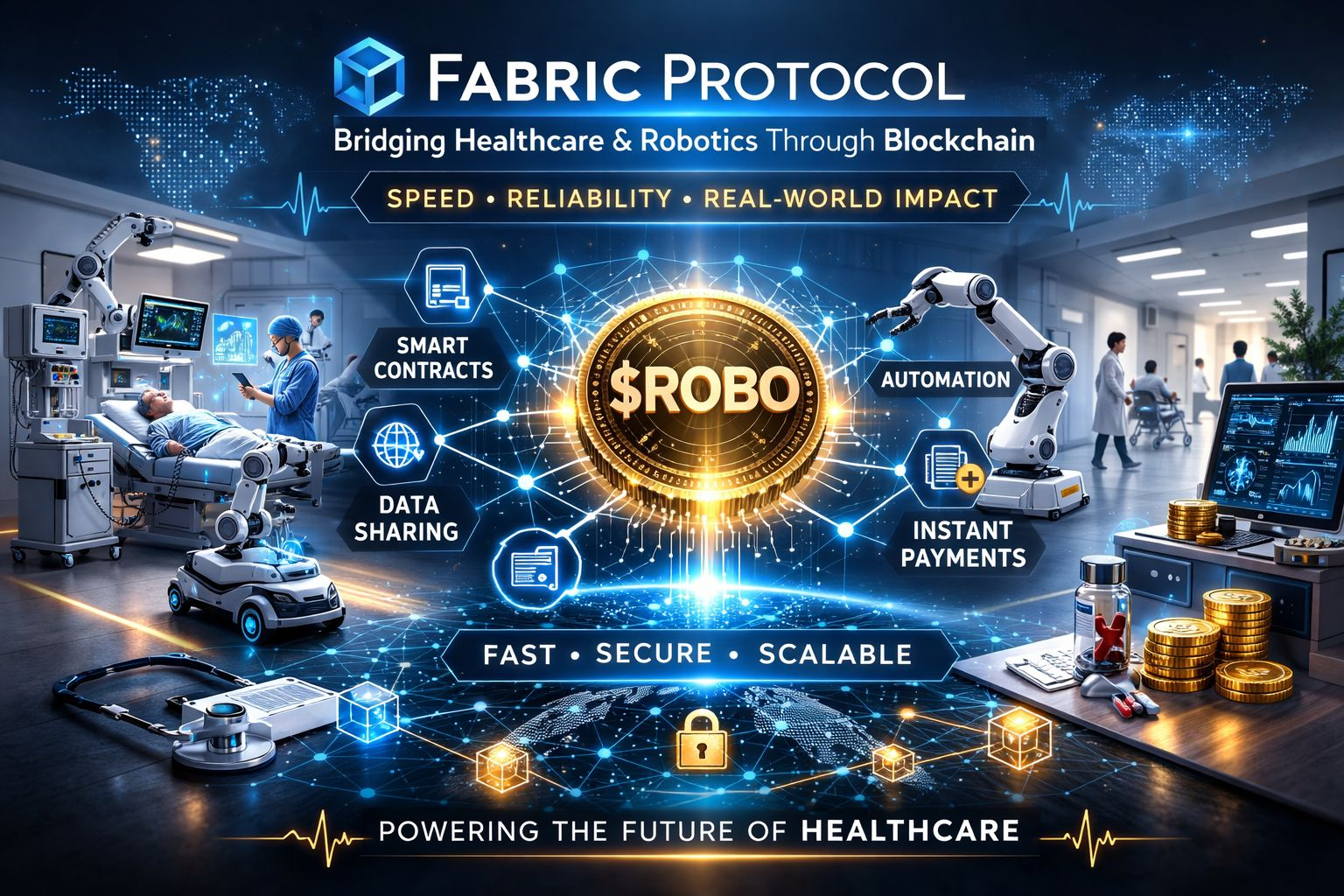
At the center of this system is the $ROBO token. It’s not just another digital asset it actually powers interactions between machines, systems, and providers. Think of it like a payment and coordination layer for healthcare automation. When robots, AI systems, or medical devices need to exchange data or trigger actions, $ROBO helps make that happen smoothly and securely.
One thing I’ve noticed is how Fabric approaches network design differently. Instead of having thousands of validators competing across the globe, they use a smaller, more controlled validator group. At first, that might sound less “decentralized,” but in reality, it solves a major issue: speed. When too many validators are involved, reaching consensus the process where all nodes agree on the state of the network takes longer. And in healthcare, even small delays matter.
By keeping the validator set lean, Fabric reduces communication overhead. Fewer nodes mean faster agreement, lower latency, and more predictable performance. It’s a trade-off, but a very intentional one. From my perspective, it shows they understand that not every use case needs maximum decentralization some need reliability and efficiency first.
Network speed is another area where Fabric focuses heavily. Instead of pushing massive amounts of data directly on chain, they optimize how and where data moves. This reduces congestion and keeps the system responsive. In simple terms, it’s like choosing the fastest route instead of just building more roads.
What makes this especially interesting is how it connects to robotics in healthcare. Imagine automated systems handling routine tasks delivering supplies, assisting surgeries, or managing patient data all coordinated through a blockchain backbone. Payments, permissions, and data exchanges happen seamlessly using $ROBO. That’s not just theory; it’s a very practical vision.
Of course, there are real world limits. No network can escape latency completely, and no system can scale infinitely without trade offs. But Fabric doesn’t pretend otherwise. Instead, they design within those limits, which honestly feels refreshing in a space full of unrealistic promises.
After watching how different blockchain networks evolve, I’ve started to appreciate this kind of approach more. Fabric Protocol isn’t trying to be everything at once. It’s focused, optimized, and aligned with real world needs especially in healthcare, where precision and speed truly matter.
In my view, that’s what makes $ROBO and the broader Fabric ecosystem worth paying attention to. It’s not just about innovation it’s about making that innovation actually work where it counts.
@Fabric Foundation #robo $ROBO #ROBO
