The first thing that hit me at Consensus Toronto was not the content.
It was the noise.
Panels bleeding into each other. Founders pitching over coffee. Projects fighting for attention in every corner. Everyone seemed to have the next big chain, the next big infrastructure play, the next big answer to everything.
After a while, it all starts sounding the same.
And then Midnight came up.
What stood out to me was that it did not feel like just another blockchain announcement. It felt more deliberate than that. More structured. More self-aware.
A lot of projects talk about innovation as if new tech alone is enough. Midnight seemed to be making a different argument: that the future of blockchain is not only about better technology, but also about better organization.
And honestly, that may be the more important part.
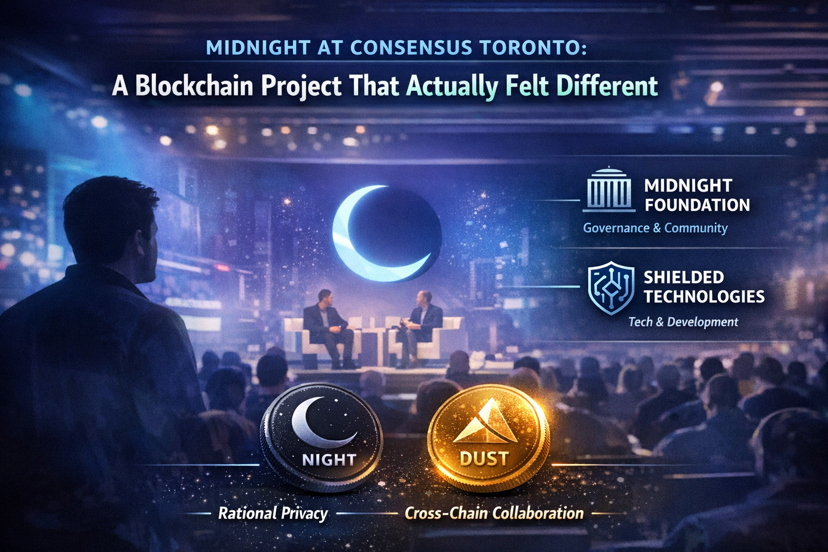
Back in May 2025, Midnight formalized a dual-entity structure: the Midnight Foundation on one side and Shielded Technologies on the other.
At first, I thought it sounded unnecessary. Why split things up? Why add more layers?
But the more I thought about it, the more it made sense.
The Foundation focuses on the long game: community, partnerships, ecosystem growth, and broader direction. Shielded Technologies handles execution: building the protocol, shipping tools, and moving fast without dragging every decision through a governance-heavy process.
That separation feels smart.
One side protects the mission. The other side ships.
In a space where projects often either move too slowly because of governance, or move too fast and leave the community behind, Midnight’s structure feels like a more balanced approach.
It also reminded me of Linux.
The Linux Foundation helps guide the ecosystem and maintain alignment, while companies like Red Hat build, commercialize, and deploy on top of that structure. Midnight seems to be borrowing from a similar playbook, but applying it to blockchain.
And to be honest, it feels overdue.
Because if blockchain wants to mature, it has to move beyond the idea that every network should be run like an experiment forever.
But governance alone is not enough to make a network matter.
The bigger issue that kept coming up across Consensus was privacy.
Early blockchains treated transparency as a core virtue. Everything visible. Everything verifiable. And that made sense in the beginning. Trust was built through openness.
But scale changes the conversation.
Institutions do not want every transaction exposed. Regulators do not want systems they cannot inspect. Users want control. Developers want flexibility. And the industry still has not fully figured out how to balance those things.
This is where Midnight’s idea of rational privacy starts to feel interesting.
Instead of treating privacy as all-or-nothing, Midnight frames it as something programmable. Something adjustable depending on the context.
That is a much more realistic view of how real systems work.
Not every piece of data should be public. Not every piece of data should be hidden either. The real challenge is designing systems where disclosure can be selective, intentional, and useful.
That seems to be the direction Midnight is aiming for.
Its architecture supports smart contracts with both public and private state. Selective disclosure is built in. Auditability is not removed, but made configurable.
That matters.
Because the privacy conversation in crypto has often been too simplistic. Either full transparency or full secrecy. Midnight seems to be arguing for something more practical in the middle.
And in my opinion, that is where real adoption becomes more possible.
Then there is the token design.
Midnight uses a dual-token model with NIGHT and DUST. One supports the economic layer of the network, while the other is tied more closely to utility and execution.
On paper, that gives developers more flexibility in how they design applications and manage costs. Whether that model works at scale is something time will answer, but at least it shows a willingness to think beyond the usual one-token-fits-all approach.
Still, what interested me even more was Midnight’s positioning in the broader market.
If this were only another privacy chain, it would probably be useful to some people and ignored by most others.
Because the blockchain space already has enough isolated ecosystems.
What Midnight seems to understand is that the future probably does not belong to one chain. It belongs to systems that can work across many chains.
Charles Hoskinson said something at the conference that sounds obvious, but is still hard to execute in practice: the future of blockchain is multi-chain and collaborative, not competitive.
A lot of people agree with that idea in theory.
Far fewer build like they actually believe it.
Midnight appears to be trying.
Its design suggests that users from other ecosystems will be able to interact with the network without being forced to abandon where they already are. Developers can build cross-chain applications. Participants can use Midnight more like a privacy layer than a destination chain.
That is a subtle but important difference.
Instead of demanding loyalty, Midnight seems to be offering utility.
And I think that is a much stronger position in today’s market.
Because users do not want to be trapped. Developers do not want to rebuild everything from scratch. Projects that reduce friction tend to have a much better chance than projects that try to replace the whole world.
And that brings me to the part that probably matters most: the developer experience.
Because none of these ideas matter if building on the network feels painful.
This is where Compact comes in.
According to Midnight’s pitch, Compact is designed to make privacy development feel familiar. Instead of forcing developers to work directly with intimidating cryptographic concepts, it leans into TypeScript-style patterns and modern tooling.
That may sound like a small detail, but it is not.
One of the biggest hidden problems in privacy infrastructure is that it often feels inaccessible. Powerful, yes. Practical, not always. Too many systems assume developers should think like cryptographers before they can build anything meaningful.
That is a huge barrier.
Midnight seems to be rejecting that mindset.
And honestly, I think that could matter more than any technical breakthrough.
Because in crypto, the projects that win are not always the ones with the most advanced architecture. Sometimes they are the ones that make difficult things feel usable.
That is what Midnight seems to be aiming for.
When I walked away from those sessions, my main takeaway was not that Midnight was the loudest project in the room.
It was not.
Its pitch was quieter than most. But maybe that is exactly why it stood out.
It was not trying to dominate the conversation with hype. It was trying to make a case for being useful.
Useful in governance. Useful in privacy. Useful across ecosystems. Useful for developers.
That is a harder story to sell in crypto, because it is less dramatic. But it may also be a more durable one.
Midnight is not positioning itself like the center of the blockchain universe.
It is positioning itself more like infrastructure — something that can support everything around it.
And in my opinion, that is what made it one of the more interesting ideas at Consensus Toronto.
Not because it promised the most.
But because it seemed to understand the problem better than most.