
I’ve noticed that most crypto projects don’t even feel different anymore.
You read the pitch, and for a second it sounds important. Then a minute later, it starts blending into everything else — another token, another grand idea, another promise that this time things will be more open, more fair, more intelligent.
After enough cycles, you stop reacting to the words.
You just look for whether there’s a real problem underneath them.
That’s kind of why SIGN caught my attention.
Not in a big, dramatic way. More in the sense that it seems to be dealing with something people actually run into: how do you prove something is real online, and how do you use that proof in a useful way?
That might sound like a small issue from the outside.
It isn’t.
A lot of digital systems still run on weak trust. Screenshots, forms, spreadsheets, private lists, manual approvals — the internet is full of things that are supposed to be verifiable, but somehow still feel messy and uncertain.
You see it with credentials.
You see it with identity.
You see it with rewards and token distributions too.
And honestly, crypto hasn’t handled that part very well.
Airdrops are a good example. In theory, they’re meant to reward users or contributors. In practice, they often reward the people who know how to farm activity, spin up wallets, and game whatever criteria are being used.
So a lot of “fair distribution” ends up feeling random, or at least incomplete.
That’s where SIGN starts to make sense.
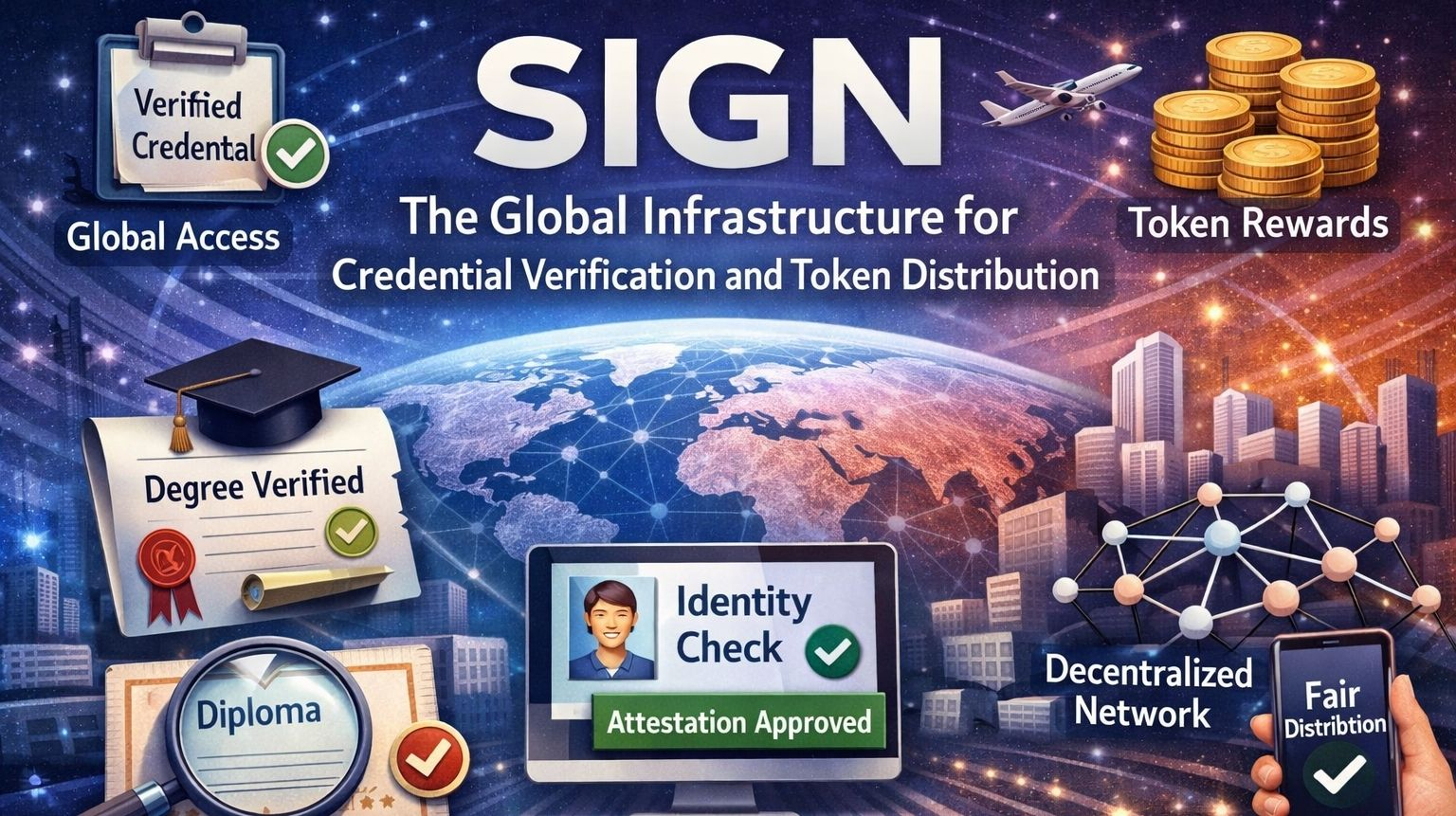
From the outside, what it seems to be building is a system around attestations — basically, records that say something happened, or someone qualifies for something, or some contribution was made.
It’s a simple idea.
And maybe that’s why it feels a bit more grounded than a lot of crypto narratives. It’s not trying to invent a new universe. It’s trying to make trust more portable and easier to check.
That matters more than people think.
Because the internet is full of situations where you need to answer very basic questions:
Did this person actually complete something?
Are they eligible for this?
Did they contribute in a meaningful way?
Should they receive access, recognition, or tokens?
Right now, those answers are often scattered across different platforms and controlled by different groups. There’s no clean way to carry that context from one place to another.
So the promise behind a project like SIGN is understandable. If credentials and claims can be issued in a more usable way, and if those claims can travel across systems, then maybe online coordination gets a little less clumsy.
That’s the optimistic version, anyway.
The more skeptical version is that trust systems always sound cleaner than they actually are.
Because even if the infrastructure works, someone still has to decide what counts.
Someone issues the credential.
Someone defines the rules.
Someone sits in the position of being trusted.
And that’s where these ideas get complicated.
Crypto likes to talk as if infrastructure can remove human judgment, but most of the time it just shifts where that judgment lives. Instead of a university, a company, or a platform holding the authority, maybe it becomes a network of issuers or protocols.
That can be better.
But it doesn’t magically remove the problem.
There’s also the question of whether people will really use it. That’s where a lot of reasonable crypto ideas stall out. A project can make perfect sense on paper and still never become part of everyday behavior.
For SIGN to matter, it’s not enough to build the rails.
Projects have to issue these attestations.
Users have to care about them.
Other platforms have to recognize them.
Without that, it risks becoming one more thoughtful piece of infrastructure that mostly lives in presentations and ecosystem maps.
Still, I don’t think it should be dismissed.
There’s something refreshing about a project that seems to be working on a boring but real problem. Crypto probably needs more of that. Less obsession with narrative, more attention on the awkward parts of the internet that still don’t work well.
SIGN may or may not succeed.
It could become useful infrastructure.
It could struggle with adoption.
It could run into the same trust bottlenecks that every credential system eventually faces.
All of that feels possible.
But at the very least, it seems to be asking a more honest question than most projects do.
Not “how do we create more excitement?”
But how do we make digital trust a little less messy?
That doesn’t guarantee anything.
Still, it makes it worth watching.
#signdigitalsovereigninfra $SIGN @SignOfficial
