
Last year, I had to get a document notarized in Dhaka. The whole thing annoyed me more than I expected. It was not only the fee. It was the waiting, the back-and-forth, and the feeling that a simple task had somehow turned into half a day of hassle. In a city where even a short trip can eat up hours, that kind of process feels even worse. I remember thinking, why does proving something so basic still need this much friction? That memory stayed with me, and later it was one of the reasons SIGN caught my attention.
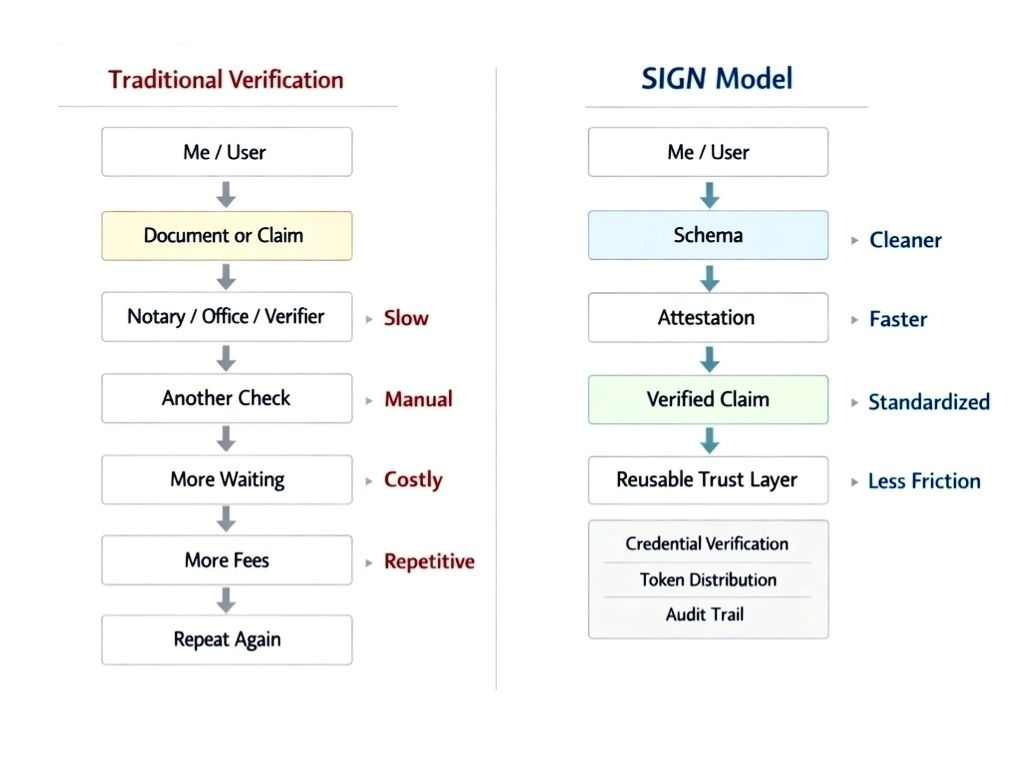
What bothers me is that this is not just a notary problem. It is a bigger trust problem. In a lot of systems, you prove one thing once, then you do it again somewhere else, then again for another platform, another office, another gatekeeper. Your identity, your eligibility, your documents, your claims, everything gets checked over and over.
To me, that is where the waste is. Not always in the proof itself, but in the long chain of middlemen wrapped around it.
That is why SIGN feels relevant to me.
Sign Protocol is described in the project’s official documentation as an omni-chain attestation protocol. In simple words, it gives builders a standard way to create schemas, issue attestations, and verify structured claims later. The docs also show that data can be stored on-chain, on Arweave, or in a hybrid model, which makes sense because not every use case needs the same balance of permanence, cost, and visibility.
What I like here is that SIGN is not only talking about trust as a slogan. Its materials tie the system to credential verification, digital identity, and token distribution, which makes the idea feel practical instead of abstract. In 2024, Sign says it processed over 6 million attestations, and its distribution stack handled more than $4 billion in tokens to over 40 million wallets. Binance Research also highlights that Sign Protocol’s schema adoption grew from 4,000 to 400,000 in 2024. That tells me this is not just a nice theory. It is already being used.
I still think adoption is the hard part.
A cleaner trust layer only matters if apps, issuers, and institutions actually use shared standards. But that is exactly why SIGN stands out to me. It is not trying to glorify another middleman. It is trying to make trust less repetitive, less manual, and a lot less expensive.