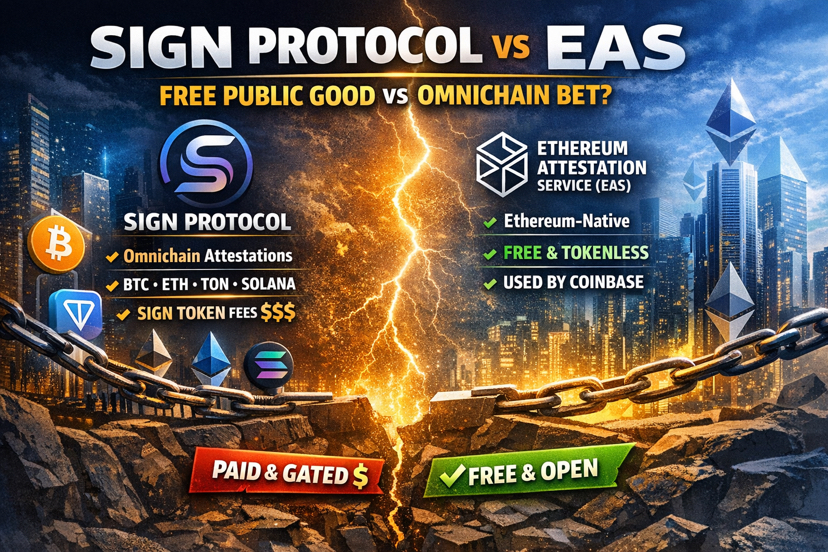
I always look at infrastructure plays through one simple lens: what already exists in the space, and why the market still has not fully converged around it. That is the mindset I had when I started looking at Sign Protocol, and honestly, my first impression was pretty positive. This did not feel like one of those projects that just throws around the word “multichain” for marketing. Building an attestation architecture across Ethereum, Bitcoin, TON, and Solana is not a normal design choice. That kind of engineering usually reflects a team that is thinking much bigger than a single ecosystem. So at first glance, I genuinely felt like Sign was building something serious.
But then I spent more time looking into Ethereum Attestation Service, or EAS, and that is where my thinking started to shift. EAS is free, open-source, and structured like a public good. Most importantly, it has no token. There is no schema registration fee, no token friction, and yet it has already done the one thing every protocol loves to promise in its pitch deck: attract real institutional adoption. Coinbase chose EAS to launch Coinbase Verifications on Base. To me, that is not a small detail. In crypto, every project talks about partnerships, but when a company like Coinbase chooses an attestation layer, that is not just another integration. That is a serious market signal.
And that is exactly where my real concern with Sign begins. If a free, tokenless, open-source protocol is already winning adoption at the institutional level, then why would a developer choose Sign today? More specifically, why would they pay SIGN-related costs to register schemas when a free alternative already exists? For me, that is not a side question. That is the center of the entire thesis. Because a big part of Sign’s value proposition depends on the idea that verifiable credentials and schemas will flow through its ecosystem, and that this flow will eventually create demand for the token. The theory sounds clean, but theory and market reality are often two different things. Markets do not ignore free alternatives, especially when those alternatives already have strong adoption signals behind them.
To be fair, I do think Sign has one very real edge, and that is its omnichain model. As strong as EAS is, in practical terms it still carries Ethereum-native gravity. Sign is clearly aiming at something broader. And if the future really includes sovereign identity systems, CBDCs, or government-backed credential networks that need to operate across both public and private chains, then Sign’s architecture could absolutely be more relevant. That is why I do not dismiss it. I think the vision is real, and for some future use cases it could be genuinely powerful.
But my issue is less about the technology and more about timing. Government and institutional deployment cycles move very slowly. The headlines show up early, but actual large-scale rollout can take years. And in that gap, developers are making choices right now. They are building today, registering schemas today, and choosing integrations today. Infrastructure markets are often decided at this exact stage. The protocol that accumulates tools, schemas, and integrations first often becomes the default standard over time. That is why Coinbase choosing EAS does not look like a normal product decision to me. It looks like a gravity event. These are the kinds of moments that accelerate network effects.
My honest opinion is that Sign is technically impressive, and I do not think its omnichain thesis is weak at all. But at the same time, I think people may be underestimating the competitive risk here. When a free, tokenless, institutionally validated protocol like EAS already exists, then a paid, token-based alternative cannot win just by being good technology. It has to be so much better that the reason to switch is obvious, or it has to dominate a market that the free alternative simply cannot serve. I think Sign is probably betting on that second path, and that is what makes it interesting.
But I still come back to the same question, because to me it is the core of the whole debate: if EAS is free, tokenless, open-source, and already has Coinbase-level validation, then why should a developer pay for SIGN? Until there is a clear, practical, and economically compelling answer to that question, Sign remains interesting to me, but not an easy bullish case. The tech is strong. The vision is strong. But in infrastructure, the best product does not always win. The product that builds network effects first usually does.