
In our hyper-connected age, we often mistake access for intimacy. We can video call a loved one across oceans, share our deepest thoughts with strangers on forums like Midnight Network, and access the sum of human knowledge at a tap. We've secured digital rights that would have seemed miraculous just a decades ago: the right to privacy (however fragile), the right to free expression, the right to information. Yet, a profound and pervasive loneliness shadows this progress, raising a uncomfortable question: can the robust architecture of our digital rights truly cure the isolation that festers in the heart of our networked existence?
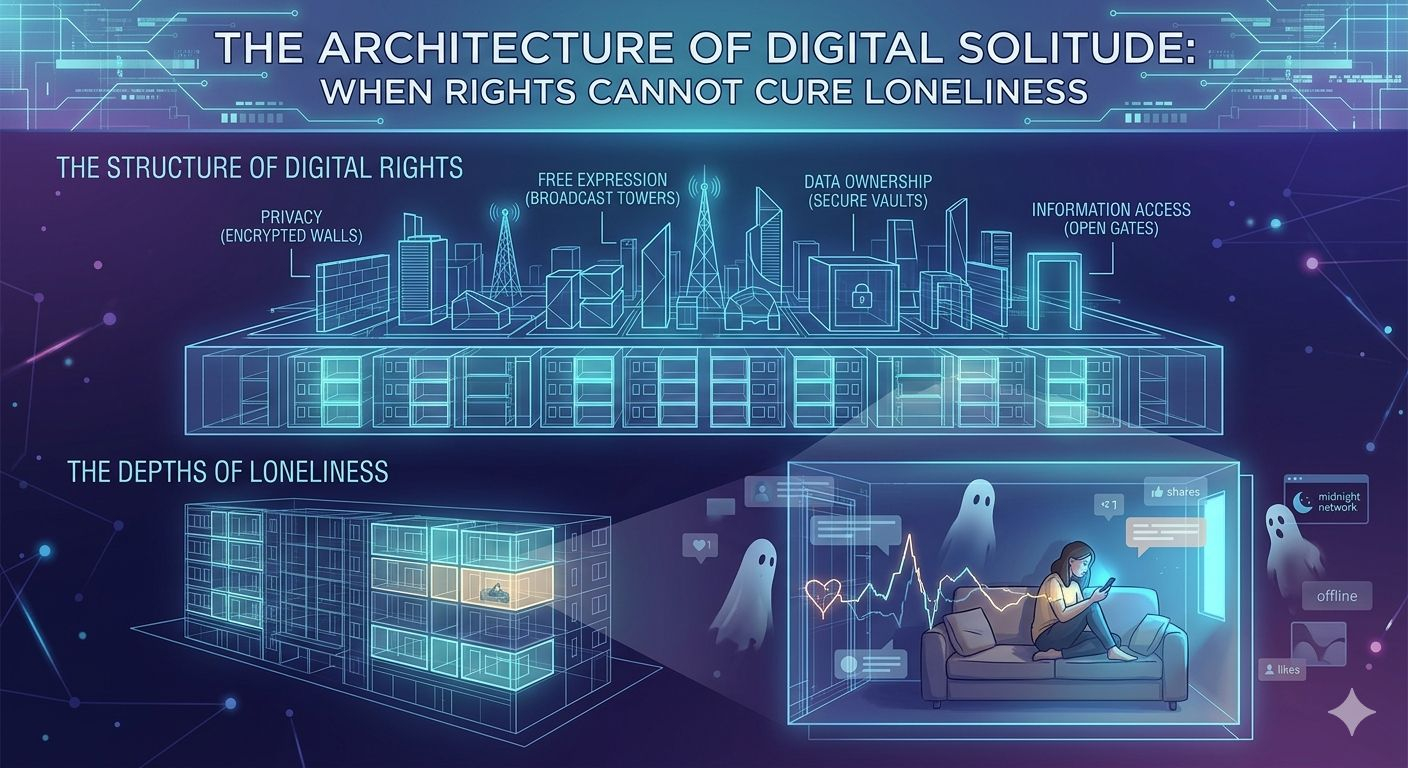
Our digital rights are, fundamentally, structural. They are legal and ethical frameworks that define the parameters of our interactions. They protect our data from surveillance, our speech from censorship, and our digital identities from theft. Think of them as the blueprints for a vast, secure city. They ensure the utilities run, the streets are policed, and your property is your own. But a secure city is not necessarily a community. A meticulously constructed apartment building, built according to all safety and housing codes, can still be filled with tenants who feel profoundly alone.
This paradox is at the heart of digital solitude. We've focused intensely on the mechanics of our digital lives, on optimizing the efficiency and security of our connections. We have the right to broadcast, but do we have the right to be heard, in a way that resonates with our need for authentic validation? We have the right to encrypt, but is that privacy just a stronger wall behind which our loneliness is hidden?
Loneliness is not merely the absence of connection; it is a complex and deeply human emotional state. It's the ache of unshared joys, the weight of unexpressed grief, and the feeling that despite being surrounded by voices, no one is truly listening to us. Digital networks, even when respecting our rights, are inherently mediated. They filter our messy, nuanced emotions into data points – likes, shares, comments. A heartfelt message is reduced to characters on a screen, devoid of the subtle cues of tone, touch, and eye contact that underpin genuine human bonding.
Furthermore, the very platforms that champion our rights are often designed in ways that exacerbate isolation. Algorithmic echo chambers, while protecting our right to see content we "like," inadvertently create intellectual silos, cutting us off from diverse perspectives and the potentially deeper, more challenging interactions that foster growth. The focus on curated digital personas, protected by our right to self-representation, can lead to a sense of inauthenticity and alienation, as we distance our online selves from our messy, vulnerable realities.
Midnight Network, as a space born from a desire for alternative digital structures, could be uniquely positioned to explore this frontier. Perhaps the conversation needs to shift from purely protecting existing rights to reimagining what true digital flourishing looks like. We need to ask: what rights do we need to cultivate genuine belonging? Is there a "right to disconnect" that goes beyond mere setting adjustments? Is there a "right to algorithmic transparency" that isn't just about code, but about understanding how our social environments are being shaped?
Ultimately, the architecture of digital solitude reminds us that legal frameworks, while essential, are insufficient for fulfilling our deep-seated human need for connection. Our rights provide the structure, the safe walls within which we live our digital lives. But filling those spaces with warmth, vulnerability, and true presence is a challenge that requires more than code or law. It demands a deliberate, empathetic reimagining of our relationship with technology, and with each other. A secure digital world is important, but a connected and compassionate digital world is essential for healing the profound loneliness that often echoes in the silent spaces between our online interactions.#NIGHT @MidnightNetwork $NIGHT