
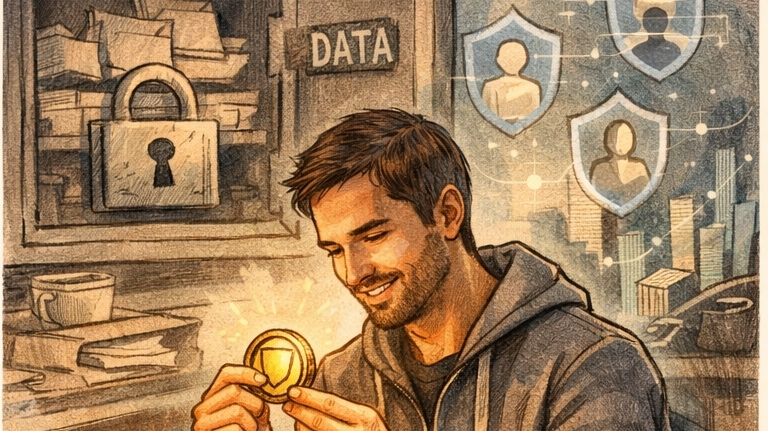
I’ll be honest—I wasn’t searching for anything deep that day. Just scrolling, passing time, the usual mix of hype posts and big promises. Every project sounded louder than the last, all trying to prove they were faster or bigger.@MidnightNetwork
Then one line made me pause.
It wasn’t flashy. It didn’t try to sell me anything. It just said something along the lines of: you can prove things here without giving away your data.
I didn’t fully understand it at first, but it felt… different enough to stick.
So I clicked.
At the beginning, it felt like every other rabbit hole—you read a bit, get confused, open another tab, try to connect things. But slowly, something started making sense. This wasn’t trying to fix blockchain by adding more features. It was quietly changing how it works at the core.
Instead of showing everything to be trusted, this system works on proofs.
Not proofs like screenshots or logs—actual mathematical confirmations. You don’t reveal your balance; you prove it’s enough. You don’t expose your identity; you prove you meet the condition. And somehow, that’s all the network needs.
That idea took a minute to settle in my head.
We’re so used to giving things away—emails, IDs, transaction history—just to be allowed to interact online. Here, it felt like the system didn’t want anything extra from me. It only wanted confirmation that I wasn’t breaking the rules.
The more I read, the more I realized this wasn’t just about privacy in the usual sense. It wasn’t about hiding things. It was about not needing to reveal them in the first place.
And that changes everything.
I kept going, a bit more interested now. I started looking into how people actually build on something like this. That’s where it got surprisingly practical.
There are tools designed around this whole “prove, don’t reveal” idea. Developers aren’t just writing code to process data—they’re writing logic to verify truths. It sounds technical, but the concept is simple: instead of asking users for information, you design systems that only ask for proof.
I imagined apps built this way. No unnecessary forms. No silent tracking. Just interactions that do what they need to do—and nothing more.
It felt cleaner. Lighter.
Then I looked at how the token fits into all this.
Normally, tokens just move from one place to another, and everything about that movement is visible somewhere. Here, it felt different. The token still powers the network, still handles transactions—but those actions don’t quietly expose the person behind them.
It’s hard to explain, but it made the whole idea of “ownership” feel more real. Not just owning assets, but owning the information connected to them too.
By this point, I realized why this project stayed in my head when everything else blurred together.
It wasn’t trying to impress me with numbers or noise. It was doing something more subtle—removing a problem I didn’t even question before. The idea that using digital systems always means giving something up about yourself.
And once you see that there’s another way, it’s hard to unsee it.
Because maybe the real shift isn’t about making blockchains more powerful—it’s about finally building systems that don’t need to know everything about you to work.
