Crypto spent years believing that better code would automatically create better outcomes.
Faster chains, smarter contracts, cleaner infrastructure, stronger architecture — the assumption was always the same: if the technology is good enough, adoption will follow.
But the market has exposed the flaw in that belief.
Code alone does not create longevity. People do.
We have seen technically impressive projects fade into irrelevance, not because the product failed at the engineering level, but because no real community formed around it. No culture. No habit. No reason for users to stay.
That is why Sign stands out.
Not because it is the most ideologically pure project in the market.
Not because it is the simplest.
But because it appears to understand something many projects still do not:
a project survives when people have a reason to participate, not just a reason to speculate.
And that may be Sign’s real advantage.
⸻
Orange Dynasty: More Than Noise, More Than Marketing
The first thing that captures attention is Orange Dynasty.
At first glance, it looks dramatic, even chaotic. There are clans, leaderboards, daily rewards, and participation loops that make it feel closer to a Web3 MMO than a traditional protocol ecosystem.
That is precisely why it is easy to dismiss too quickly.
Because underneath that chaos is something crypto consistently struggles to build:
repeatable, large-scale coordination.
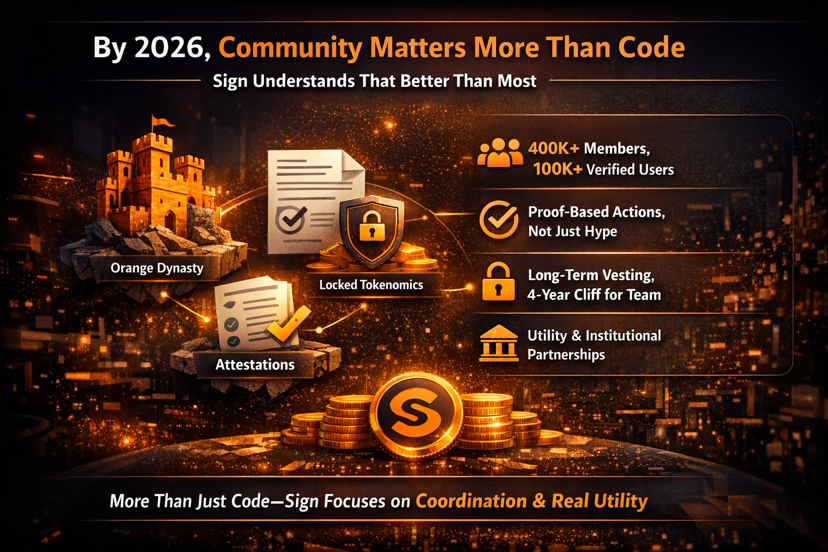
Within two weeks of launching in August 2025, Orange Dynasty reportedly attracted:
• over 400,000 members
• more than 100,000 verified users
Those are not trivial numbers.
More importantly, this does not resemble the usual wave of short-term airdrop hunters. It looks more like an ecosystem designed to keep people engaged, active, and returning.
In crypto, attention is cheap.
Retention is not.
Orange Dynasty may appear messy on the surface, but it seems to be doing something most projects fail to achieve: turning participation into behavior.
⸻
Sign’s Foundation Is Built on Verifiable Action
What makes Sign more interesting is that its community layer is not built on empty engagement alone.
Its core mechanism is attestations.
At a basic level, attestations allow actions, achievements, or states to be proven on-chain. That changes how users interact with the system. Instead of rewarding purely artificial activity, the model pushes participants toward actions that can actually be verified.
This is an important distinction.
A large share of crypto activity is still designed around low-friction incentive loops: click, claim, repeat. That may generate numbers, but it rarely creates meaningful value.
Sign attempts to anchor participation in something stronger:
credible, provable action.
That does not automatically guarantee long-term success. But it does create a more durable framework than ecosystems built entirely on speculation or superficial engagement.
In other words, Sign is not just trying to attract users.
It is trying to structure activity that has more legitimacy.
⸻
Tokenomics: Where Projects Reveal Their Real Intentions
This is where many projects either build trust or lose it.
Narratives are easy to manufacture.
Token structure is much harder to hide.
SIGN has a total supply of 10 billion tokens.
On its own, that number means very little. A large supply is not inherently bearish, just as a smaller supply is not inherently strong. What matters is how the supply is distributed, how quickly it unlocks, and who controls it.
This is where Sign begins to look more disciplined.
A significant portion of the supply is allocated to ecosystem and community rewards, which suggests the project is designed to distribute value over time rather than through a single event.
At launch, only around 12% of the total supply was circulating.
That matters because it reduces the risk of immediate sell pressure, one of the most common problems after token generation events.
The more important signal, however, comes from insider lockups.
Investor Allocation
Investor tokens are vested over two years.
Team Allocation
Team tokens are locked even more aggressively:
• four-year vesting
• with a one-year cliff
That is not a cosmetic decision. It is a structural one.
It means the people closest to the project cannot benefit fully from early hype and walk away. They are tied to the long-term outcome of what they are building.
For ordinary holders, that matters.
It does not eliminate risk. No token structure can do that. But it does reduce one of the most damaging patterns in crypto: the gap between what insiders can do and what the community is left to absorb.
Sign appears to be designed with longer-term alignment in mind.
⸻
A Token Only Matters If It Has a Real Role Inside the Ecosystem
Many crypto projects launch tokens first and invent utility later.
That approach rarely ages well.
SIGN appears to have a more defined role. It is positioned as:
• gas on Signchain
• access to premium features, including AI-assisted contracts
• a governance asset
• a token used for staking, delegation, voting, and rewards
That does not automatically make it valuable. Utility is only meaningful when there is actual usage behind it.
But it does mean SIGN is not being presented as a purely decorative asset. It is intended to operate inside the system, not merely sit beside it.
And that distinction matters.
The strongest token models are not built on “hold and hope.”
They are built on hold, use, and participate.
⸻
TokenTable May Be the Most Underrated Part of the Sign Thesis
One of the most important but least discussed pieces of this ecosystem is TokenTable.
The scale is notable:
• more than $4 billion in token distributions
• across EVM, Solana, TON, and Move
• 6 million attestations processed
• tokens distributed to 40 million wallets in 2024
If those figures hold, then Sign is not just building a narrative layer. It is involved in the infrastructure of real token movement across multiple chains.
That matters for a simple reason:
when a native token becomes connected to actual service flows, distribution activity, and infrastructure usage, demand becomes more grounded in utility rather than pure speculation.
This is where many projects fail. They can generate attention, but not relevance.
If Sign can maintain this operational role at scale, then SIGN’s value proposition becomes much stronger.
⸻
The Bull Case Depends on Real Growth, Not Just Narrative Strength
The long-term bullish thesis for Sign is relatively clear.
If the ecosystem continues to grow in terms of:
• wallet reach
• attestation volume
• token distribution activity
• protocol usage
then the role of SIGN inside that network becomes more meaningful.
More activity can lead to more token circulation.
More circulation can lead to stronger embedded demand.
And when that demand is tied to real usage rather than temporary excitement, the market eventually starts to notice.
But this only works if the growth is genuine.
Plenty of projects can generate short-term momentum.
Very few can turn that momentum into durable usage.
So the thesis is not simply that “the story sounds good.”
The thesis is that if Sign continues to be used, the market may eventually be forced to price that utility in.
That is a much stronger argument than speculation alone.
⸻
A Dual Strategy: Community Energy and Institutional Stability
One of the most interesting aspects of Sign is that it does not appear to be choosing a single lane.
Most crypto projects tend to be one of two things:
• retail-focused, community-heavy, and highly gamified
• or institutional, infrastructure-driven, and culturally weak
Sign seems to be trying both.
On one side, it is building a highly active community through Orange Dynasty, staking systems, daily rewards, and social participation loops.
On the other side, it is also pursuing government and institutional relationships.
From a business perspective, that is a smart move.
Retail attention can be powerful, but it is also volatile. Government or institutional contracts, if secured, can offer more stable and predictable revenue.
That creates a dual-engine model:
• community generates energy
• institutions can provide stability
If both sides develop successfully, Sign may end up more resilient than projects that depend entirely on one type of market behavior.
⸻
The Central Tension: Control vs Crypto Values
This is also where the model becomes more complicated.
Governments generally prefer oversight, structure, and control.
Crypto, at least in its original form, values openness, neutrality, and freedom.
Those two forces do not align naturally.
So Sign’s strategy contains a real tension:
can a project remain attractive to crypto-native users while also becoming useful to institutions that may demand more centralized forms of control?
That is a serious question.
It may also be the project’s biggest philosophical risk.
At the same time, the market has shown that ideological purity alone does not guarantee survival. Many highly principled projects have failed to build meaningful adoption.
Sign seems to be making a more pragmatic bet:
that usefulness may matter more than purity.
Not everyone will agree with that approach.
But in modern crypto markets, practicality often outperforms ideology.
⸻
Final View
Sign is not a perfect project.
It is not a simple project.
And it is certainly not a risk-free one.
But it does appear to be built around a more mature understanding of what actually survives in crypto.
Not isolated code.
Not short-term hype.
Not narratives with no operational depth.
But ecosystems that combine:
real usage
repeated participation
meaningful infrastructure
disciplined token release
and a community that continues to show up
That is what makes Sign worth watching.
It is not merely a bet on price.
It is a bet on coordination, utility, and long-term survival.
And in this market, that may be one of the smartest bets a project can make.