I remember the first time I realized that most blockchains are essentially gated communities designed by architects who hate the idea of anyone ever leaving the neighborhood. You see it in the way tokenomics are usually structured where every incentive is a gravitational pull toward a single ecosystem and a single token. It is a lonely way to build a future. We have spent years talking about decentralization while building economic silos that are as rigid as any legacy banking system. This is the exact paradigm Midnight is looking to dismantle. Instead of forcing everyone to bow to a single sovereign asset, the goal is to create a cooperative tissue that actually functions across different networks. It is a bold play to move away from the isolated island model and toward something that actually looks like an interconnected web.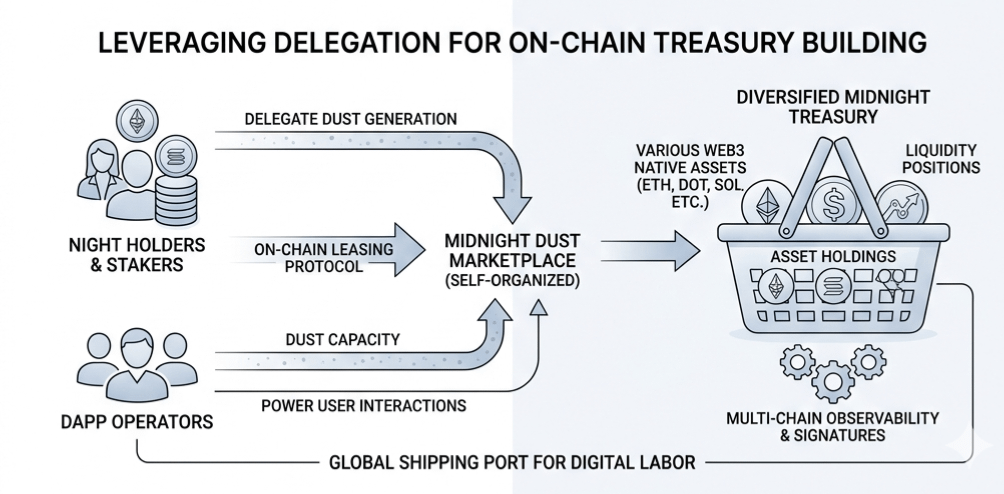
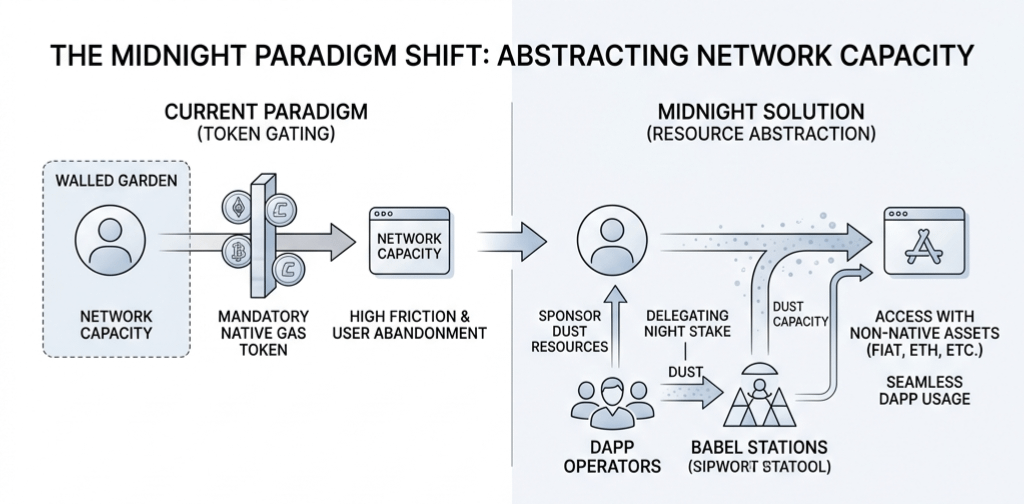
The current industry standard for network capacity is a mess of friction. Usually, if you want to do anything on a chain, you have to go through the ritual of acquiring the native gas token which often means jumping through the hoops of centralized exchanges or sketchy bridges. Midnight reframes this by introducing the concept of a capacity marketplace. Think of network capacity as the actual on-chain work being performed which is measured in a resource called DUST. In the old world, you either owned the token or you were locked out. In this new model, we are looking at a system where a user can access that capacity directly by holding the native NIGHT token or indirectly through a sponsor. It is the difference between having to own the power plant just to turn on your lights versus simply paying for the electricity you use.
The real beauty of this setup is how it treats DApp operators and non-native users. Imagine an application where the developer handles all the heavy lifting of DUST resources in the background. The end user might be paying in fiat or some other random token without even knowing they are interacting with a blockchain. This is the kind of abstraction that the industry desperately needs if we ever want my parents to use these tools. We are talking about Babel Stations that act like DUST filling stations where a user submits a transaction with an intent and a station operator swaps in the necessary resources. It is a pragmatic shift away from the crypto-purist obsession with native token utility and toward a world where the tech actually serves the user rather than the other way around.
Of course, the cynical side of me knows that purely off-chain peer-to-peer exchanges for this kind of capacity are a trust exercise that can get messy. That is why the transition to on-chain, ledger-native leasing is the real milestone to watch. When NIGHT holders can delegate their DUST generation through a protocol-level mechanism, we get a self-organized marketplace that does not rely on a handshake and a prayer. This feeds directly into a diversified treasury that can hold assets from across the entire Web3 space. We are moving toward a reality where the treasury is not just a pile of its own printing-press money but a robust basket of various chain-native assets.
This vision depends on things like cross-chain observability and multichain signatures which are the actual gears turning behind the scenes. It allows an agent on Midnight to see what is happening on Ethereum or any other chain and trigger actions accordingly. If someone wants to pay for Midnight capacity using ETH, the system can observe that lock-up and unlock the DUST needed to move the needle. It turns the blockchain from a walled garden into a clearinghouse for digital labor. We are finally moving away from the idea of a blockchain as a static vault where you store your pride and joy and toward the idea of a blockchain as a global shipping port where the containers move seamlessly regardless of whose flag is flying on the mast.