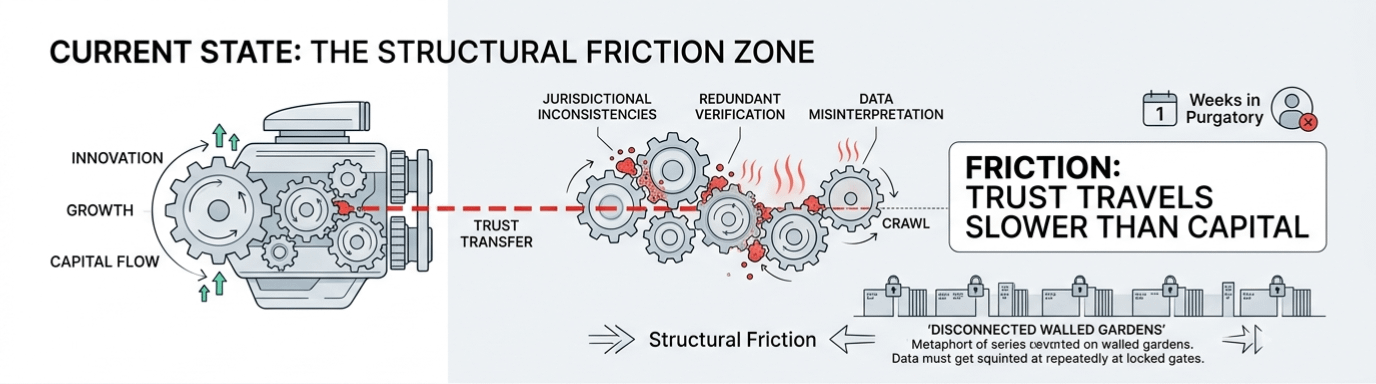
I was sitting last month watching the sheer volume of capital move through a single afternoon and I couldn't help but think about how we have spent the last decade obsessed with the wrong kind of speed. We talk about high frequency trading and instant settlements as if they are the endgame but the real friction in the Middle East right now is not how fast the money moves but how slowly the trust travels behind it. I have watched brilliant founders with fully verified credentials get stuck in a digital purgatory for weeks just because they crossed a jurisdictional line that did not recognize a stamp from three hundred miles away. It is a classic case of the pipes being built faster than the water can be purified and that is exactly where a project like Sign starts to look less like a niche protocol and more like the missing piece of a regional puzzle.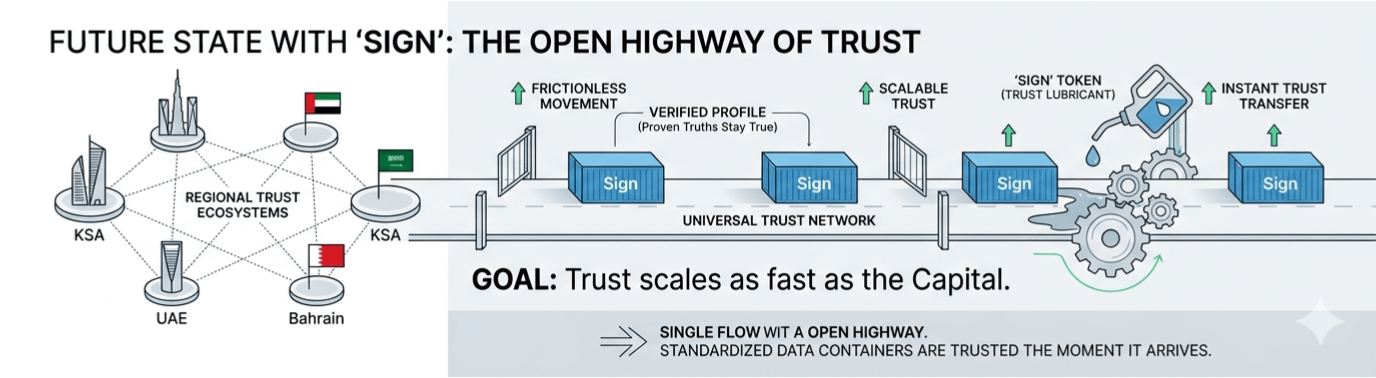
The old guard would tell you that the solution is just more verification or a bigger centralized database but that line of thinking is exactly why we are in this mess. In the legacy world we treat identity like a passport that has to be squinted at by every single person you meet which is an exhausting way to run a digital economy. Sign is trying to flip that script by ensuring that once something is proven true it stays true regardless of where it lands. The goal here is not to create a mountain of new checks but to stop the endless loop of redundant validation that kills momentum. If a business is approved in one ecosystem it should not lose its soul or its clarity just because it wants to operate in another and yet we still act like data loses its meaning the moment it hits a different server.
Of course the cynical side of me knows that the path to this kind of sovereign infrastructure is littered with the corpses of projects that promised universal standards. We have seen plenty of people try to force everyone into a single box only to find out that different jurisdictions actually like their own rules. The reality check here is that coordination is messy and most systems are being lashed together with digital duct tape while we wait for a real standard to emerge. Inconsistencies in how data is interpreted do not usually stop growth entirely but they act like a fine grit sand in the gears of a high performance engine. You can still drive but you are burning way more fuel than you should just to stay at cruising speed and that structural friction is what happens when trust cannot scale as fast as the capital.
When you look at Sign through the lens of this specific growth story it stops being about the abstract concept of decentralized identity and starts being about the physics of movement. It is about whether a verified profile can carry its original context across borders without needing a translator or a second opinion. If they pull this off then the token is not just some speculative asset or a piece of paperwork on a blockchain but the actual lubricant for a regional machine that is trying to move at the speed of light. We are essentially moving away from the era of the locked gate and toward the era of the open highway. If the old way of doing things was like a series of disconnected walled gardens then Sign is trying to be the universal freight container that ensures the cargo inside is trusted the moment it arrives at the dock.