
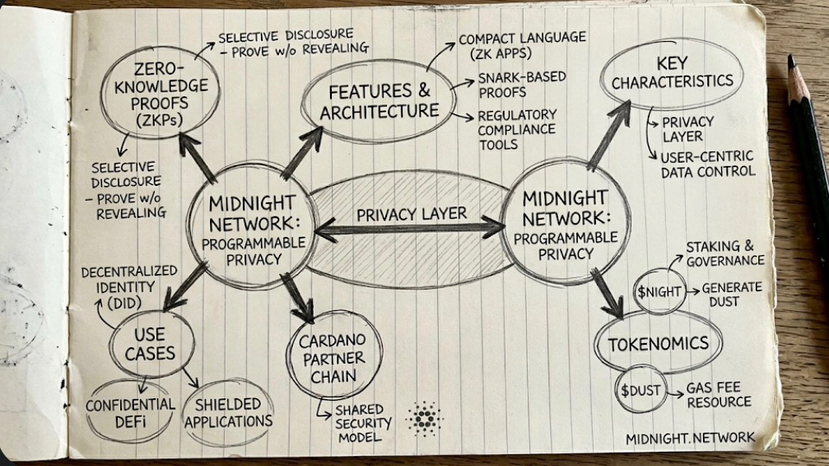

While exploring different blockchain ecosystems recently, I came across something that made me pause for a moment. It wasn’t a bug, not a hack, and not even a financial loss. It was something more subtle. I realized how deeply exposed user activity can be across most platforms. Every transaction, every interaction, every connection all visible, all traceable. I didn’t think much of it before, but over time it started to feel like a gap in the system. I’ve seen people split wallets, avoid interactions, or hesitate before using certain applications. That’s when I started thinking maybe privacy in Web3 is still not solved. But then I discovered @MidnightNetwork and it felt like I was finally looking at a system built to address this exact issue.
Midnight Network is designed with a very clear purpose: to bring privacy into blockchain without breaking the core principle of trust. It does this using zero knowledge proofs, a powerful cryptographic method that allows transactions and computations to be verified without revealing the actual data behind them. This means users can interact, transfer, and execute logic on chain while keeping their sensitive information protected. What impressed me most is that this is not just theory it is a structured system designed to operate in real conditions. Midnight is not removing transparency; it is refining it, making sure only necessary information is visible.
As I explored further, I realized Midnight Network is not just another blockchain it is a privacy focused layer designed to support secure and confidential applications. One of its most important features is private smart contracts. In most existing systems, smart contracts are completely open, exposing both logic and data. While that works for transparency, it creates limitations for real-world applications where confidentiality is required. Midnight solves this by allowing smart contracts to operate privately while still being verifiable. This creates a new category of applications where data protection is built into the logic itself.
Another strong aspect of Midnight Network is its connection to the broader ecosystem, particularly its association with Cardano. Midnight is designed to complement and extend capabilities within the Cardano ecosystem, focusing specifically on privacy. While Cardano provides a strong foundation for secure and scalable blockchain infrastructure, Midnight adds a specialized layer where confidential computation and data protection become possible. This relationship is important because it shows that Midnight is not isolated it is part of a larger vision where different layers handle different responsibilities. From my perspective, this kind of integration strengthens the overall ecosystem and makes adoption more practical.
The token model of Midnight Network also plays a critical role in its design. It separates responsibilities between $NIGHT and DUST. $NIGHT is used for governance, giving participants the ability to influence decisions and guide the network’s direction. DUST, on the other hand, is used for execution handling transaction fees and the computational cost of generating proofs. This separation might seem simple at first, but it solves a major issue. Privacy systems require consistent computational effort, and if execution costs depend on a volatile governance token, it can lead to instability. By separating these roles, Midnight ensures that the network remains efficient and predictable.
When I look at the overall architecture, I see a system where every component supports the main goal: privacy with usability. Zero knowledge proofs protect transaction details. Private smart contracts secure application logic. The dual token model ensures operational stability. And its alignment with Cardano strengthens its position within a larger ecosystem. These elements are not random features they are carefully designed parts of a unified framework. Midnight Network is not trying to compete on hype; it is focusing on solving a fundamental problem in blockchain design.
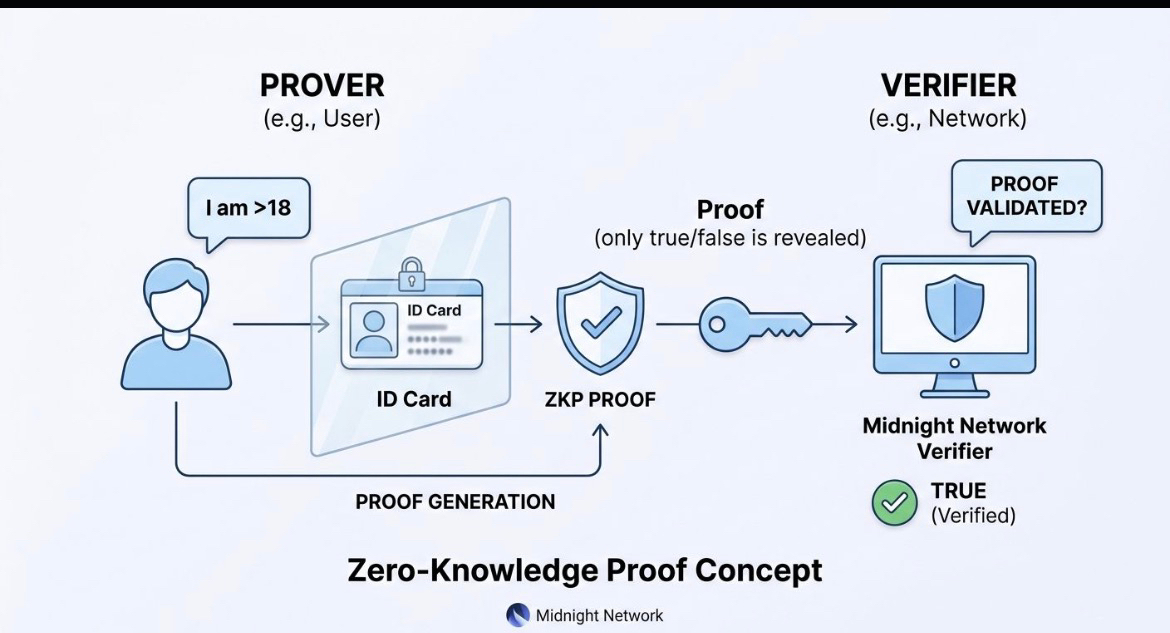
As I continued learning, I started to think about real world applications. Privacy is essential in many areas finance, identity, business operations, and even simple user interactions. Without privacy, users are forced to choose between transparency and comfort. Midnight Network removes that trade off. It allows users to participate in decentralized systems without exposing unnecessary information. This is a major step forward because it aligns blockchain technology more closely with real world expectations.
I also appreciate that Midnight Network is not positioning privacy as a secondary feature. Instead, it is building the entire system around it. This approach makes a difference because it ensures consistency across all layers of the network. From transaction validation to smart contract execution, everything is designed with privacy in mind. This creates a stronger foundation compared to systems where privacy is added later as an optional feature.
At the same time, I am still exploring how everything works in practice. There are technical layers behind zero knowledge proofs and private computation that require deeper understanding. But even at this stage, I can see the direction clearly. Midnight Network is focusing on long term usability, not short term trends. It is building infrastructure that can support real applications, not just theoretical concepts.
If you understand what I explained, then answer this:
Which network builds privacy first blockchain systems?
