

Something secondary. Something you add once the real infrastructure is already built. Something that matters only to a small corner of users or to people who are overly focused on ideology. I think that was a serious misread from the beginning, and Midnight Network sits right in the middle of that mistake.
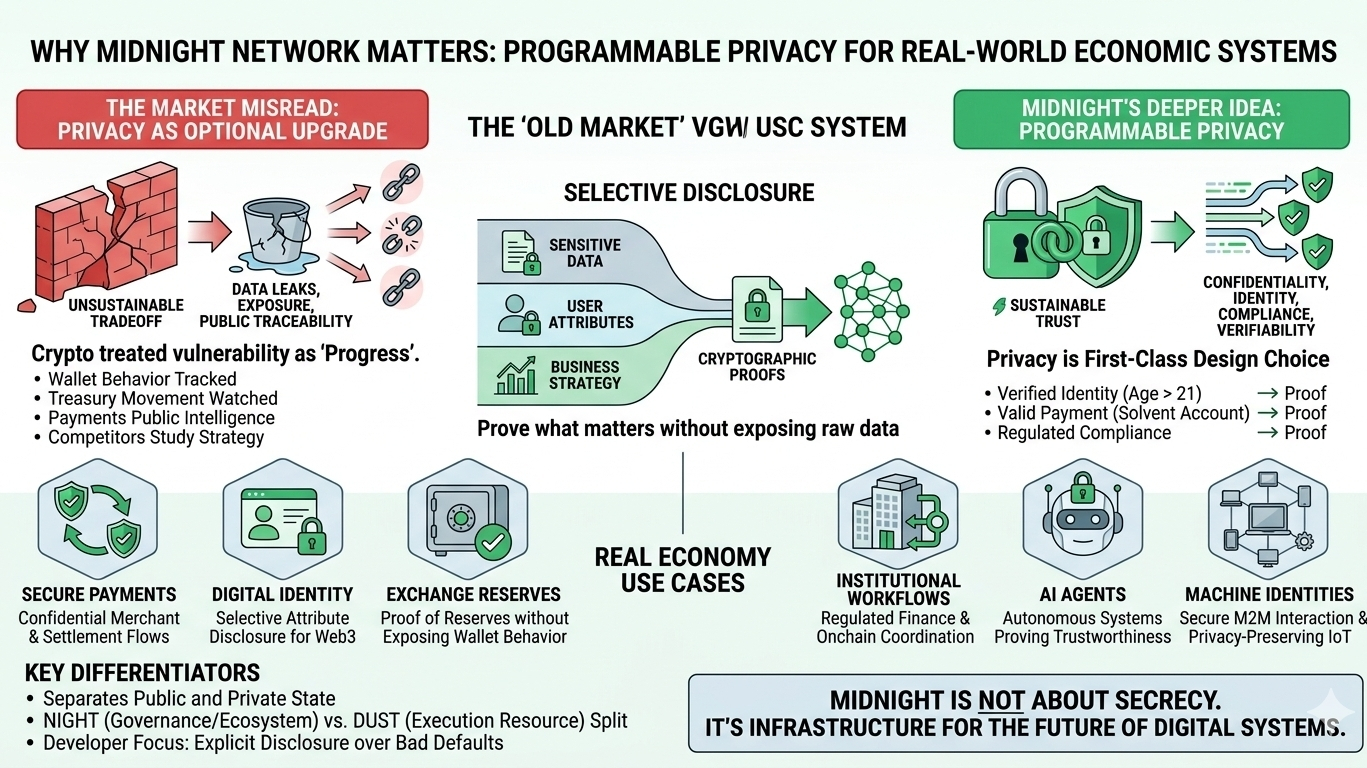
The real issue was never whether people liked the word privacy. The real issue was whether open digital systems could ever become part of normal economic life while exposing too much of the people and businesses using them. That is where the market kept getting lazy. It confused transparency with progress, even when that transparency was creating obvious weaknesses. In crypto, that weakness became normal. Wallet behavior could be tracked. Treasury movement could be watched. Competitors could study each other’s activity in real time. Payment patterns could become public intelligence. User behavior, business relationships, and strategy could all leak through the chain itself.
For a speculative market, maybe that looked acceptable for a while. For a real economy, it never was.
That is why Midnight matters.
What makes Midnight interesting is that it is not really built around the old privacy-coin mindset. It is not simply trying to hide everything and call that innovation. The deeper idea is more mature than that. Midnight is built around the idea that privacy and disclosure should not be treated as absolutes. Some information needs to be verified. Some information needs to remain private. Some information needs to be shown only to specific parties under specific conditions. That sounds simple, but it changes the whole direction of the system.
Instead of forcing users into a world where everything is public by default, Midnight tries to make privacy programmable. That difference is the whole story.
The network is designed around selective disclosure. That means data does not have to be exposed to everyone just to prove that something valid happened. A user or application can keep sensitive information private, generate a cryptographic proof around it, and let the network verify the result without revealing the raw data underneath. That is a much more realistic model for how finance, identity, compliance, and business systems actually work in the real world.
And honestly, this is where crypto has felt immature for years.
Too much of the industry acted like radical transparency was automatically virtuous. It was not. In many cases it just meant involuntary exposure. It meant public surveillance pretending to be openness. It meant treating every user, company, institution, and application as if they should be comfortable operating under permanent visibility. That was never going to scale into serious adoption. It may have worked for early experimentation, but it was always going to break once blockchains started pushing toward payments, regulated finance, machine identity, and large-scale onchain coordination.
Midnight seems built from the assumption that this break was inevitable.
That is why its design feels more deliberate than the average narrative-driven launch. The network separates public and private state instead of pretending one model can serve every need. Sensitive data stays off the public ledger, while proofs and intended public outputs can still be verified onchain. So the point is not secrecy for its own sake. The point is to prove what matters without exposing everything else. That is a very different philosophy from older crypto privacy narratives, and in my view it is one of the strongest parts of the project.
The same thinking carries into the development layer.
Midnight’s programming model is not just about using zero-knowledge proofs somewhere in the background and hoping developers figure the rest out. It tries to make privacy a first-class design choice inside the application itself. Disclosure is meant to be explicit, not accidental. That matters more than people think. One of the biggest problems in software is that bad defaults quietly shape the entire system. If publicity is the default, then most builders will leak more than they intend. If disclosure has to be chosen deliberately, then privacy stops being an afterthought and starts becoming part of the architecture.
That is a subtle design choice, but it says a lot about how Midnight sees the future.
It is also why the network should not be reduced to a simple “private chain” label. That phrase is too flat for what Midnight is actually trying to do. This is closer to privacy infrastructure for programmable systems. It is trying to build an environment where confidentiality, compliance, identity, and verifiability can exist together instead of constantly fighting each other. That is a harder problem than launching another chain with a faster throughput number or another token with a cleaner meme.
And the market usually notices hard problems late.
I think that is already happening here.
As Midnight moved closer to mainnet, the conversation around it started to look less theoretical. The project is no longer sitting in the safe zone where everything is just a concept. It has been approaching launch with a clearer structure, with the NIGHT token already introduced ahead of mainnet and with the network model becoming more visible. That does not automatically guarantee success, but it changes the quality of the discussion. Once a system gets close to real operation, people stop responding only to vision and start looking at how the machine is actually meant to work.
That is where Midnight becomes more interesting, not less.
The token model is a good example. Midnight separates NIGHT from DUST, and that separation says a lot about the network’s priorities. NIGHT is the native token tied to governance and the broader ecosystem. DUST, on the other hand, is designed as the shielded resource used for execution. That split matters because it prevents the private execution layer from simply becoming another freely circulating asset narrative. In other words, Midnight is trying to keep usage, privacy, and network economics connected without flattening them into the same thing.
I actually think this is one of the more thoughtful parts of the design.
A lot of projects talk about token utility in broad, empty language. Midnight at least appears to be asking a more serious question: if privacy is core infrastructure, what kind of economic model supports that without turning it into a speculative distortion? The NIGHT and DUST structure is one answer to that question. Whether the market values it correctly is another matter, but the effort to separate execution from pure token circulation feels intentional and grounded.
Then there is the launch structure itself, which deserves a more honest reading than simple hype or simple criticism.
Midnight’s early operator model shows that the team is prioritizing stability and controlled rollout at launch. That immediately creates tension, because whenever a project talks about privacy, infrastructure, and serious adoption, the question of decentralization follows right behind it. And it should. A privacy-preserving network that becomes too dependent on a narrow operator set risks reproducing the same concentration problems that blockchain is supposed to escape.
So I do not think this part should be ignored.
At the same time, I understand why Midnight is approaching launch this way. If the project wants to support enterprise infrastructure, regulated workflows, and systems that may end up touching payments, reserves, identity, and other sensitive activity, then a carefully managed start is not surprising. The real issue is not whether that compromise exists. The real issue is whether it stays temporary. If Midnight genuinely expands toward broader community-driven participation after launch, then the current model can be read as a bootstrap phase. If it does not, then the project will eventually run into the same hard questions every infrastructure chain faces when pragmatism starts looking too comfortable.
That tension is real. It does not ruin the thesis, but it absolutely belongs inside it.
What keeps Midnight compelling anyway is the type of use cases gathering around it. The network’s story gets stronger when you look at where privacy actually becomes necessary. Not fashionable. Necessary.
Payments are an obvious example. Once stablecoins start moving through serious merchant and settlement flows, public-by-default transaction visibility stops looking efficient and starts looking irresponsible. Exchanges face a similar issue. Proof of reserves matters, but full exposure of wallet behavior, counterparties, and flows is not the only way to achieve credibility. Identity systems face it too. Device networks, machine-to-machine coordination, and AI agents create even more pressure. If autonomous systems are going to interact economically, they need ways to prove trustworthiness and validity without exposing everything about themselves to the world.
That is where Midnight starts to look less like a niche privacy bet and more like an infrastructure bet on where digital systems are heading.
And that is the part I think the market is still underestimating.
People still talk about privacy in crypto as if it belongs to one category. But privacy in the next phase of digital infrastructure will not sit in one category. It will sit underneath many categories. Finance will need it. Identity will need it. AI will need it. Consumer applications will need it. Enterprise software will need it. Cross-border value transfer will need it. Machine networks will need it. Once you see that, the conversation changes. Privacy is no longer a side feature competing for attention. It becomes a condition for serious participation.
That is why Midnight’s timing feels important.
Not because it discovered privacy before anyone else, but because it is arriving at a moment when the cost of ignoring privacy is becoming harder to hide. The market can still spend time chasing clean narratives and faster charts, but the underlying world is moving toward more sensitive data, more regulatory pressure, more intelligent automation, and more economically relevant digital coordination. In that environment, public-by-default systems begin to look less like honest infrastructure and more like unfinished infrastructure.
Midnight is basically making that argument in protocol form.
Of course, none of this means the project should be romanticized. It still has to execute. It still has to prove that selective disclosure can work at meaningful scale without collapsing into friction, complexity, or institutional overreach. It still has to show that the balance between privacy and auditability is not just elegant in theory but usable in practice. And it still has to avoid becoming a system where “compliance-friendly privacy” quietly turns into a softer language for permissioned control.
That risk is real too.
Any project working at the intersection of privacy and regulation walks into an uncomfortable zone. If it leans too far toward secrecy, it limits adoption and invites the wrong kind of attention. If it leans too far toward control, it stops being a meaningful correction and starts becoming another managed system dressed in better language. Midnight’s real challenge is not just technical. It is political in the deeper sense. It has to define who gets to see what, under what rules, and with what limits. That is not a small design question. That is where infrastructure reveals what kind of world it is actually helping build.
This is what keeps my attention on Midnight more than the surface-level story.
The core idea is not that privacy should win against transparency. The core idea is that transparency was never supposed to mean universal exposure in the first place. Markets blurred that distinction because it was easier. Builders accepted it because it was normal. Users tolerated it because there were no better systems yet. Midnight is part of a growing realization that this design choice was never sustainable.
In that sense, the market may really be learning too late.
Privacy was never optional. It only looked optional while crypto was small enough to treat leakage, exposure, and public traceability as acceptable trade-offs. But once blockchains move closer to real payments, institutional coordination, digital identity, AI-driven interaction, and serious economic infrastructure, those trade-offs stop looking clever. They start looking reckless.
That is why Midnight matters.
Not because it promises to hide the world, but because it starts from the uncomfortable truth that real digital systems cannot work properly if every participant is forced to live in public all the time. And if Midnight can actually carry that idea from theory into functioning infrastructure, then it will matter for more than privacy as a niche narrative. It will matter because it helps redraw the rules of what onchain trust is allowed to look like.