
I’ve been in crypto long enough to know that most new narratives don’t stay new for very long.
The names change.
The branding gets cleaner.
But the pattern is usually the same.
A lot of noise, a lot of tokens, and a lot of people pretending something ordinary is profound.
That’s probably why I’ve become slower to pay attention.
Not cynical exactly. Just tired of seeing the same cycle repeat itself with a different coat of paint.
So when I first came across SIGN, I didn’t think much of it.
The name went into the same mental pile as everything else.
But the more I sat with it, the more it felt like it was at least looking at a real problem — not an invented one, and not one that only exists in pitch decks.
Because one thing crypto still handles badly is proving who did what, and who should get what.
That sounds simple when you say it quickly.
It isn’t.
Anyone who has ever tried to qualify for an airdrop, join an allowlist, or participate in some on-chain campaign knows how messy this gets.
You do the tasks.
You follow the steps.
You stay active.
And then at the end, you’re still not fully sure whether any of it actually counted.
That uncertainty has become strangely normal in crypto.
Projects are trying to reward real users, avoid bots, and make distributions feel fair.
Users are trying to prove they showed up, participated, or contributed in some meaningful way.
And most of the time, both sides are working through systems that feel patched together.
A spreadsheet here.
A snapshot there.
A wallet check, a Discord role, maybe some third-party tool in the middle.
Nothing about it feels clean.
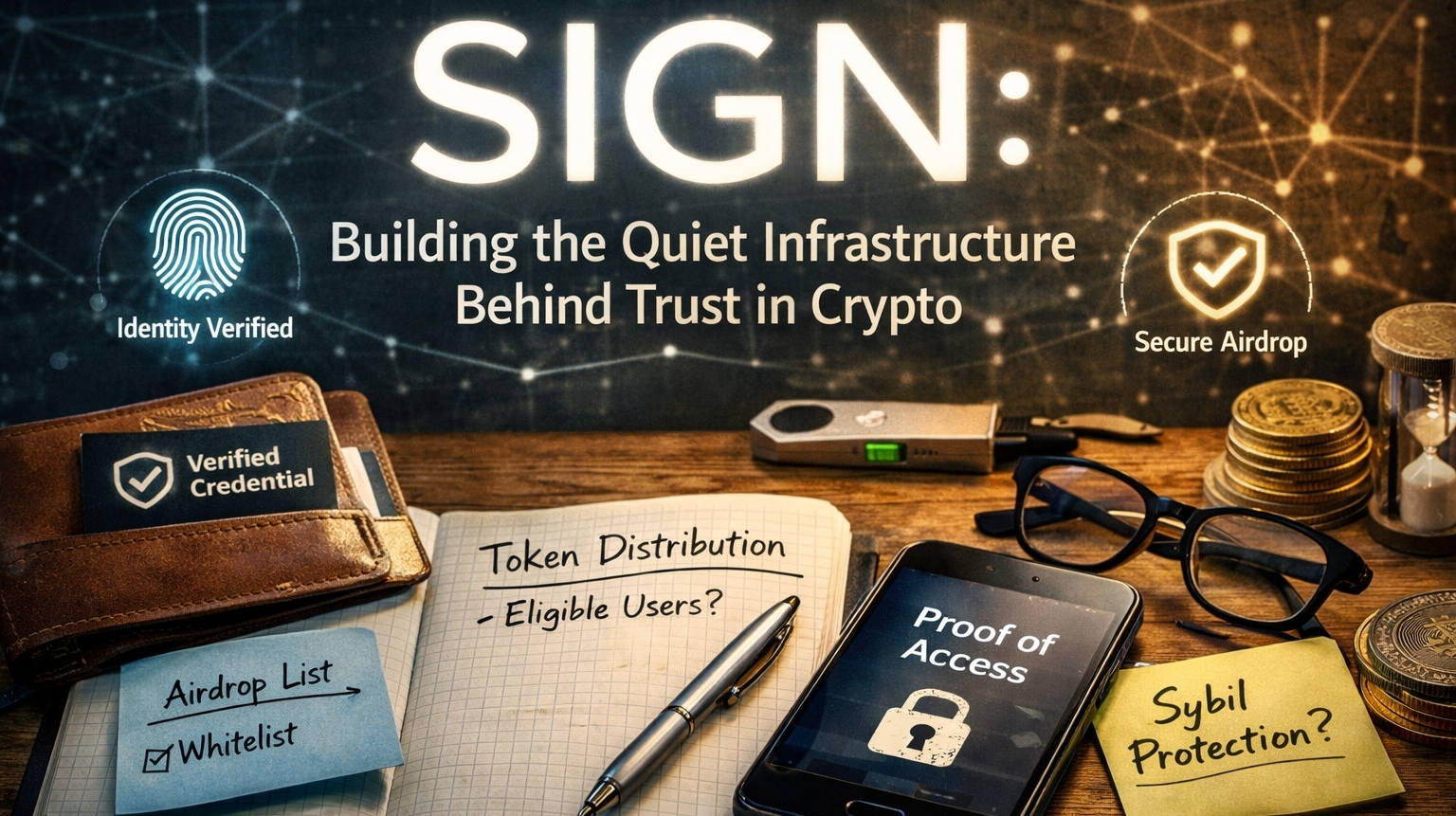
That seems to be the area SIGN is stepping into.
At its core, it’s trying to make credential verification and token distribution feel more structured.
Not glamorous.
Not especially exciting.
Just more coherent.
And honestly, that may be the most believable thing about it.
A lot of crypto projects try to sound bigger than the problem they’re solving.
SIGN, at least from the outside, feels like it’s dealing with something much more ordinary: the friction around trust, eligibility, and coordination.
Who actually participated?
Who qualifies?
How do you verify that without rebuilding the whole process from scratch every time?
Those are useful questions.
They’re not sexy questions, but they’re real ones.
And real questions are usually where the more durable ideas come from.
That said, I don’t think this is some guaranteed breakthrough.
Crypto is full of decent ideas that made sense on paper and still went nowhere.
Not because they were useless, but because adoption is hard.
For something like SIGN to matter, people actually have to use it.
Projects have to trust it enough to plug it into real distribution flows.
Communities have to accept the logic behind the credentials.
And the broader ecosystem has to want shared infrastructure more than it wants to keep reinventing its own systems.
That’s a big ask.
There’s also a human side to this that crypto people sometimes ignore.
Credentials sound neat when they’re presented as clean pieces of proof.
But people and communities aren’t always clean.
Participation is messy.
Reputation changes.
Wallet behavior doesn’t tell the full story.
And once you start turning those things into permanent records or distribution logic, the edge cases start to matter a lot.
That doesn’t make the idea bad.
It just means the problem is deeper than software.
Even the token distribution angle deserves a little caution.
In theory, better verification should lead to better distribution.
Maybe fewer bots, fewer fake farmers, fewer obvious exploits.
But systems like this can also create new blind spots.
The more formal the rules become, the easier it is for unfairness to hide behind process.
So I don’t look at SIGN and think, this changes everything.
I just think, this is trying to fix a part of crypto that has been clumsy for a long time.
And that alone makes it more interesting than most of what gets attention in this market.
Maybe it works.
Maybe it becomes one of those quiet pieces of infrastructure people end up using without talking much about.
Or maybe it runs into the same wall a lot of these projects do — limited adoption, niche relevance, and a market that moves on too fast.
That’s always possible.
Still, I think it’s worth watching.
Not because it feels huge.
But because it feels grounded.
And after enough years in crypto, that’s usually the first thing I look for.
#signdigitalsovereigninfra $SIGN
