
I’ve been in this space long enough to stop getting excited every time a new trend shows up.
At this point, most of crypto feels like the same story told with different branding. A new token, a new slogan, a new promise that this time everything changes. Then a few months later, people move on to the next thing.
Lately it’s been AI everywhere.
Before that it was restaking, gaming, social, metaverse, whatever the market needed to keep itself entertained. A lot of it feels like noise dressed up as innovation.
That’s probably why Midnight Network stood out to me a bit.
Not because I think it’s a sure thing. And not because “zero-knowledge” hasn’t already been overused to death in crypto. It has.
But underneath the label, the project seems to be going after a problem that actually matters.
One of the weirdest things about crypto is that it talks so much about freedom, ownership, and control, while making a huge amount of your activity visible by default.
That may be fine for some things.
But once you move beyond simple transfers and start thinking about real use cases, that model starts to feel awkward pretty quickly. Most people do not want every payment, every interaction, or every piece of sensitive data sitting out in the open forever.
And honestly, that’s not paranoia. That’s normal.
People want transparency when it matters. But they also want boundaries. They want to be able to use digital systems without turning their personal or business life into a public feed.
That seems to be the tension Midnight Network is trying to address.
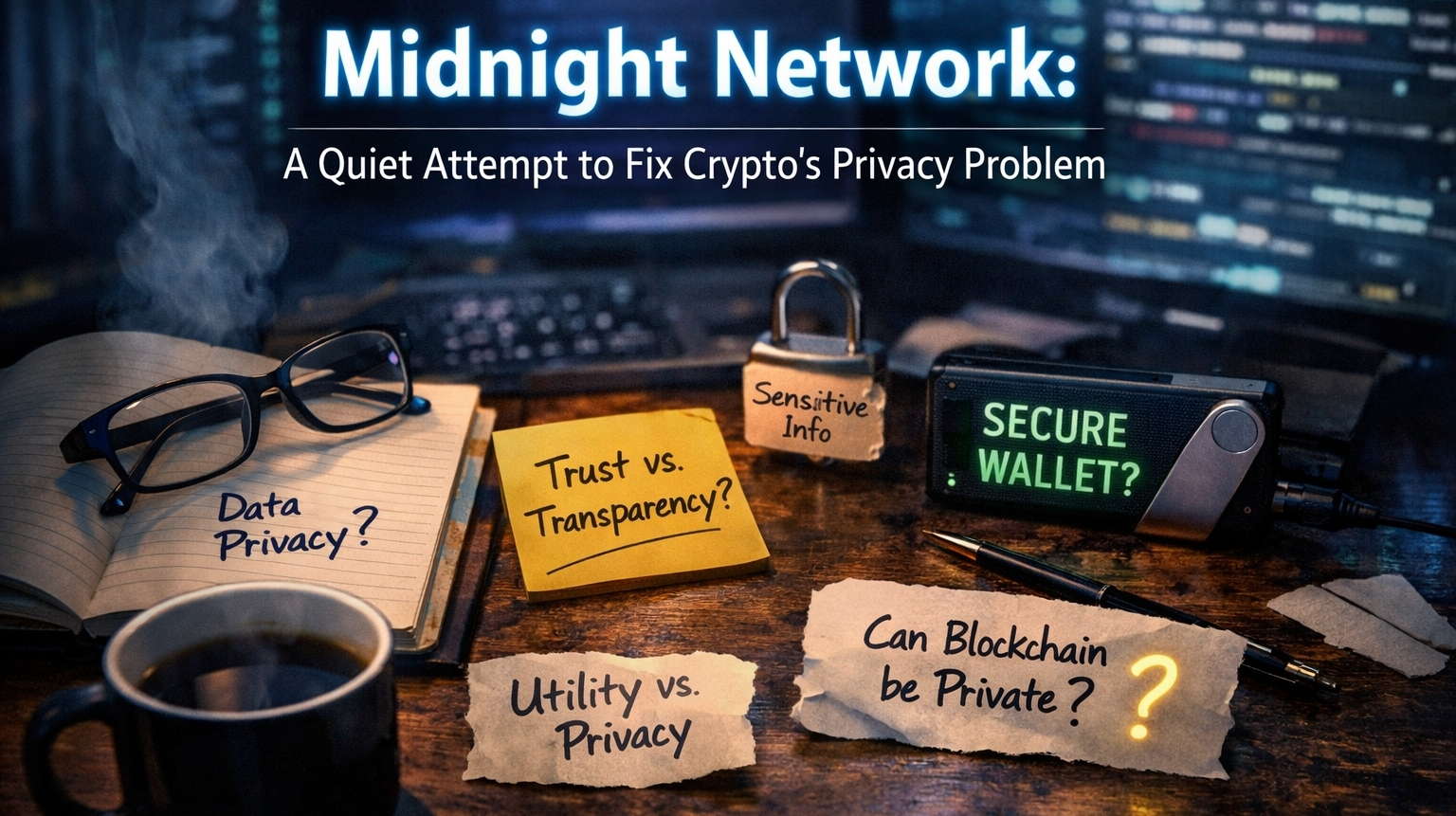
The basic idea is pretty simple: can a blockchain be useful without forcing people to give up privacy in the process?
That question has been sitting in the background of this industry for years.
A lot of public chains are built around radical transparency, and that works well if your only goal is open verification. But in the real world, not everything should be fully visible just because it runs on shared infrastructure.
Businesses do not want sensitive data exposed.
Users do not want their financial history mapped out by strangers.
Institutions might want the benefits of blockchain systems without broadcasting every detail of what they’re doing.
So when Midnight talks about using zero-knowledge proofs to offer utility without giving up data protection or ownership, that at least feels connected to an actual friction point.
And I think that matters.
Not because the technology itself is enough. Crypto has never had a shortage of clever technology. The graveyard is full of technically impressive projects that never found real demand.
That’s why I don’t think the interesting part is whether Midnight sounds advanced.
The interesting part is whether it can make privacy feel practical.
That’s a very different challenge.
A lot of privacy-focused crypto projects have struggled because they either became too complex, too niche, or too disconnected from everyday users. Sometimes the ideas were good, but the experience was not. Sometimes the market just wasn’t ready. Sometimes regulators made the whole category harder to touch.
That could easily happen here too.
And to be fair, crypto people sometimes hide behind technical language when they still haven’t answered the basic question: who is this really for, and why would they use it?
That’s where I still have some hesitation.
Midnight Network sounds thoughtful in theory, but theory is cheap in this industry. The harder part is whether developers actually want to build on it, whether users can benefit from it without needing to understand the machinery underneath, and whether privacy can be offered in a way that feels natural instead of ideological.
Because most people are not looking for “privacy” as a belief system.
They’re just looking for systems that don’t feel invasive.
That’s an important difference.
What makes Midnight at least worth paying attention to is that it seems less focused on chasing the usual crypto reflexes — more speculation, more visibility, more financial theater — and more focused on a quieter design problem that probably has to be solved if this industry wants to mature.
Not every action on the internet needs to be public.
Not every useful system should force people to choose between security, openness, and discretion.
That’s a real issue. And crypto still doesn’t have a clean answer for it.
So no, I wouldn’t frame Midnight Network as some breakout moment or pretend it changes everything.
It may work. It may not.
It may end up as one of those projects people respect more than they use. That happens all the time.
But I do think it’s asking a better question than most.
And these days, that alone is enough for me to keep an eye on it.
#night $NIGHT @MidnightNetwork
