

For a long time, I used to think of blockchains as separate islands. Each one had its own rules, its own users, and its own system. Whenever we needed to move assets between them, we relied on bridges. And honestly, as a developer, that process always felt risky and messy. You lock assets on one chain, mint a wrapped version on another, and just hope everything works smoothly. Many times, it doesn’t. That is a real problem in the industry, not just theory.
That is why when I started looking into Midnight, the idea felt different to me. Instead of building a completely new network from zero, Midnight builds on top of Cardano. Its validators are not new or unknown. Cardano stake pool operators can run Midnight nodes alongside their existing work. This means the security layer is already tested and trusted. From my perspective, that removes one of the hardest parts of building a blockchain, which is creating trust in the network from scratch.
At the same time, Midnight is not just a sidechain. It keeps its own identity. It has its own execution, its own privacy features, and its own design. I see it like using a strong engine that already works, and then building your own system on top of it. You don’t need to worry about security from day one, so you can focus more on innovation.
What really stands out to me is how it approaches cross-chain interaction. Instead of forcing users to move assets through complicated bridges, Midnight offers privacy as a service. Other blockchains can connect to it, use its privacy features, and even pay using their own native tokens. There is no need for wrapped assets or unnecessary complexity. As someone who has worked with multiple chains, this idea feels much cleaner and more practical.
From a developer point of view, this matters a lot. Building across different chains usually means dealing with different SDKs, different RPC systems, and completely different logic. It takes time and energy just to make things work together. Midnight tries to simplify that experience through its programming language, Compact. It is designed in a way that feels familiar, especially if you have used TypeScript. It hides the heavy cryptography behind the scenes, so you can focus on building instead of struggling with technical complexity.
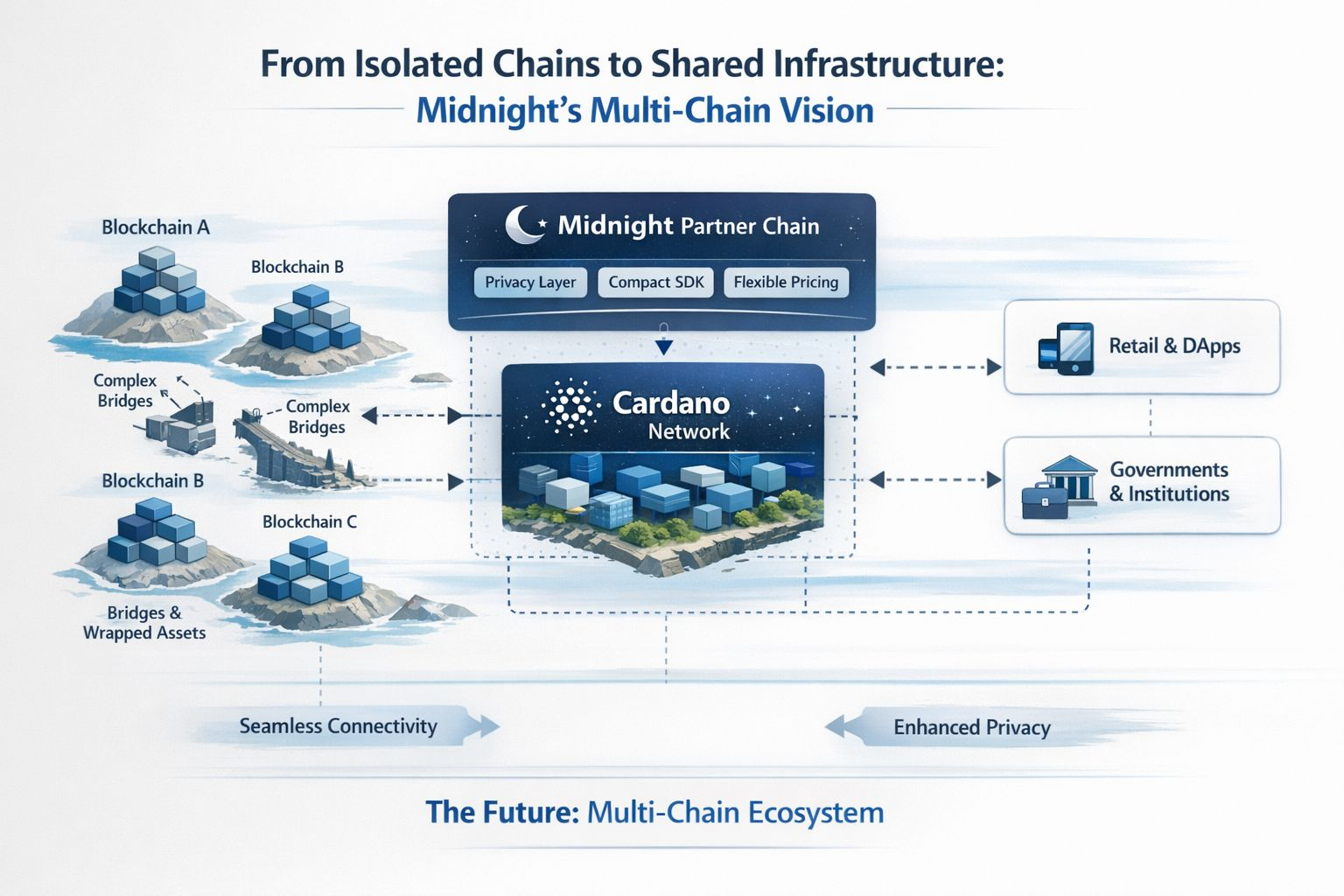
Another detail I find important is the pricing model. Most blockchains use a simple gas system where every action is priced in a similar way, even if the resources used are different. Midnight is trying something more flexible by charging based on actual resource usage. This may sound like a small change, but in real development, predictable and fair costs make a big difference.
When I step back and look at the bigger picture, Midnight does not feel like a project trying to compete with every other chain. Instead, it feels like infrastructure that fits into a larger system. The future of crypto is clearly moving toward a multi-chain world. Different blockchains will specialize in different things. Midnight seems to focus on one key layer, which is privacy.
For example, imagine a financial app built on one chain that needs private transaction data. Instead of rebuilding everything or moving to another network, it could simply connect to Midnight and use its privacy layer. That kind of flexibility could make development faster and more efficient.
What I find refreshing is the shift in mindset. Instead of fighting for users and liquidity, Midnight’s approach feels more about cooperation. Share what makes sense, like security and infrastructure, and compete where it matters, like features and developer experience. That is something the industry has been missing for a long time.
Of course, this idea is still developing, and real adoption will decide its success. But from what I see, Midnight is not trying to follow old patterns. It is trying to build for a future where blockchains are connected, not isolated.
For me, the biggest takeaway is simple. If privacy is going to matter in the long term, it cannot stay locked inside one chain. It has to be available everywhere. And Midnight looks like one of the few projects actually building in that direction.