A Question That Keeps Coming Back to Me
I’ve started to question something I used to take for granted: why is proving something about myself online still so complicated, slow, and often invasive?
Every time I sign up for a service, apply for something, or try to verify my identity, I’m asked to hand over pieces of myself—documents, emails, phone numbers, sometimes even biometric data. I’m told it’s necessary. I’m told it’s for security.
But the more I think about it, the more it feels backwards.
Why do I have to expose everything just to prove one thing?
That question is what led me to explore Sign Protocol, and what I found wasn’t just another blockchain product. It felt more like a quiet shift in how trust itself could be structured.
The Core Problem: Trust Is Broken and Inefficient
If I strip everything down, most digital systems today are built around one fragile assumption: we don’t trust each other, so we centralize trust.
Banks verify identities. Platforms store credentials. Governments issue documents. Companies act as intermediaries for validation.
And while this works at scale, it comes with serious problems:
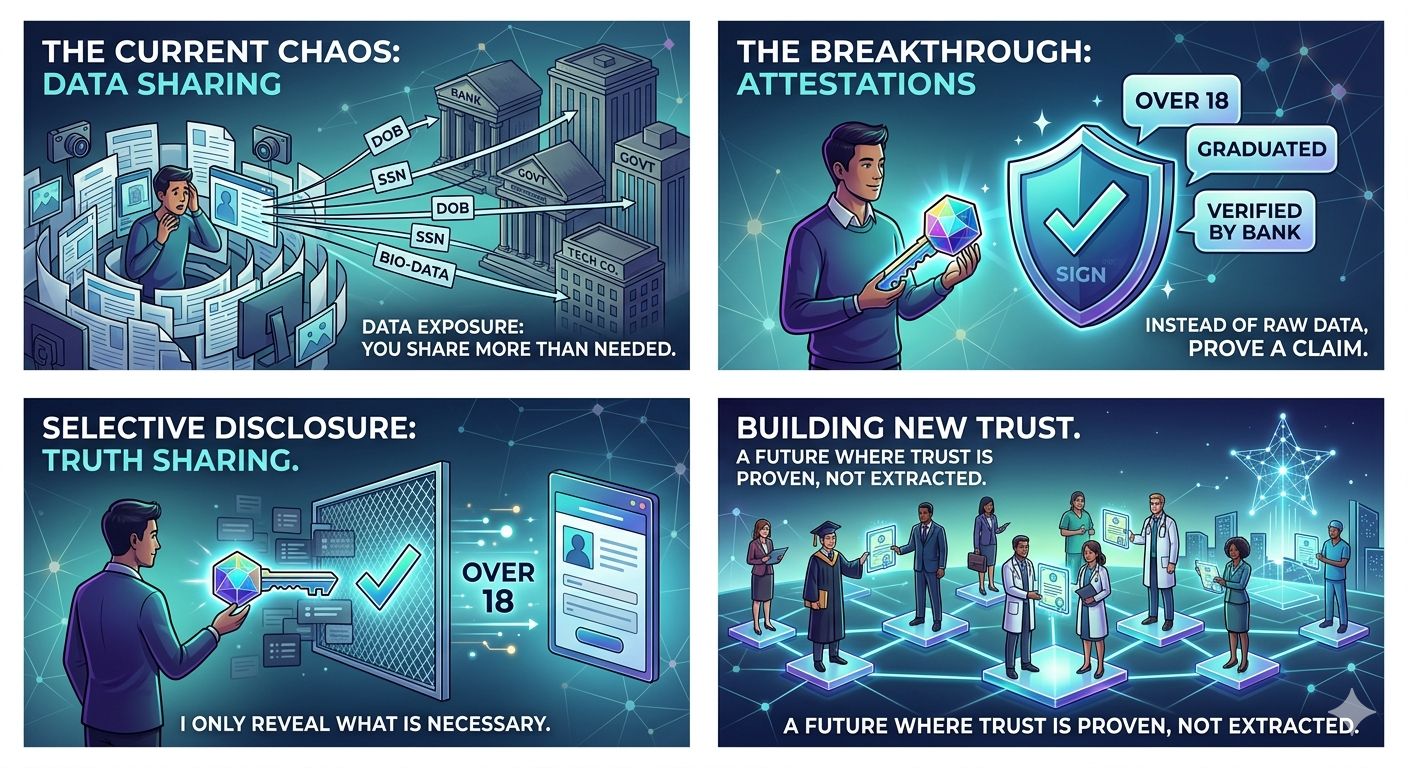
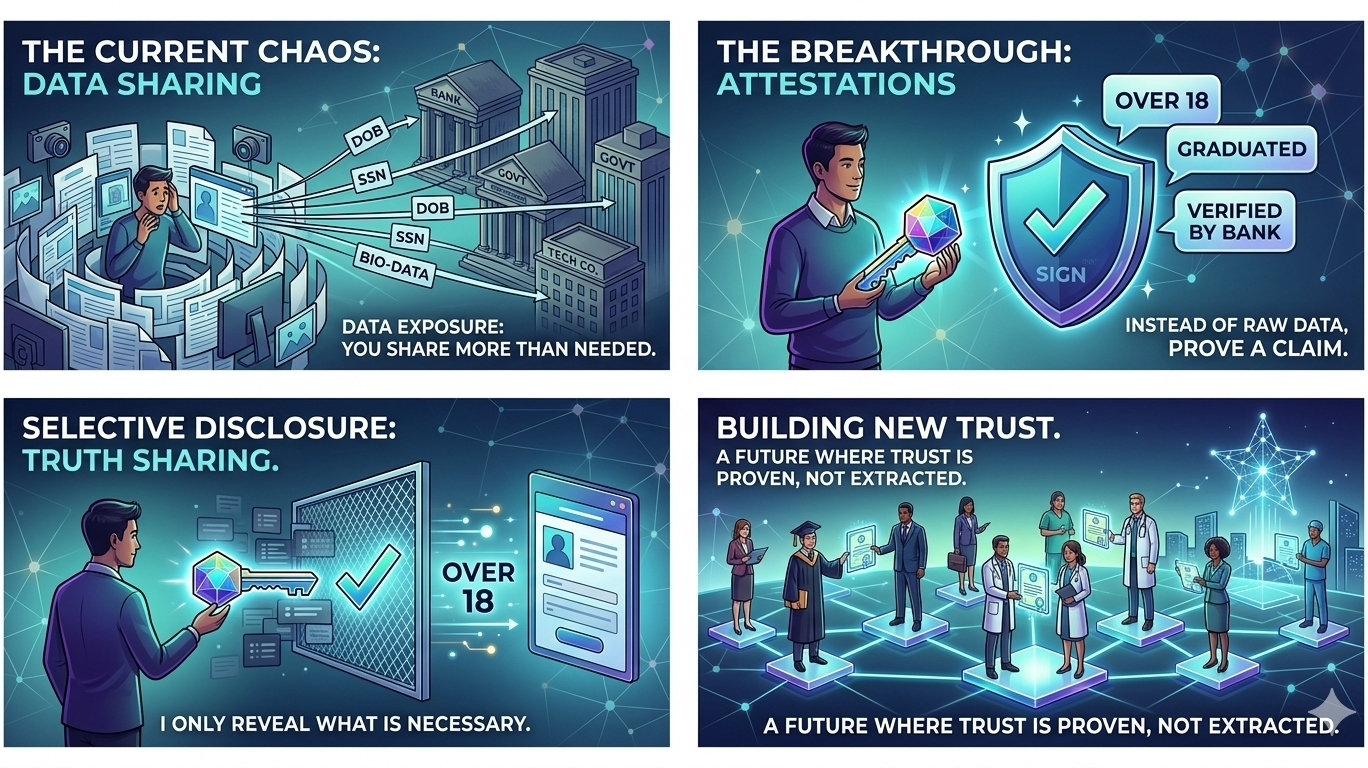
Data exposure: I often have to reveal more than necessary
Repetition: I keep verifying the same information again and again
Dependency: I rely on centralized authorities to confirm what I already know is true
Risk: If one system is breached, everything tied to it becomes vulnerable
I’ve noticed this especially in areas like onboarding. Opening a bank account, signing up for financial services, or even accessing certain online tools—these processes are slow, repetitive, and often frustrating.
It’s not just inefficiency. It’s a structural flaw.
We’ve built systems where proof requires exposure, and that’s where things start to break.
What If Proof Didn’t Require Exposure?
This is where Sign Protocol introduces a different idea—one that initially felt simple, but the more I thought about it, the more powerful it became.
Instead of sharing raw data, what if I could share proof of a claim?
Not my entire identity, but a statement like:
“I am over 18”
“I have completed this course”
“I am verified by this institution”
And what if that statement could be trusted without revealing the underlying data?
Sign Protocol is built around something called attestations. At first, I thought of them as digital certificates, but that felt too limited. They’re more like verifiable statements issued by one party about another, stored in a way that others can trust.
And here’s the key shift:
I don’t need to reveal everything. I only reveal what’s necessary.
How Sign Protocol Actually Works (In Simple Terms)
I like to think of Sign Protocol as a system of structured trust statements.
An entity (like a university, company, or platform) issues an attestation
That attestation says something specific and verifiable
It gets recorded in a system that can be publicly checked (often blockchain-based)
I, as the user, can present that attestation when needed
What makes it powerful is something called selective disclosure.
This means I can prove something without revealing all the details behind it.
For example:
Instead of showing my full ID, I prove I’m eligible
Instead of sharing my full academic record, I prove I graduated
Instead of exposing my financial history, I prove I meet a requirement
It feels like a small change, but it flips the model entirely.
We move from data sharing to truth sharing.
Where This Starts to Matter in Real Life
The more I think about it, the more I see how this applies across different industries.
1. Healthcare
Right now, medical records are fragmented and sensitive. If I visit a new doctor, I often have to repeat everything or transfer records manually.
With attestations:
A hospital could issue a verified medical history summary
I could share only what’s relevant for a specific consultation
Sensitive data stays protected
We’re not exposing everything—we’re proving what matters.
2. Education and Credentials
Fake degrees and unverifiable certifications are still a problem.
With Sign Protocol:
Universities issue verifiable attestations of graduation
Employers can instantly verify authenticity
I don’t need to chase paperwork or emails
It reduces friction and increases trust at the same time.
3. Finance and Onboarding
This is where I see the biggest immediate impact.
KYC (Know Your Customer) processes are repetitive and frustrating. Every platform asks for the same documents.
But imagine this:
I complete KYC once
A trusted entity issues an attestation
I reuse that attestation across services
No repeated uploads. No endless forms.
It’s not just convenient—it’s transformative.
4. AI and Digital Reputation
This part surprised me the most.
As AI systems grow, they need ways to evaluate trust:
Is this data reliable?
Is this user credible?
Is this content verified?
Attestations can act as signals of trust in these systems.
Instead of guessing, AI can rely on verifiable claims.
That creates a new layer of machine-readable trust, which feels like something we’re only beginning to understand.
A Philosophical Shift: From Institutions to Statements
What really stayed with me is that Sign Protocol isn’t trying to replace institutions—it’s trying to reshape their role.
Instead of acting as gatekeepers, institutions become issuers of truth.
And instead of storing everything centrally, truth becomes:
Distributed
Verifiable
Portable
I don’t need to go back to the source every time.
I carry the proof with me.
It feels like moving from a world where:
“Trust lives in systems”
to a world where:
“Trust lives in statements”
That’s a subtle but profound shift.
My Reflections: Why This Feels Different
I’ve looked at many blockchain projects before, and honestly, a lot of them felt abstract or disconnected from real problems.
But this feels grounded.
Because the problem it’s solving—how we prove things about ourselves—is something I deal with constantly.
What makes it compelling to me is:
It doesn’t try to replace everything
It fits into existing systems
It improves efficiency without demanding total disruption
It’s not loud. It’s not flashy.
But it’s deeply practical.
But There Are Real Concerns
At the same time, I don’t think this is a perfect solution.
There are challenges that can’t be ignored.
1. Adoption
For this to work, institutions need to participate.
If universities, banks, and governments don’t issue attestations, the system loses its value.
And adoption at that level is slow.
2. User Experience
Even though the idea is simple, the implementation can feel complex.
Managing attestations, wallets, permissions—it’s not always intuitive.
If users don’t understand it, they won’t trust it.
3. Centralization Risks
Ironically, even in decentralized systems, power can concentrate.
If a few major entities become dominant attestation issuers, we’re back to a form of centralization—just with a different structure.
4. Interoperability
Different systems need to recognize and accept the same attestations.
If ecosystems don’t align, we end up with fragmented trust again.
And that would defeat the purpose.
Where This Might Be Heading
I don’t think Sign Protocol is trying to create a perfect system overnight.
What I see instead is something more gradual:
First, niche adoption (Web3, digital communities)
Then, integration into real-world systems (finance, education)
Eventually, a broader shift in how digital identity works
It’s not a revolution that happens all at once.
It’s more like a quiet restructuring beneath the surface.
A Thought That Stays With Me
I keep coming back to one idea:
What if trust didn’t require exposure?
What if I could move through digital systems without constantly handing over pieces of myself?
Sign Protocol doesn’t fully answer that yet.
But it points in that direction.
And maybe that’s enough for now.
An Open-Ended Conclusion
I don’t know if systems like this will become the standard. There are too many variables—technology, regulation, human behavior.
But I do know this:
The way we handle identity, trust, and verification today feels outdated.
And when I look at something like Sign Protocol, I don’t just see a tool.
I see a question being asked at a structural level:
Can we build a world where trust is proven, not extracted?
I’m still thinking about that.