


Last winter I was sitting in a crowded cafe while a guy at the next table tried to figure out why he had been left out of a token claim. He was not angry at first. Mostly he looked tired. He kept opening old wallets scrolling through transactions and checking messages from months earlier as if the answer might suddenly appear. From where I sat it looked less like finance and more like someone trying to prove he had once belonged somewhere.
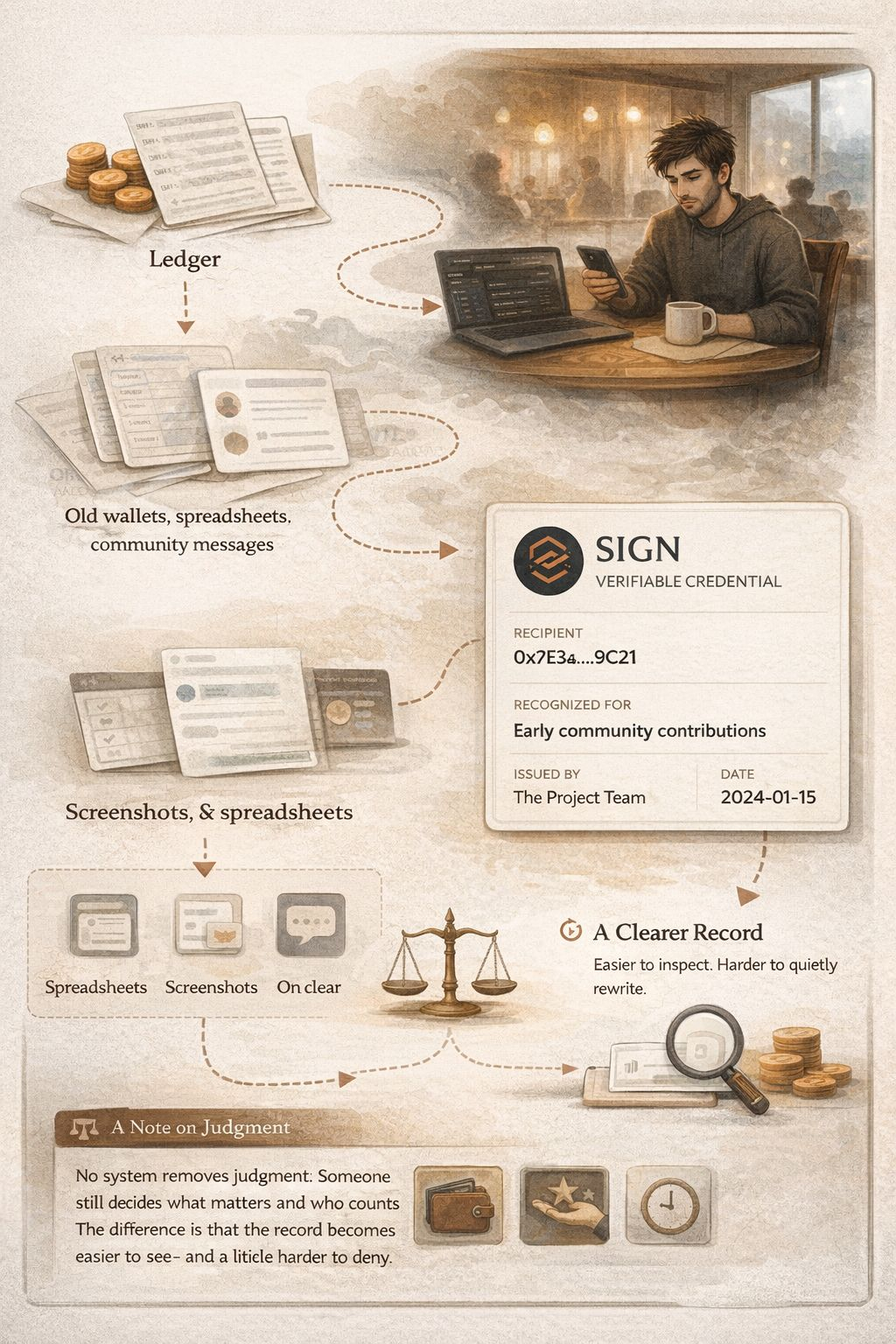
That is the part people tend to skip over. Token distribution sounds mechanical until you see what it asks from people. Before anything gets sent someone has to decide who counts. That decision often hides behind a spreadsheet a snapshot or a set of rules written after the fact. By the time users arrive all they can do is test themselves against a system that already made up its mind.
That is why SIGN seems worth studying. Not because it fixes trust in some grand sense but because it deals with a very plain problem. If a project wants to give something to the right people it needs better records than scattered screenshots and community memory. It needs a way to show that a certain person wallet or account was recognized for a specific reason at a specific time.

What I find useful here is the modesty of the idea. A credential in this setting is not some deep truth about identity. It is just a claim that can be traced back to whoever issued it. That alone changes the feeling of the system. It becomes easier to inspect and a little harder to quietly rewrite.
Still none of this removes judgment. Someone chooses what matters. Someone decides which actions deserve recognition and which do not. The infrastructure may make those choices easier to verify but it cannot make them neutral.
And maybe that is what stays with me when I look at systems like this. Not whether they eliminate unfairness but whether they leave a clearer record of how unfairness gets decided.