I jumped into the Binance CreatorPad campaign for Midnight Network and its $NIGHT token because privacy in crypto has always felt like that one puzzle piece everyone talks about but nobody really nails. I’m no dev or whale—just a regular guy who’s been grinding these campaigns for a few months now, chasing leaderboard spots while actually learning something useful. My motivation was simple: after watching too many “privacy coins” flop under real scrutiny, I wanted to see if Midnight’s zero-knowledge model was actual practical privacy or just fancy theory floating in whitepapers. I expected a clean, no-nonsense interface where I could quickly test shielded transactions and selective disclosure without needing a PhD. Boy, was I wrong on the smooth part.
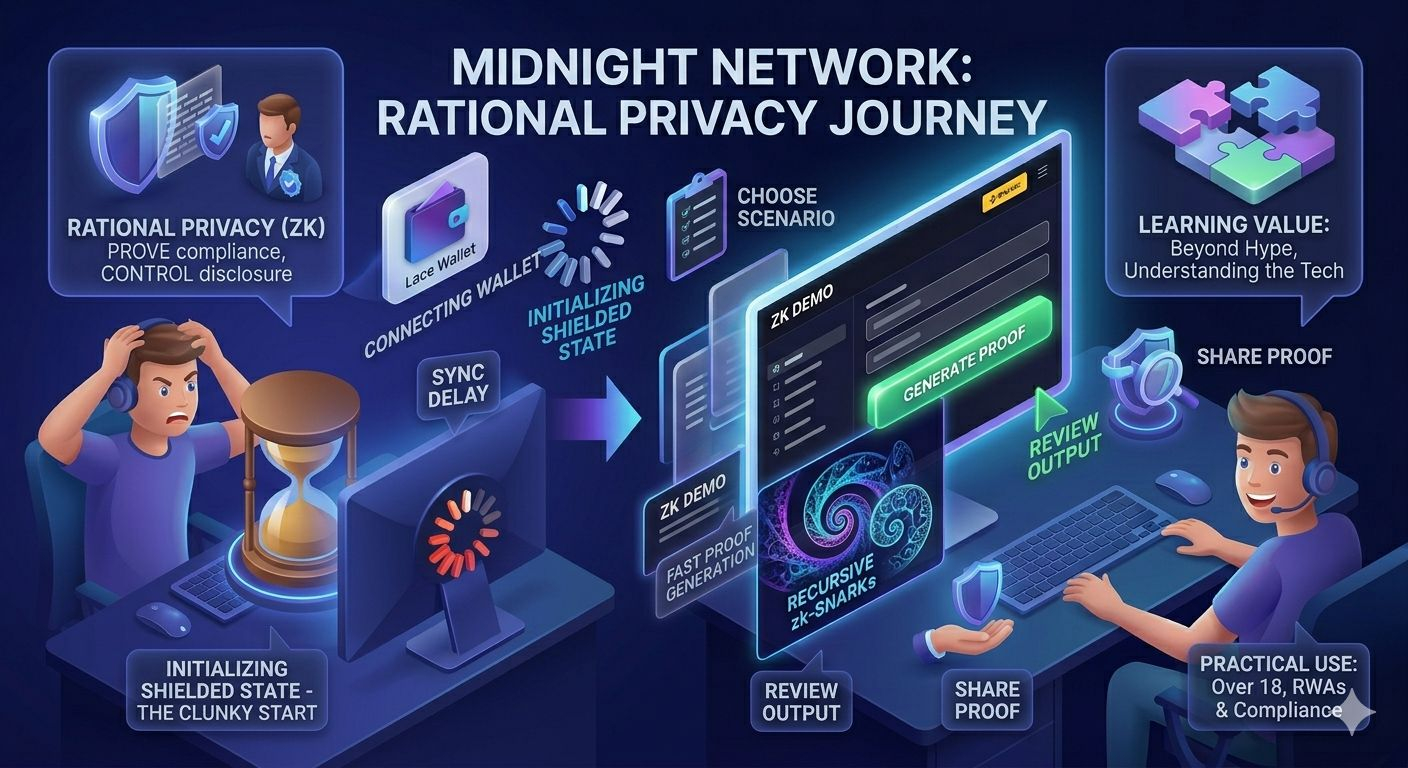
Right from the start, I hit a tangible hiccup that had me muttering at my screen. I clicked “Join Now” on the CreatorPad page, followed the quick social tasks, then moved to the protocol interface part—tapping the big “Connect Wallet” button in the Midnight testnet demo. The wallet (Lace, for anyone curious) popped up fine, but the sync to the testnet environment dragged like it was downloading the entire blockchain on dial-up. That little loading spinner just kept spinning, with a vague “initializing shielded state” message that told me nothing. I refreshed twice, switched browsers, the works. Ever hit a wall like this on your first try, where the hype meets real-life lag and you start questioning your life choices?
Once it finally loaded, the flow I tackled was straightforward but revealing. I started by selecting the ZK demo section—basically a simple tool to generate a proof without exposing data. Step one: pick a sample scenario like proving compliance for a mock transaction. Step two: input basic details (nothing sensitive, just test values). Step three: hit “Generate Proof” and watch the magic happen in the background. Step four: review the shielded output on the public side while the private data stayed hidden. Step five: simulate sharing the proof with a fake verifier. Nothing too wild, but it walked me through the core of their rational privacy approach.
What surprised me positively was how quickly the proof generation actually fired once the sync cleared. The interface showed this clean animation of recursive zk-SNARKs doing their thing—data locked away, but the verification popped up instantly on the other end. It felt less like black-box theory and more like something I could actually use in a real app, which exceeded the usual hype I see in these campaigns. That “aha” moment made me lean forward in my chair like I’d just unlocked a cheat code.
Of course, there were rough spots that kept it real. The button labels were a bit cryptic—“Initiate Selective Disclosure” sounds cool until you’re staring at it wondering if it’s the one that burns your test tokens or just hides them. And the pop-up confirmations sometimes lagged by a solid 10-15 seconds, leaving me second-guessing if I’d double-clicked or if the testnet was under load. It wasn’t broken, just… clunky enough to remind you this is still early days.
I’ll own up to one blunder that still makes me chuckle. I went in thinking zero-knowledge meant total anonymity, like “send and forget” style. So I tried crafting a full shielded transfer right away, expecting it to vanish completely. Nope—the interface gently nudged me with a tooltip: this is rational privacy, not full opacity. You prove what’s needed and reveal only what you choose. I felt like a noob who’d skipped the intro docs, but hey, that’s how you learn.
That slip shifted my whole view of the protocol. Before, I saw ZK as cool math for cypherpunks. After fumbling through the interface myself, I get it now—it’s programmable privacy that actually fits messy real-world needs, like proving you’re over 18 to a service without handing over your birthday. It’s not hiding everything; it’s controlling exactly what shows up, and that feels way more usable than the all-or-nothing privacy plays I’ve tried on other chains.
Who thrives here? The ideal user is the tech-curious grinder—someone comfy with wallets and testnets who enjoys poking at new mechanics for the learning payoff. They’ll climb the CreatorPad leaderboard while picking up genuine insights. On the flip side, absolute beginners might bail fast. If you’re the type who gets frustrated by a single unclear label or a spinning loader, this could feel overwhelming before the good stuff kicks in.
Here’s my pro tip from the run-through: if the wallet sync lags like it did for me, don’t spam refresh—head to your browser settings, clear the cache for the Midnight domain only, then reconnect. Saved me minutes on the second go and kept my flow steady. What’s your go-to fix for these wallet hiccups in testnet campaigns?
The underrated takeaway from all this hands-on clicking? The real value in these CreatorPad tasks isn’t just the points or potential $NIGHT rewards—it’s how the slick UX still trips you up in sneaky ways that force you to actually understand the tech. Timing matters too; I noticed folks who jumped in early and iterated on their posts seemed to edge out the late rush. Reminds me of that other chain’s early testnet where the interface was polished but the privacy felt bolted-on—this one integrates it from the ground up.
What surprised you most when you first tried a ZK demo like this? And how do you balance the excitement with the inevitable UX growing pains?
Personally, I walked away thinking privacy doesn’t have to be either extreme theory or fragile promises. My raw take: Midnight’s zero-knowledge model is tilting hard toward practical right now, especially as RWAs and regulated stuff heat up. It’s not perfect yet, but the hands-on feel convinced me it’s building something that could actually stick in the real world instead of just sounding good on paper. Worth the grind? Absolutely—keeps me coming back for more.