
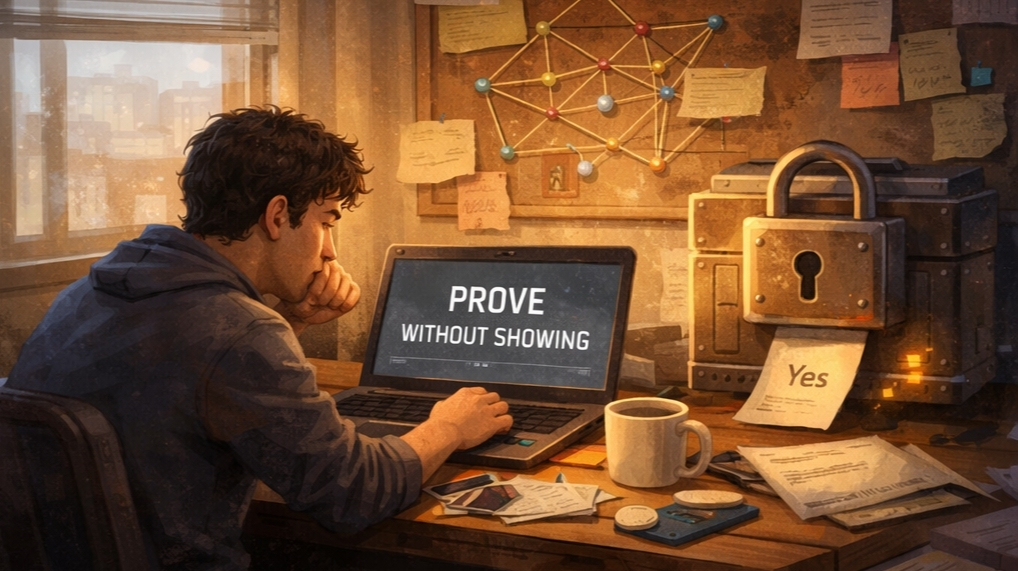
I wasn’t even trying to learn anything that day. Just scrolling, switching between apps, barely paying attention. Then one line caught my eye—something about proving something without showing it. I paused. Read it again. It sounded weirdly impossible.
Still, it stayed in my head.
So I tapped in.
At first, it looked like every other blockchain project I’d seen—tokens, network talk, big ideas. I almost clicked away. But something felt different. It wasn’t trying too hard to impress. No loud promises, no overhyped claims. Just a simple idea that kept repeating in different ways: you don’t have to reveal everything to be trusted.
That part bothered me a little, because it goes against what we’re used to. Normally, if you want access to anything online, you give something up—your data, your identity, your activity. Even blockchains, which are supposed to give control back, often put everything out in the open. It’s transparent, sure, but also… exposed.
This project didn’t follow that pattern.
The more I explored, the more I realized it works almost silently. Instead of sharing your actual data, it creates a kind of proof—a small piece of evidence that says, “yes, this is correct,” without explaining anything else. No extra details, no unnecessary exposure.
I remember sitting there thinking, wait… so the system trusts the result, not the data itself?
That’s when it really clicked.
It felt like solving something privately and only showing the final answer. Nobody sees your steps, but they still know you got it right. And somehow, that’s enough.
As I kept digging, I saw how everything in the project was built around that idea. The tools weren’t about collecting data—they were about protecting it while still making it usable. Developers weren’t just building apps; they were creating systems where people could interact without constantly giving pieces of themselves away.
Even the token started to feel different once I understood this. It wasn’t just there to move value around. It had a role in making the whole system work—supporting verification, keeping things secure, and allowing these proofs to exist and flow. It felt more connected to the actual purpose of the network, not just sitting on top of it.
The ecosystem around it had the same vibe. Less noise, more intention. Apps that didn’t ask for everything upfront. Interactions that felt lighter, almost like the system trusted you by default instead of questioning you at every step.
And honestly, that’s what stuck with me the most.
I didn’t expect to rethink how trust works online, but I kind of did. I always assumed transparency was the only way—show more, reveal more, prove more. But this showed me a different angle. Maybe trust isn’t about how much you show. Maybe it’s about how little you need to.

By the time I closed my phone, it didn’t feel like I had just learned about another crypto project. It felt like I had stumbled onto a quieter idea—one that doesn’t try to take your data and protect it later, but simply doesn’t ask for it in the first place.
And once you see that, it’s hard to go back to anything that works the old way.
#TrumpConsidersEndingIranConflict #freedomofmoney
