
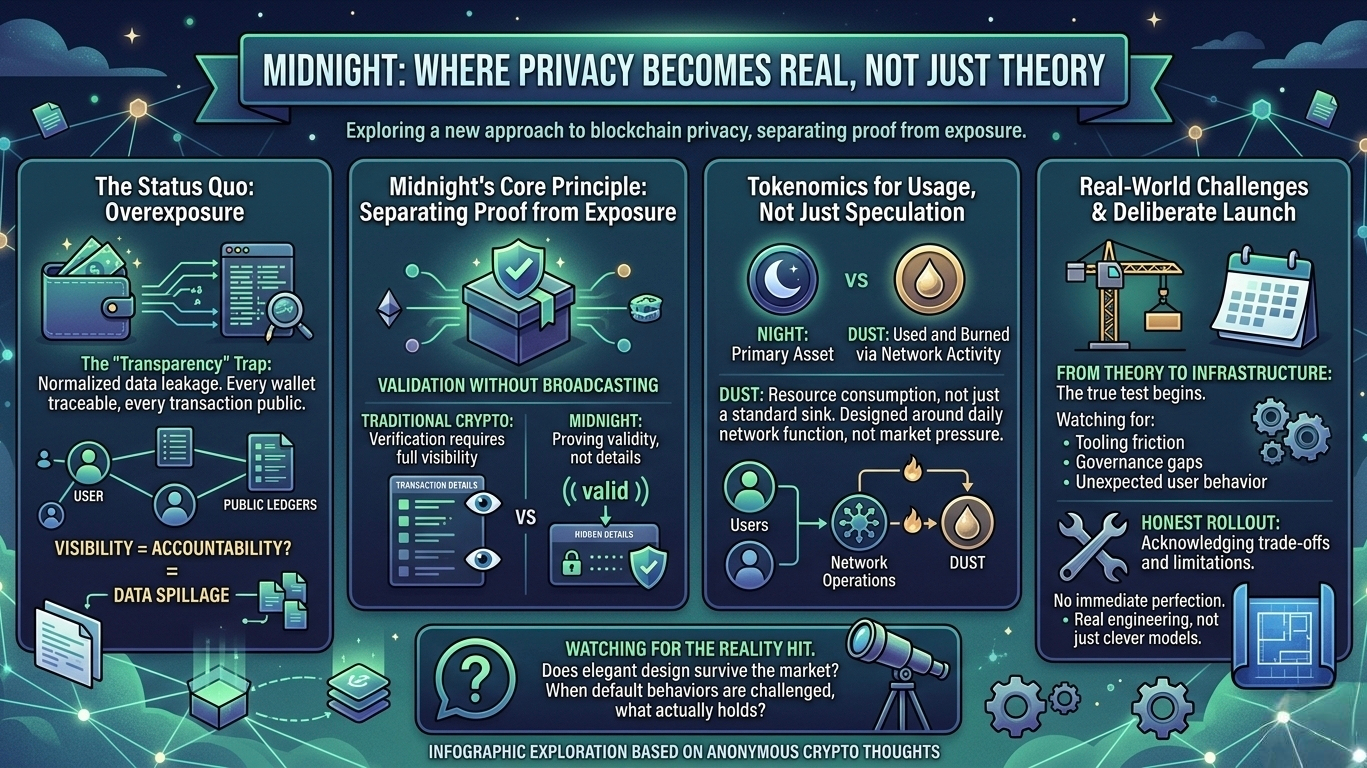
After years in crypto, I’ve seen countless projects dress up the same old problems and label them as progress. Same mechanics, slightly cleaner branding, louder marketing—but underneath, it’s the same friction in a shinier package. That’s why Midnight stands out to me. It doesn’t ignore the flaws of the world it’s entering; instead, it seems determined to tackle one of the most persistent issues: the false equation of transparency with privacy.
Most chains have normalized overexposure. Every wallet is traceable, every transaction public, every interaction lingering indefinitely on the network. People call it “transparency,” as if mere visibility automatically ensures accountability. But over time, it often feels more like leakage—sensitive information spilling where it shouldn’t, and the act of verification becoming indistinguishable from broadcasting it. That’s exactly the challenge Midnight is trying to solve.
I don’t see it as a project trying to make everything disappear. That would be easier to dismiss. What Midnight seems to be doing is subtler: separating proof from exposure. Something can be valid without revealing every detail of the process behind it. It sounds obvious once you say it out loud, but crypto has spent years conflating verification with visibility. They are not the same—and Midnight appears to understand that distinction.
Part of what keeps me paying attention is its token design: NIGHT and DUST. NIGHT acts as the primary asset, while DUST is what gets burned through network usage. This isn’t the standard spend-and-sink token model; it feels more like drawing down a resource as the system functions. I’ve seen plenty of tokenomics that look impressive on paper but are essentially recycled pressure systems with prettier diagrams. Midnight’s approach, by contrast, shows that someone thought about the daily experience of using the network—not just how holders interact with it in the market.
That doesn’t mean the network will be flawless. Early rollouts rarely are. The real test isn’t whether the model sounds clever on paper—it’s how it behaves under real-world conditions. Will users encounter friction? Will ordinary interactions turn into paperwork? Many projects fail at this stage, not because the concept was bad, but because execution can’t match theory.
I also respect how Midnight is approaching its launch: controlled, deliberate, and honest about limitations. It doesn’t claim instant decentralization or perfection. There’s no theatrical slide claiming the rollout is ethically “pure.” The team acknowledges that structure always comes with trade-offs—and that being upfront about them is part of real engineering.
Here’s the critical tension: the project is built around privacy, scoped disclosure, and protected data. That means the moment it transitions from idea to infrastructure, I’m watching closely for the first cracks. Not because I want it to fail, but because experience teaches suspicion of anything that looks too clean before launch. Elegant systems often get chewed up by reality: tooling friction, unexpected user behavior, hidden central points, or governance gaps. The market often notices only when it’s too late.
Despite these challenges, Midnight doesn’t feel like mere recycling. It feels deliberate and thoughtful—the kind of project that recognizes crypto has spent years confusing openness with usefulness. Trust doesn’t require exposing every underlying detail, and Midnight is building a system around that principle.
This approach keeps me coming back, even if I’m not fully convinced. Because if Midnight is right, it exposes a bigger truth: much of what this market treated as normal was never functional—it was just default behavior, and defaults can persist for years until someone builds around the damage they cause.
I don’t think the story is settled. I don’t think the hard part has even begun. But every time I look at Midnight, I come back to the same question: when theory stops protecting the network, when reality hits, what actually holds?
Watching. Not yet convinced. But definitely watching.
@MidnightNetwork #night #NİGHT #NIGHT $NIGHT
