
the digital world runs on a quiet contradiction.
the more applications talk about better experiences, the more data users are asked to hand over. what gets called convenience often comes with an old price, control moves out of the user’s hands.
this paradox does not exist only in web2. even in crypto, data still gets pushed toward 2 extremes. either it is opened up to make verification easier, or it is sealed tightly to protect privacy. both directions make sense, but both still leave a sense of something missing.
too much transparency, and the user is exposed.
too much opacity, and the application becomes rigid.
the hard part is finding a way for data to remain useful to the application without being treated as raw material that is automatically absorbed by the system. this is where Midnight Network made me stop and pay attention.
put simply, an application does not always need to see the full original data in order to work. in many cases, what it needs is just 1 proof that is sufficient to confirm a condition. old enough. authorized enough. qualified enough. transaction valid.
when a system only needs to know that a condition has been met, it does not need to keep the whole record. when an application only needs to verify a state, it does not need to collect the full history. Midnight Network becomes interesting because it turns that logic into the basis of its architecture.
the reason this matters is that the internet still runs on a rough default. if you want better service, you share more. if you want to be trusted, you reveal more. Midnight Network suggests a different default, one where access to data is more tightly limited and tied to a specific purpose.
to me, that is what separates this project from many systems that simply wear the privacy label. privacy on its own is not enough. if a system only focuses on hiding, applications become hard to coordinate. but if it only optimizes for inspection, it easily slips into a model where everything can be seen.
imagine an application that used to request 10 data fields just to unlock 1 basic function. if a new architecture allows it to check only the condition that matters, then everything else no longer has to leave the user’s hands. that difference is not just efficiency. it is a shift in the balance of power between the user and the application.
the utility of Midnight Network, at least to me, is not about adding more features. its utility is about allowing applications to operate with the minimum amount of data required. that restraint may turn out to be more durable in an environment that is becoming increasingly sensitive to the question of data.
if data can be used in a more selective way, then reusability changes as well. instead of every platform collecting the same kind of information and building its own silo, we can imagine a model where a proof can be checked across 3 different contexts without copying the entire original dataset.
from the user’s side, the value may lie in no longer being forced to choose between convenience and privacy. most users do not care much about architecture. they simply remember that every time they click confirm, they lose another small part of control.
but this is where the pace should slow down.
i do not think this direction is easy. for a model like this to be accepted, it demands a new kind of trust. developers have to believe that they do not need to see everything in order to build a good product. businesses have to believe that control does not automatically mean maximum retention. users also have to believe that a limited proof can still be trustworthy enough.
Midnight Network may be right in direction, but being right in direction does not mean the road is easy. markets usually reward what is quick to deploy, easy to learn, and early to scale. that is the real cost of any architecture that asks people to think differently.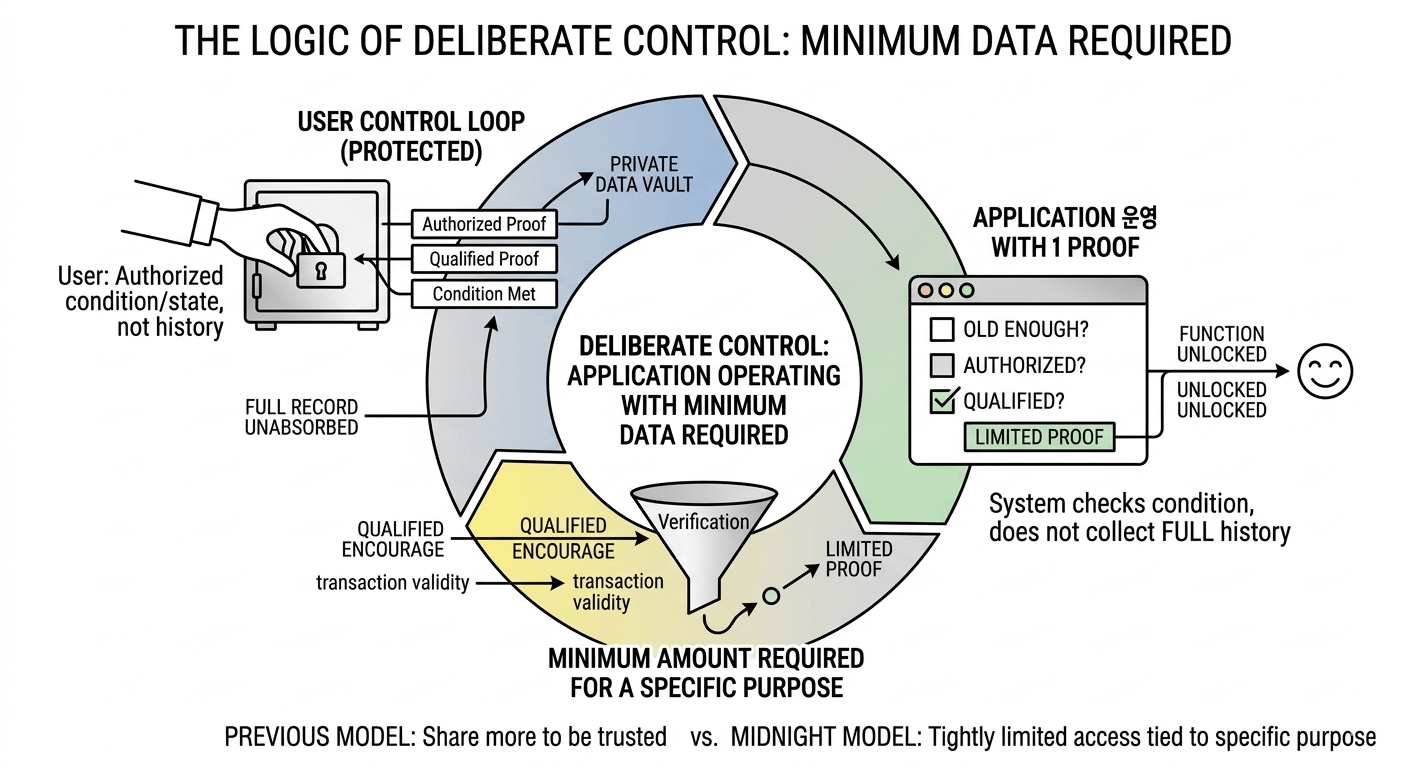
to me, that is the biggest test. not whether Midnight Network has an elegant thesis, but whether that thesis can actually enter real behavior.
looked at more broadly, this is not just a crypto story. it connects to how the internet matures after a long phase of growth driven by collection. it connects to how businesses balance compliance and user experience. it connects to how markets rethink the relationship between openness, responsibility, and control.
i do not see Midnight Network as a final answer. there is still a great deal that needs to be tested, from the smoothness of the experience to the willingness of developers to adopt it at scale. but i do think the project is touching a very real fault line.
because perhaps a more mature phase of the internet will not follow the logic of default openness, nor the logic of absolute closure. it may follow the logic of deliberate control, where data is revealed only in the part that needs to be revealed, for the right purpose, at the right time. if Midnight Network contributes to that shift, even by only 60 percent, that contribution is already meaningful.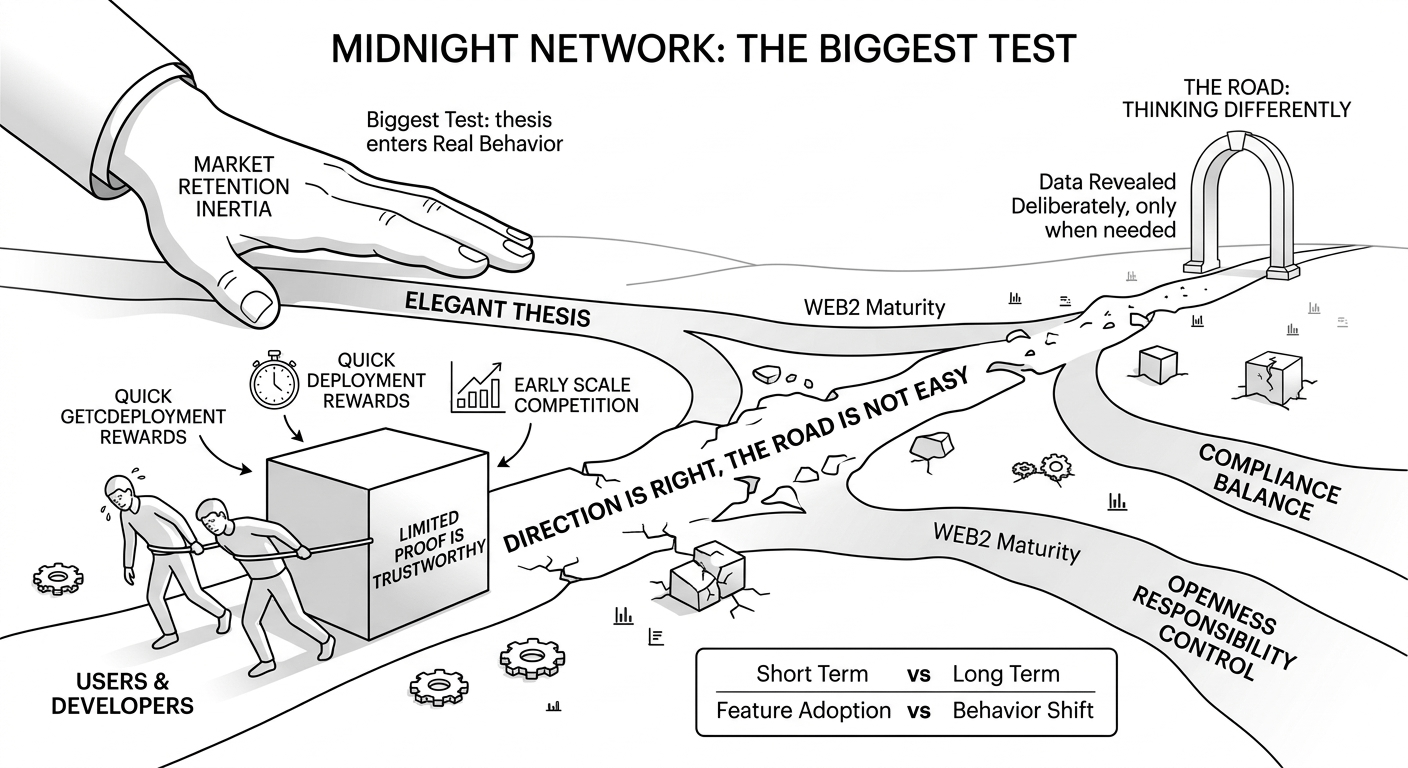
@MidnightNetwork #night $NIGHT
$SIREN $BULLA #TrumpConsidersEndingIranConflict #BinanceKOLIntroductionProgram #OpenAIPlansDesktopSuperapp