

Yesterday Evening just a few hours after the ShieldUSD Preview deployment window quietly closed, I found myself staring at transaction tracess instead of sleeping. The claim activity had already slowed, but the network still carried that quiet signal yo only notice when something real has just been tested. I kept circling back to a cluster of contract interactions fragments repeating in a pattern that didn’t look like retail noise. Gas stayed stable, almost unnaturally calm, and the transfer flows came in structured batches rather than scattered bursts. It felt less like a public chain under stress and more like a controlled environment where institutions were rehearsing something they intend to scale laterre.
At one point while simulating a private execution flow using Compact, I hit a pause that didn’t immediately make sense. The transaction didn’t fail, it did not revert, it just held in place longer than expected, as if waiting for something unseen to resolve. That moment stayed with me because it did not feel like inefficiency. It felt deliberate. @MidnightNetwork is not optimizing for speed in the way most chains do it’s optimizing for correctness under privacy constraints. That distinction becomes very real when you are the one waiting on a state transition that you can not fully observe.
What I’m seeing across Midnight is not a simple stack of features but a loop that feeds into itself. The dual-token structure, with DUST powering private execution and NIGHT governing the system, creates a circular dynamic where usage influences governance and governance reshapes usage. The technical layer reinforces this loop through zero-knowledge proofs that separate identity from transaction data, while Compact loweras the barrier for developers who would otherwise never touch cryptographic systems. And then there’s the governance reality, where a small, known set of operators currently runs the network. That layer feeds back into everything else because infrastructure visibility directly impacts how privacy is perceived, especially by institutions that operate under regulatory oversight.
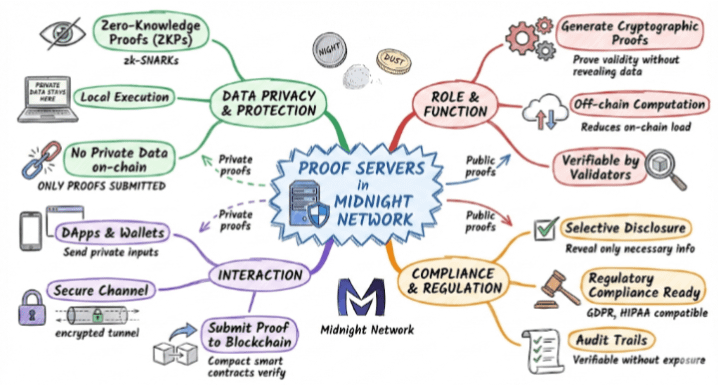
When I mentally place Midnight next to systems like Fetch.ai or Bittensor the contrast becomes sharper. Those networks lean into openness and emergent participation, whereas Midnight feels intentionally constrained, almost engineered to balance privacy with accountability. It’s not trying to be the most decentralized system from day one. It’s trying to be the most usable private system for entities that cannot afford ambiguity.
The honest part I keep returning to is the gap between design and operational reality. The zero-knowledge architecture is sound, and on paper it ensures that node operators cannot access shielded transaction data. But the network today is still run by a small group of identifiable operators, and that concentration introduces a different kind of pressure. Not a technical one, but a legal and coordination-based one. Every blockchain faces this to some degree, but Midnight’s federated starting point makes that exposure more visible and, in some ways, more immediate.
I don’t think this undermines the project. If anything, the transparency around this transition phase is one of the more credible signals I have seen in recent launches. But it does make the timeline toward decentralization feel like the single most important variable in the entire system. Everything else privacy guarantees, institutional adoption, developer trust ultimately loops back to how quickly and convincingly that transition happens.
What I’m left thinking about isn’t just the architecture or the token model, but the people who will build on top of this. The developers who are drawn in by the simplicity of Compact, the teams experimenting with private financial primitives, the users who may never understand zero-knowledge proofs but will depend on them anyway. Midnight is asking them to trust a system that is still in the process of becoming what it promises to be, and that creates a subtle tension that doesn’t resolve easily.

I keep wondering where that moment is, the one where a network like this stops feeling like a controlled experiment and starts feeling like neutral infrastructure. And more importantly, whether the builders already stepping in will recognize when that shift actually happens, or if they will simply have to trust that it did.
