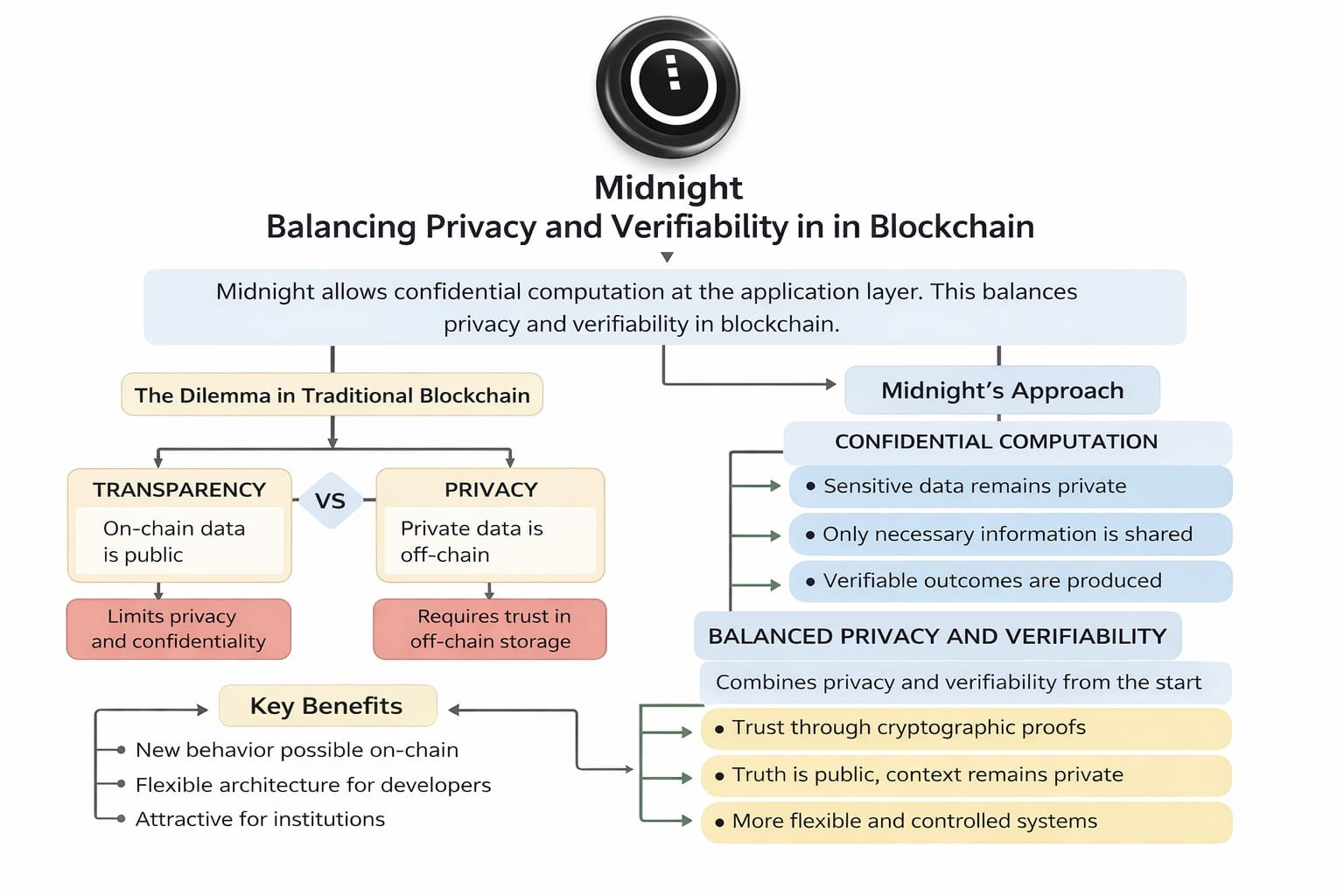
I tend to judge blockchain platforms by a simple idea: what new behavior do they make possible? Not just improvements in speed or cost, but something fundamentally different in how people can build and interact. With Midnight, the interesting shift comes from confidential computation living directly at the application layer.
Most builders today work within a pretty rigid structure. If data goes on-chain, it’s public. If it’s private, it usually lives off chain, which means you have to trust whoever is holding it. That split has always felt awkward. It forces developers to choose between transparency and privacy, even when neither extreme really fits the problem. Midnight tries to soften that divide by allowing computation to remain private while still producing outcomes that anyone can verify. It’s not about hiding everything — it’s about sharing only what’s necessary.
That changes how trust is constructed. Instead of transparency acting as the default proof of honesty, cryptographic guarantees take that role. Users don’t need to reveal their raw data; they just need to show that certain conditions are satisfied. It’s a different way of thinking about participation. You’re not exposing information, you’re proving something about it.
From an engineering perspective, this introduces a new layer of decision making. Builders aren’t just writing logic anymore. They’re deciding what should be proven publicly and what can stay hidden. That adds complexity, but it also expands the design space. Applications start to feel less like open ledgers and more like controlled environments where information flows intentionally.
One way I keep coming back to it is this: Midnight allows truth to be public while context stays private. The outcome of an interaction is verifiable, but the details behind it don’t have to be exposed. That’s closer to how high-value systems work outside of crypto. Financial institutions, enterprises, even simple business agreements all operate on selective disclosure. Midnight brings that dynamic into a blockchain environment without losing verifiability.
This also lines up with a broader shift in the market. As more institutional players enter the space, full transparency becomes harder to justify. Not everything should be visible to everyone. Trading strategies, sensitive data, and proprietary logic all benefit from confidentiality. Privacy starts to look less like an extra feature and more like something foundational. Midnight seems designed with that reality in mind.
Of course, there’s friction. Confidential computation introduces overhead, proofs take time to generate, and developers need to learn new mental models. There’s also a philosophical divide in the community. Some still see transparency as non negotiable, and any move toward privacy raises concerns. Those tensions won’t disappear overnight.
Still, the direction feels meaningful. Midnight doesn’t just tweak existing patterns it opens the door to a different one. Instead of forcing builders to choose between privacy and verifiability, it lets them combine both from the start. That changes the conversation entirely.
In the end, what stands out is the flexibility it gives builders. They can design systems where outcomes are trustworthy without exposing everything behind them. That ability to separate truth from context might seem subtle, but it shifts how applications can be built. And once that shift takes hold, the transparency versus privacy debate starts to feel less like a constraint and more like an outdated assumption.@MidnightNetwork #night $NIGHT