
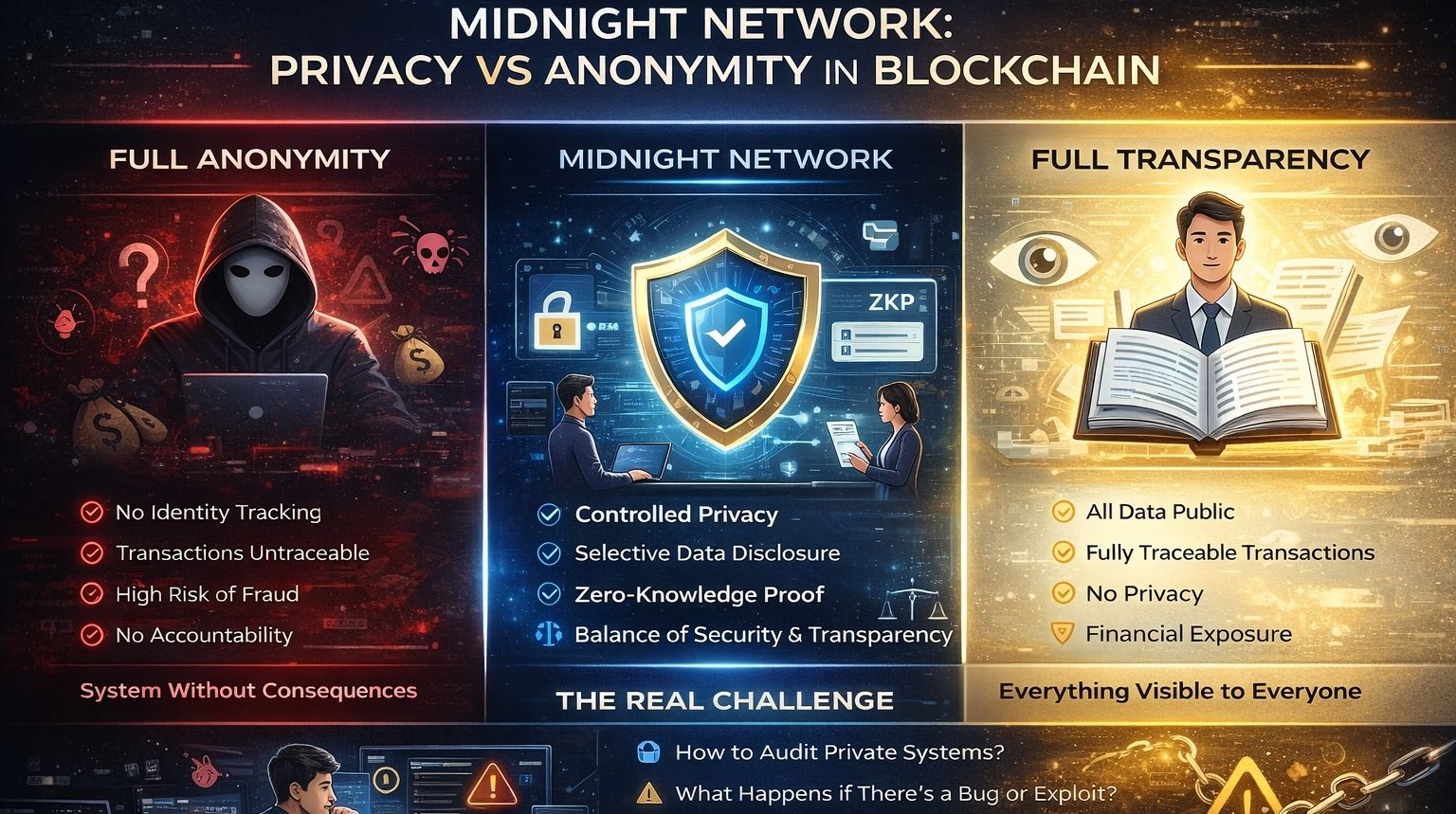
I’ve been thinking a lot about privacy in blockchain lately, and honestly, what Midnight Network is trying to solve feels incredibly real.
Blockchain, up until now, has leaned heavily toward transparency. And for simple transactions, that works. Sending crypto? No problem. But when it comes to sensitive areas like personal finances or business data, that level of openness starts to feel uncomfortable.
Just imagine this for a second: your salary, your company’s revenue, or your financial activity—completely visible on a public ledger. That’s not just transparency… that’s exposure. And for most people, that’s a line they’re not willing to cross.
This is where Midnight Network introduces a more balanced idea: not full anonymity, but controllable privacy. And that distinction matters more than most people realize.
Privacy and anonymity are not the same thing.
Privacy means your data is protected, but can still be revealed under the right conditions. Anonymity, on the other hand, removes identity entirely—no trace, no accountability. And while that sounds appealing on the surface, it creates serious risks.
Because let’s be honest—if everything is fully anonymous, what happens when things go wrong?
Fraud, stolen funds, illegal activity… if no one can trace anything, then who takes responsibility? A system with zero accountability quickly becomes dangerous. It stops being trustless and starts becoming lawless.
But the opposite extreme isn’t ideal either.
A fully transparent system means everyone can see everything. And in reality, people don’t want their financial lives exposed to the world. Transparency without boundaries becomes intrusive.
So naturally, the real solution seems to lie somewhere in the middle.
That’s exactly the space Midnight Network is trying to explore, mainly through the use of Zero Knowledge Proof. The idea is simple in theory but powerful in practice: prove something is true without revealing the underlying data.
For example, instead of exposing your entire financial history to get a loan, you could simply prove that you meet the required criteria. It’s like showing that you qualify—without handing over every detail behind it.
That approach feels far more aligned with how the real world works. We don’t operate on extremes of full secrecy or full exposure. We operate on selective disclosure.
But even with all these advantages, I still have some doubts.
What happens when something breaks?
In traditional transparent blockchains, everything is visible. That visibility, while messy, allows anyone to audit, investigate, and learn from failures. It creates a system where issues can be traced and understood openly.
In a privacy-focused system, that process becomes much harder.
If a bug appears, or if the system is exploited, how do you fully investigate it without access to the underlying data? And more importantly, who verifies the truth in those situations?
This is where an uncomfortable question comes in: are we reintroducing trust?

Crypto was built on the idea of minimizing trust—removing reliance on centralized actors and replacing it with verifiable systems. But if privacy limits verification, does that shift trust back toward developers or system designers?
That doesn’t mean the approach is flawed. In fact, it might be necessary.
Use cases like healthcare, digital identity, and enterprise finance simply cannot function on fully transparent systems. Sensitive data needs protection—there’s no debate there.
But the real challenge is deeper:
How do you build a system that preserves privacy, while still allowing meaningful auditing when it matters?
That balance is incredibly difficult to achieve, and it’s something the entire industry is still figuring out.
Personally, I don’t think the future belongs to complete anonymity or total transparency. Neither extreme fits the complexity of the real world.
Instead, the future likely sits somewhere in between—a space where privacy is the default, but accountability is still possible when required.
And while I do lean toward privacy, I can’t ignore the trade-offs. Because at the end of the day, security and trust need to coexist—and getting that balance right is far from simple.
So the real question is:
What matters more to you—complete openness, or controlled privacy with a bit of uncertainty?