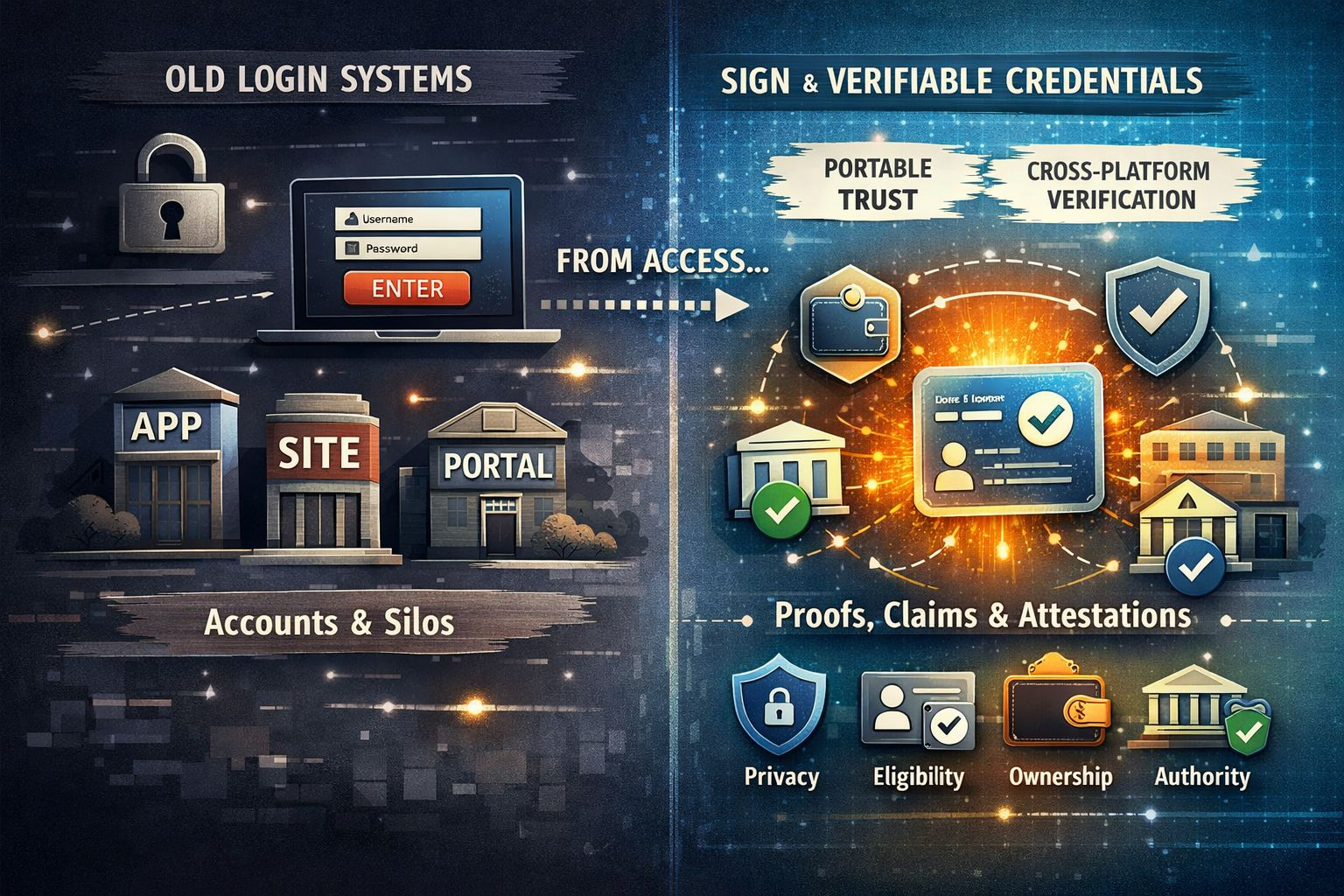
From what I’ve observed, the internet is moving into a phase where access is no longer the main issue. Trust is. That’s the shift I keep coming back to when I think about SIGN. For years, digital systems were built around the idea that if a user could log in, the important part was already solved. I don’t think that assumption holds anymore. A login can open an account, sure, but it cannot carry trust across ecosystems, prove a claim with precision, or verify something meaningful without forcing people to hand over far too much data. That is exactly why SIGN feels relevant to me. It is not just trying to improve identity on the internet. It is trying to rebuild the way verification itself works.
When I look at traditional login systems, I see a structure that belongs to an older internet. Logins were designed for closed platforms. They were built for apps, websites, portals, and services that wanted to manage their own users inside their own walls. The idea was simple: create an account, store the user record, verify access, and maintain the relationship inside that system. That model made sense when digital interactions were mostly platform-based and self-contained. But that’s not the internet we’re moving toward now. What I see instead is an internet that is increasingly connected, layered, composable, and cross-platform. In that environment, being able to sign in is useful, but it’s no longer enough.
$SIGN stands out here because it is built around credential verification and attestations, not just around access. That difference matters more than people think. A login tells a platform that someone controls an account. SIGN’s model is far more powerful because it deals with proofs, claims, evidence, and verifiable statements. In practical terms, that means the system is not limited to asking, “Can this user enter?” It can help answer much more valuable questions: Can this person prove eligibility? Can this wallet prove ownership? Can this organization prove authority? Can a credential be verified without exposing everything behind it? Can trust move from one environment to another without starting from zero every single time?
That, to me, is the real future internet question. Not access, but proof.
I think this is why SIGN feels much more aligned with where the web is heading than ordinary login infrastructure. The next generation of digital systems will not be built around endless account creation. They will be built around portable trust. Users, communities, organizations, and networks will need to verify meaningful claims across multiple environments. They will need systems that can confirm identity-related facts, authorizations, qualifications, and participation without forcing every interaction into a giant centralized profile. SIGN is relevant because it treats verification as a core digital primitive, not as a side feature attached to an account.
@SignOfficial What I find particularly compelling is that SIGN does not frame verification as a narrow identity problem. From my perspective, it frames it as infrastructure. That’s a much stronger idea. Identity on the future internet won’t work well if it remains trapped inside isolated applications. It has to become part of a broader trust layer where claims can be issued, checked, and reused. This is where SIGN’s attestation model becomes important. An attestation is not just a login event. It is a structured statement that can be referenced, verified, and trusted in context. That changes the quality of digital interaction. Instead of depending only on platform-controlled accounts, the internet can begin to work with reusable proofs.
And honestly, I think that changes the balance of power too.
The login model gives platforms enormous control over digital legitimacy. They own the account. They store the identity data. They define what counts as verification. They decide what trust signals matter within their own environment. If a user leaves, much of that value stays behind. Reputation stays behind. Verified status stays behind. Access history stays behind. For me, that has always been one of the biggest limitations of the modern web. We built a digital world where people create value, but the proof of that value is often controlled by the platforms that host it.
SIGN points in a different direction. It suggests that verification should not remain trapped inside private silos. Instead, trust should be able to move with the user, the institution, the wallet, the contributor, or the system that actually holds that trust relationship. That’s a huge conceptual improvement. It means the internet can begin shifting away from platform-owned identity and toward verifiable, portable, inspectable claims. I think that’s one of the strongest reasons SIGN feels more future-ready than login systems do.
Privacy is another area where this difference becomes impossible to ignore. In the login-based web, users are constantly asked to overshare. A service asks for a full account setup, then another asks for the same thing, then another. Email, phone number, password, recovery info, personal details, identity documents, profile data. The same data gets copied over and over across systems that may not even need most of it. From what I’ve seen, this creates a web full of identity duplication, unnecessary exposure, and constant risk. The worst part is that it gets treated like normal digital behavior.
SIGN matters because its model is much closer to minimal disclosure than the standard account model. That’s a big deal. In a healthier internet, a system should be able to verify only what is relevant. It should be able to confirm a claim without demanding an entire identity package. That is exactly the kind of shift credential-based infrastructure can support. Instead of asking users to reveal everything, systems can verify a specific fact or condition. That approach is cleaner, safer, and much more appropriate for a world where privacy is becoming a structural requirement rather than a nice extra.
I also think SIGN is more aligned with the future because the internet is becoming increasingly machine-readable. It is no longer just a human clicking from page to page. More digital actions now involve workflows, automation, smart rules, token systems, programmable distributions, governance processes, and software-driven verification logic. In that kind of environment, logins are too shallow. They can start a session, but they do not carry enough meaning to support more advanced trust decisions. Systems need structured proofs they can evaluate. They need claims that can be checked, referenced, and enforced without rebuilding trust every time. That is where SIGN feels much more useful than a standard authentication layer.
This is especially obvious when I think about token distribution and digital allocation systems. In many ecosystems, distribution is not just about sending assets. It is about sending them to the right people under the right conditions. Eligibility matters. Identity conditions matter. Compliance may matter. Participation records may matter. Reputation or role may matter. A login alone cannot solve that. A wallet connection alone cannot solve that either. What matters is whether the system can verify the relevant conditions with clarity. SIGN’s broader infrastructure vision makes sense here because it links credential verification with distribution logic. That creates a much stronger trust model than an ordinary platform login ever could.
The same logic applies to digital identity more broadly. A login proves account control. SIGN’s infrastructure is more concerned with whether a claim can be trusted, whether an action can be evidenced, and whether a system can verify what happened under a known structure. That is a more advanced digital foundation. It supports not only participation, but accountability. Not only access, but validation. Not only entry, but evidence. I think that distinction becomes more important as the internet moves into higher-stakes environments where people and institutions need stronger digital trust guarantees.
What makes this even more interesting to me is that SIGN does not sit comfortably inside the old categories. It is not just a login product. Not just an identity registry. Not just a token tool. Not just a signature system. From my observation, its real value comes from how these trust-related functions connect. That is what makes it more relevant to the future internet. It treats verification as something operational. Something infrastructure-level. Something that can support identity, distribution, authorization, proof, and recorded trust across multiple layers. That kind of architecture feels much more durable than the old model where every platform creates its own isolated account universe and calls it identity.
I keep coming back to one idea: the internet ahead will care less about where you signed in and more about what you can prove. That single shift explains why SIGN matters. A person may need to prove they belong to a specific group. A contributor may need to prove a role. A wallet may need to prove eligibility. A system may need to prove that a distribution followed an approved rule. An organization may need to prove authority over an action. These are not login questions. They are verification questions. And the systems that solve verification well will shape the next phase of the internet more than the systems that merely manage accounts.
This is also why I think SIGN feels more relevant than a lot of projects that still frame digital identity too narrowly. The problem is not simply that identity online is inconvenient. The problem is that digital trust is fragmented, repetitive, overexposed, and often controlled by the wrong layer. Login systems solve convenience in a limited way. SIGN aims at something deeper. It addresses how digital claims are formed, how they are trusted, how they are checked, and how they can support real interaction across ecosystems. That is a much bigger ambition, and in my view, a much more necessary one.
Of course, login systems will not disappear. I don’t think that’s realistic. Accounts will still exist. Authentication will still matter. Services will still need ways to control access and secure sessions. But I see those systems becoming more basic, almost secondary. The higher-value layer will be verification. The real internet of the future will depend on who can prove what, under which authority, with how much privacy, and with what level of portability. That is the terrain where SIGN becomes important.
So when I ask myself whether SIGN is actually related to the idea that verifiable credentials matter more than login systems, my answer is simple: yes, deeply. In fact, I’d go further. From my own observation, SIGN only makes full sense when viewed through that lens. It is not just about replacing one sign-in method with another. It is about moving the internet beyond login as the center of trust. It is about building a world where digital interactions rely on verifiable claims, structured attestations, and reusable evidence rather than on bloated account silos. That is why SIGN feels less like a feature for today’s web and more like infrastructure for what comes next.
And that, for me, is the strongest point of all. The future internet will not be defined by who managed to enter a platform. It will be defined by who can prove something meaningful without surrendering everything else. Login systems were built for access. SIGN is built for trust. In the internet that is coming, trust will matter more.