

The hardest problem I faced in Web3 was not gas fees or scaling. It was something much more frustrating. Deciding who actually deserves something… and doing it without everything turning into chaos. It sounds simple until you try it yourself.
I’ve run programs where things start clean. Clear rules, proper structure, everything looks organized. Then suddenly submissions increase, data spreads everywhere, spreadsheets break, and you’re stuck late at night checking wallets and profiles one by one. Even after all that effort, mistakes still happen. Wrong people get rewarded, real contributors get missed, and you end up questioning your own system.
I tried solving it off-chain. That became messy. I tried solving it on-chain. That became rigid. Hardcoding rules into contracts feels good at first, but the moment conditions change, everything breaks. You either rebuild from scratch or patch things in a way that slowly becomes unmanageable.
That’s when my perspective shifted.
Instead of trying to build one perfect system, what if the system didn’t need to “decide everything” on its own?
That’s where Sign started to feel different to me. It doesn’t force everything into one structure. It lets you define conditions as proofs. Simple idea, but powerful. Instead of saying “this contract decides everything,” you say “this must be true, and here is the proof.”
That small shift changes how you build.
Take a simple example. Instead of manually reviewing who deserves a grant, you define eligibility through signals. Someone has proof of contribution. Someone is verified by another builder. Someone completed a task. These are not guesses. These are verifiable pieces of information. Your system just checks them.
No manual filtering. No messy spreadsheets. No last-minute confusion.
At first glance, it feels like a small improvement. But when you’ve experienced the pain of broken systems, it feels like a huge difference. You are no longer rebuilding logic every time. You are using existing proofs and letting the system respond to them.
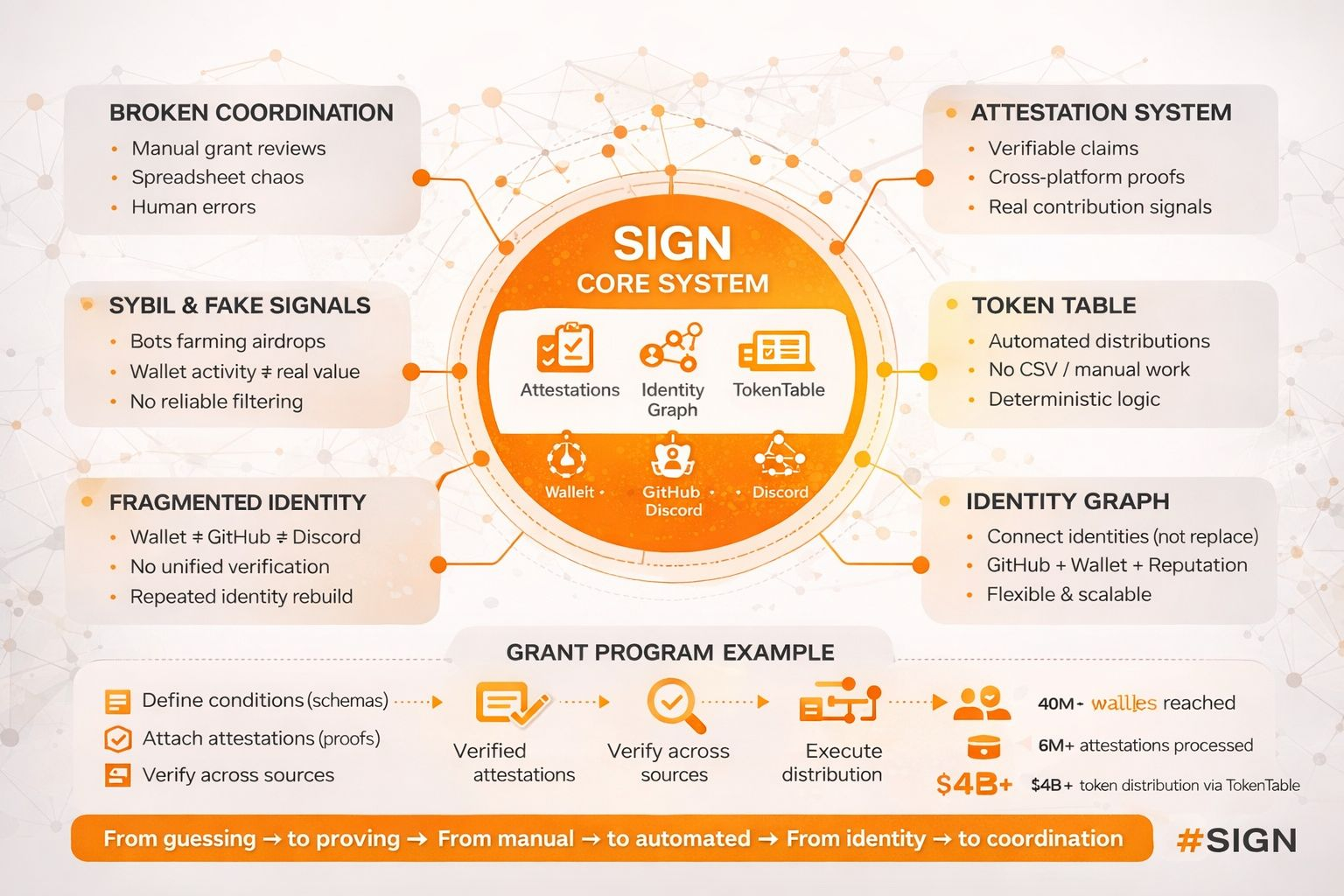
Another thing I like is how it treats identity. It doesn’t force you into one single profile. I’ve seen that approach fail too many times. Instead, it connects pieces. Your wallet, your work, your contributions, your reputation. All separate, but linked through proofs. It feels more natural. You don’t restart your identity every time. You build on top of what already exists.
And when I think about the future, this becomes even more important.
AI agents are starting to interact with blockchain systems. They won’t just need balances. They will need context. They will need to know if something is trustworthy, if a condition has been verified, if an action should be allowed. Right now, that context is missing. Systems either trust blindly or rebuild logic again and again.
Something like Sign could carry that context forward. Instead of rechecking everything, the system can rely on existing proofs. That changes how automation works.
But I’m not blindly optimistic.
There are real questions here. Who decides which proofs matter? Who issues them? What happens when bad actors try to game the system? Because they will. And if too much power ends up with a few verifiers, we risk creating new gatekeepers, just in a different form.
So I see this as progress, not perfection.
For me, the value of Sign is not that it “fixes Web3.” It doesn’t. But it gives a way to handle complexity without everything breaking the moment conditions change. And after years of dealing with messy processes, rigid contracts, and unreliable systems…
That alone feels like a meaningful step forward.