

I’ll be honest, one of the most frustrating decisions I keep facing as a builder is not about speed or cost. It’s about choosing between making something useful… or keeping it private. And the worst part is, you usually can’t have both.
If I build on a fully transparent chain, everything is exposed. Every transaction, every user interaction, every piece of data sits there forever. But the moment I try to protect that data, things become complicated fast. Complex cryptography, difficult tooling, and suddenly the whole project becomes harder to build than it should be. After a while, it starts feeling like this trade-off is just part of Web3.
And honestly, I don’t think it should be.
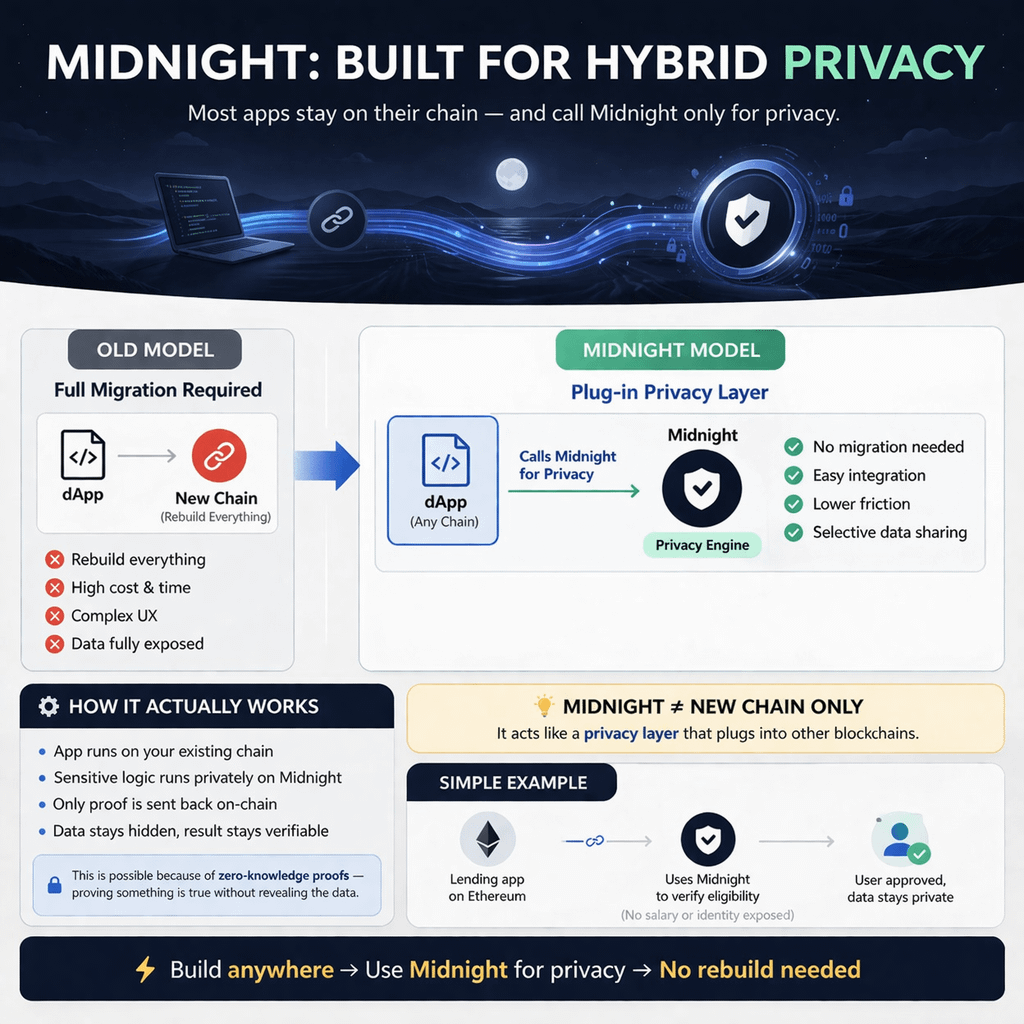
That’s exactly why Midnight started to feel different to me. Not because it’s another chain or another token, but because it looks at the problem in a more realistic way. It doesn’t try to make everything private. It tries to make privacy controllable.
That idea sounds small, but it changes everything.
Instead of hiding all data, Midnight focuses on proving things without exposing unnecessary details. You don’t say “trust me.” You say “this condition is true,” and the system verifies it without revealing everything behind it. It’s a shift from secrecy to selective proof.
Let me give you a simple example. Imagine applying for a loan in a decentralized app. Normally, you would have to reveal your full financial history. With this model, you could simply prove that you meet the requirements without exposing your entire balance or transaction history. The system confirms you qualify, but your private data stays private. That’s the kind of logic Midnight is trying to bring on-chain.
And from my experience, that’s exactly what real applications need. Most serious products can’t exist in a fully transparent environment. Financial tools, identity systems, even basic user platforms all deal with sensitive data. At the same time, going fully private creates problems with trust and compliance. Midnight sits right in that middle space where real systems actually operate.
What also makes it interesting is how it connects with Cardano. It’s not trying to replace it. It’s extending it. Cardano handles security and settlement, while Midnight handles privacy and computation. If this works the way it’s designed, it turns Midnight into a layer that other systems can rely on, not just another standalone network.
The token model is where things really clicked for me. At first, splitting into two tokens felt unnecessary. But then I thought about gas fees.
NIGHT is the main asset. It’s what people hold and use for governance. But instead of spending it directly, it generates DUST over time, and DUST is what actually pays for transactions. That means your usage is separated from market speculation.
For example, if you’re running an app and the token price suddenly doubles, your costs don’t suddenly explode with it. You’re using DUST, not directly spending the main asset. That makes costs more stable and predictable, which is something most developers struggle with today.
From a builder’s perspective, that’s a big deal. It means I don’t have to design around unpredictable fees or worry about users dropping off because interactions suddenly became expensive.
Another thing I like is how approachable the system feels. Midnight uses a TypeScript-like language called Compact. That might not sound exciting, but it matters. Most developers don’t want to learn complex cryptography just to build an app. They want tools they already understand. Midnight seems to understand that adoption doesn’t come from complexity, it comes from usability.
Of course, none of this guarantees success.
Privacy is one of the hardest problems in this space, especially when regulations come into play. If the system leans too far toward privacy, it risks rejection. If it leans too far toward transparency, it loses its purpose. Finding that balance is not easy. And even if the technology works, it still needs real applications to prove its value.
But when I zoom out, this doesn’t feel like another trend. It feels like a missing step.
We’ve already solved decentralization. We’ve built programmable systems. The next layer was always going to be privacy, but not the extreme version. The usable one.
That’s what keeps me thinking about Midnight.
Not full transparency. Not full secrecy. But the ability to choose what matters, and prove it when needed.
If that idea actually works in practice, it won’t just improve Web3.
It will quietly change how we build everything on top of it.