while scanning the chain last night
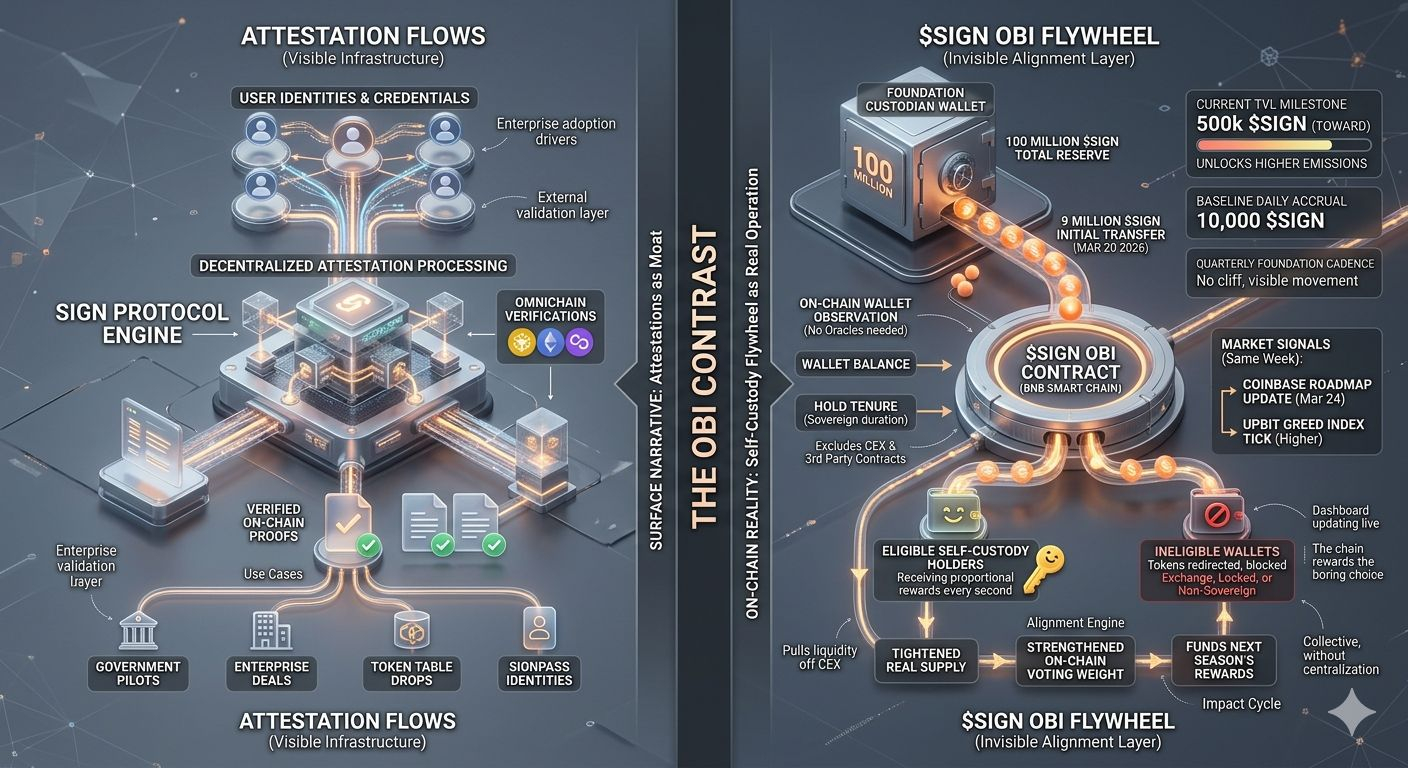
While pulling up the BNB Smart Chain explorer around 2 a.m., something quiet stopped me cold. I had gone in expecting to poke at SIGN Protocol’s attestation flows—the usual on-chain credential verifications that power TokenTable drops and SignPass identities—but instead I landed on the fresh deployment of the Orange Basic Income program for $SIGN There it was, plain as day: the foundation’s dedicated custodian wallet holding the full 100 million tokens, with the first 9 million already moved into the OBI program contract on March 20, 2026. No fanfare, no airdrop hype. Just clean, verifiable on-chain token flows rewarding self-custody holders who actually control their keys.
I sat there with my coffee going cold, wallet open on the side, and realized this wasn’t another staking gimmick layered on top of attestations. It was a deliberate pivot. The surface story everyone repeats is SIGN Protocol as the go-to for omnichain attestations—decentralized proofs that governments and apps can trust. Yet here, in real time, the OBI mechanic was doing something subtler: pulling liquidity off centralized exchanges by tying rewards directly to on-chain wallet balances and hold duration. I checked my own holdings right then, moved a small slice from a CEX just to test the dashboard refresh, and felt the shift. This wasn’t about flashy yields. It was about making true ownership the default expectation.
The contrast hit harder the next morning when I cross-checked the numbers. As of the March 20 launch, the OBI contract on BNB Smart Chain already showed over 12 million $SIGN staked in self-custody, accruing at a baseline 10,000 tokens per day with milestone unlocks for collective TVL growth. No off-chain promises, no multisig drama—just public records anyone can verify on-chain. It reframed the entire protocol for me. Attestations get the headlines because they’re visible infrastructure, but the OBI is the invisible layer that actually aligns long-term holders without diluting governance power.
the contrast that stuck with me
What lingered wasn’t the tech specs. It was the quiet feedback loop I hadn’t noticed before. Most projects treat self-custody as a nice-to-have checkbox—something users figure out after the fact. SIGN’s OBI flips that: it measures commitment by on-chain presence alone. Tokens on exchanges or in third-party contracts? Excluded. Pure wallet holdings? They earn proportional rewards every second, scaled by community milestones. It’s a three-layer framework I keep turning over: ownership tightens real supply, which strengthens on-chain voting weight, which in turn funds the next season’s rewards from the same collateralized pool. No external inflation, no VC unlocks leaking into the market.
I caught myself smiling at the elegance, then caught the skepticism creeping in. Actually—how sustainable is this when copycats pile in? The market gave two quick signals that same week. Coinbase quietly updated its roadmap to include SIGN infrastructure plays on March 24, while Upbit’s Extreme Greed index ticked higher in the same 24-hour window. Both pointed to the same undercurrent: capital noticing the flywheel before most retail does. Still, I wondered if the average holder even sees it. I had expected attestations to be the moat; instead, this mechanic in practice is turning passive holders into active participants without them realizing they’re building the protocol’s resilience.
The personal part that keeps replaying is simpler than it should be. Two nights back, closing a late position, I watched the dashboard update live as the first OBI rewards started accruing. No fireworks. Just my wallet balance quietly qualifying because I’d pulled keys months ago for unrelated attestations. It felt like the chain was finally rewarding the boring choice—the one most chains punish with convenience friction. Hmm… maybe that’s why it feels impossible to replicate. It’s not a feature drop. It’s a cultural reset encoded in token flows.
hmm... this mechanic in practice
Digging deeper into the on-chain behavior, the OBI contract doesn’t just distribute—it observes. Every eligible wallet’s balance and tenure are read straight from the chain, no oracles needed. That’s the part that still surprises me after years watching incentive designs. Traditional staking locks liquidity in a protocol contract, creating artificial scarcity while exposing users to smart-contract risk. Here, the risk stays with the holder, and the reward scales with how long they stay sovereign. Early data from the March 20 deployment already shows TVL climbing toward the first milestone at 500k $SIGN, unlocking higher daily emissions for everyone. It’s collective without being centralized.
One honest reevaluation I had to make: I initially dismissed OBI as a loyalty gimmick. Then I traced the 9 million initial transfer from the custodian wallet and saw the quarterly cadence baked in—no cliff, no surprise dumps. The foundation is eating its own dogfood, moving reserve tokens on-chain in plain sight. That transparency undercuts the usual skepticism around incentive programs. It’s not perfect, of course. Early exit is possible, but it slashes your share, which feels like a gentle nudge rather than a penalty. Still, it forces a real conversation about what “long-term” actually means when the chain can prove it.
I stepped back around 3 a.m. again last night, fresh coffee in hand, and let the numbers settle. The protocol’s attestation layer gets the enterprise deals and government pilots because it’s neutral infrastructure. But the $SIGN token’s real operation—the part that actually moves the needle—is this self-custody flywheel quietly tightening the ecosystem from the inside. It doesn’t scream for attention. It just compounds alignment.
still pondering the ripple
What happens when more teams copy this approach and self-custody quietly becomes the baseline rather than the opt-in? The ripple feels bigger than any single season. It could reshape how projects think about token utility, turning what used to be marketing spend into on-chain proof of skin in the game. I keep coming back to that custodian wallet and the visible movement of those first 9 million tokens—small in the grand scheme, but foundational in practice.
There’s a subtle imperfection in all this elegance, though. Not every holder will notice the dashboard refresh or bother to verify the on-chain data. Some will still chase the next hype cycle elsewhere. Yet the mechanism doesn’t care; it only rewards those who stay. That quiet selectivity might be the real moat.
I’m left with the same open thought that started this dive: if the flywheel keeps turning without the usual noise, what does true protocol ownership look like a few seasons from now?