

It usually happens around 2:07 a.m.
That’s the moment the spreadsheet stops making sense.
I’ve been there more times than I care to admit. Running a Web3 grant program sounds clean when you describe it in a tweet. Define criteria. Collect applications. Evaluate contributions. Distribute funds.
Simple, right?
Not even close.
What actually happens is a slow, stomach-turning descent into chaos.
First you get the submissions. Then you export everything into a Google Sheet because that’s the only place you can see it all at once. Wallet addresses. GitHub links. Discord handles. Some half working formula trying to rank people.
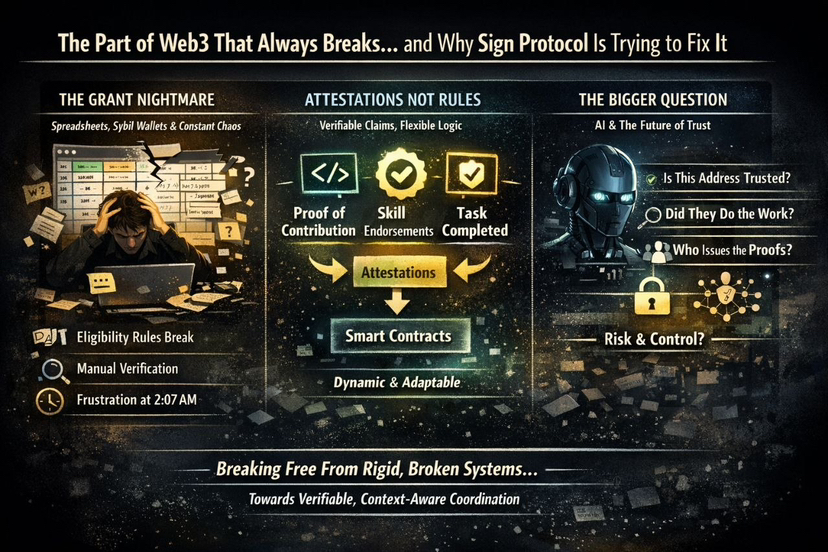
Then someone edits the sheet.
A column breaks.
Half the data becomes inconsistent.
And suddenly you’re staring at rows of wallets and usernames at two in the morning wondering who actually deserves funding.
I remember one grant round where I thought we had everything under control. Clear rules. Defined metrics. Automated scoring.
Two weeks later the whole thing was duct tape and caffeine.
Sybil wallets slipped through. Real contributors got overlooked. People started messaging asking why they weren’t selected. And the worst part?
Even after all that manual work… I still knew the system wasn’t fair.
This is the dirty secret of Web3 coordination.
Scaling isn’t the hardest problem.
Gas fees aren’t either.
The real nightmare is deciding who gets what… and proving the system didn’t collapse while making that decision.
And that’s where Sign Protocol started to make sense to me.
Not as another identity experiment.
Not as another Web3 reputation system that promises to solve trust forever.
Those usually end badly.
I’ve watched a dozen universal identity ideas crash into reality. People don’t want to tie everything they do into a single profile system that might change rules next year.
Too rigid. Too fragile.
Sign Protocol approaches the problem differently.
It doesn’t try to force everything into one massive rulebook.
Instead, it introduces something deceptively simple: attestations.
Think of them as verifiable claims.
Proofs that something happened.
Proof that someone contributed.
Proof that someone completed a task, received an endorsement, or met a requirement.
That sounds obvious… but it changes how systems get built.
Because instead of coding every possible rule directly into a smart contract which becomes brittle the moment conditions change you let the system reference external proofs.
That distinction matters more than people realize.
Let me go back to the grant example.
Normally the process looks like this:
You define eligibility rules inside a contract. Maybe it checks wallet activity. Maybe it checks a GitHub repo. Maybe it checks token balances.
But the moment those rules stop fitting reality… everything breaks.
Suddenly you need to update logic.
Redeploy contracts.
Patch exceptions.
And every patch makes the system uglier.
I’ve seen contracts that looked elegant on launch turn into Frankenstein’s monster within months.
With Sign Protocol, the logic shifts.
Instead of saying:
This contract determines eligibility.
You say:
These conditions must exist.
And those conditions are verified through attestations.
Maybe someone has an attestation proving they contributed to an open-source project.
Maybe another builder endorsed them.
Maybe they completed a course or hit a milestone.
Each of those signals exists independently.
But the distribution system can read them.
Combine them.
React to them.
Suddenly the process isn’t about manually verifying everything.
It’s about assembling verifiable truth from different places.
That removes a huge amount of friction.
You’re not rewriting logic every time something changes.
You’re just referencing new signals.
It sounds small.
It isn’t.
Because coordination real coordination is the hardest unsolved problem in Web3.
And the current alternatives are ugly.
Either you trust centralized operators to make decisions.
Or you hardcode rigid rules that break the moment the real world shifts.
Neither option scales.
Sign Protocol lives in the middle.
Messy. Flexible. Closer to how the real world actually works.
And honestly… that’s what makes it interesting.
But the part that really caught my attention isn’t even the grants use case.
It’s where this goes next.
AI agents.
They’re already starting to interact with on-chain systems. Slowly. Clumsily. But it’s happening.
And the big missing piece isn’t execution.
It’s context.
Right now an AI agent looking at a wallet basically sees numbers.
Balances.
Transactions.
Maybe some activity history.
But it doesn’t see reputation.
It doesn’t see contributions.
It doesn’t see whether the wallet behind those actions has ever actually done anything useful.
So every new system has to rebuild verification from scratch.
Every single time.
That’s inefficient.
And worse… it’s fragile.
Something like Sign Protocol creates a layer of verifiable context.
An agent could check attestations before executing something.
Did this address complete a verified task?
Is this contributor trusted by other builders?
Did this entity meet the requirements of a protocol?
Instead of blind trust or endless verification logic… the system just reads the proofs.
That’s a big shift.
But I’m not naive about it.
Because this is where the uncomfortable questions start.
Who gets to issue these attestations?
Which ones actually matter?
What happens when bad actors start gaming the system?
And they will.
Web3 incentives practically guarantee it.
If a handful of attesters become dominant, the whole model risks drifting toward something familiar.
Centralized gatekeepers.
Just with prettier tools.
That’s the tension.
Sign Protocol doesn’t magically restore trust in Web3.
Nothing does.
But it does offer a framework for handling complexity without collapsing every time the rules change.
And that alone is meaningful.
Because after years of watching Web3 coordination devolve into spreadsheets, patchwork scripts, and contracts that age like milk…
Seeing a system designed to handle evolving signals instead of rigid logic feels like progress.
Real progress.
Not the hype-cycle version.
The slow, slightly messy kind.
The kind that actually survives contact with reality.
Which leaves me wondering something I still don’t have a clean answer to…
If systems like Sign Protocol become the layer where reputation, verification, and contribution all get recorded…
who decides which signals count?
And what happens when those signals start shaping everything else in Web3?