For a long time, I assumed the hardest part of building systems was making the right decisions.
Define the logic.
Apply the rules.
Determine the outcome.
That always felt like the core challenge.
But the more systems interact with each other, the more another problem starts to surface.
It’s not that systems struggle to decide.
It’s that they keep deciding the same things over and over again.
A user performs an action once.
They participate, contribute, qualify under certain conditions.
That moment produces a decision somewhere:
yes, this counts.
But when that same user moves into another system, something resets.
The decision disappears.
The system starts again.
Does this qualify here?
Should this matter in this context?
The answer might end up being the same.
But the process is repeated.
This repetition feels normal.
But at scale, it becomes one of the biggest sources of friction in digital coordination.
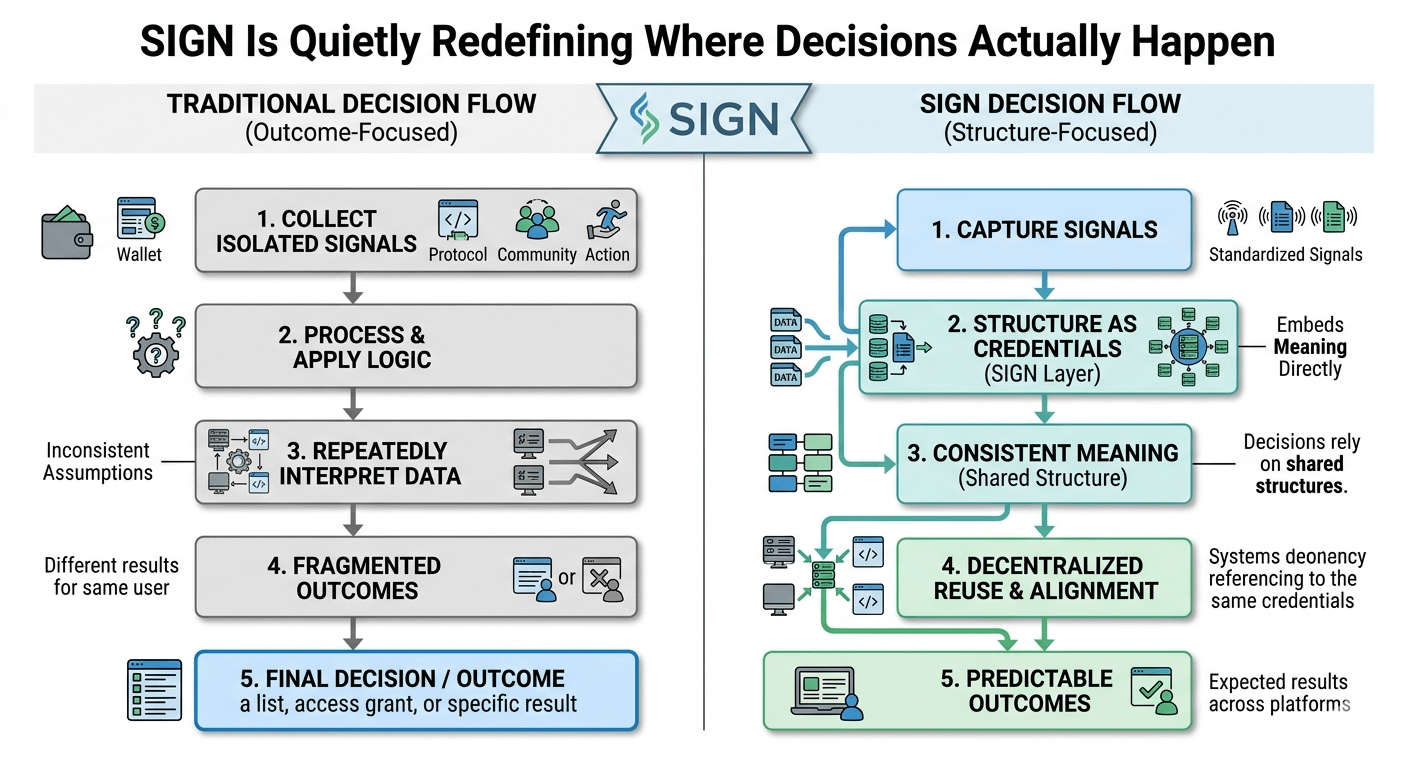
Developers rebuild the same logic.
Systems evaluate the same signals independently.
Users experience slightly different outcomes across platforms.
Nothing breaks completely.
But alignment slowly weakens.
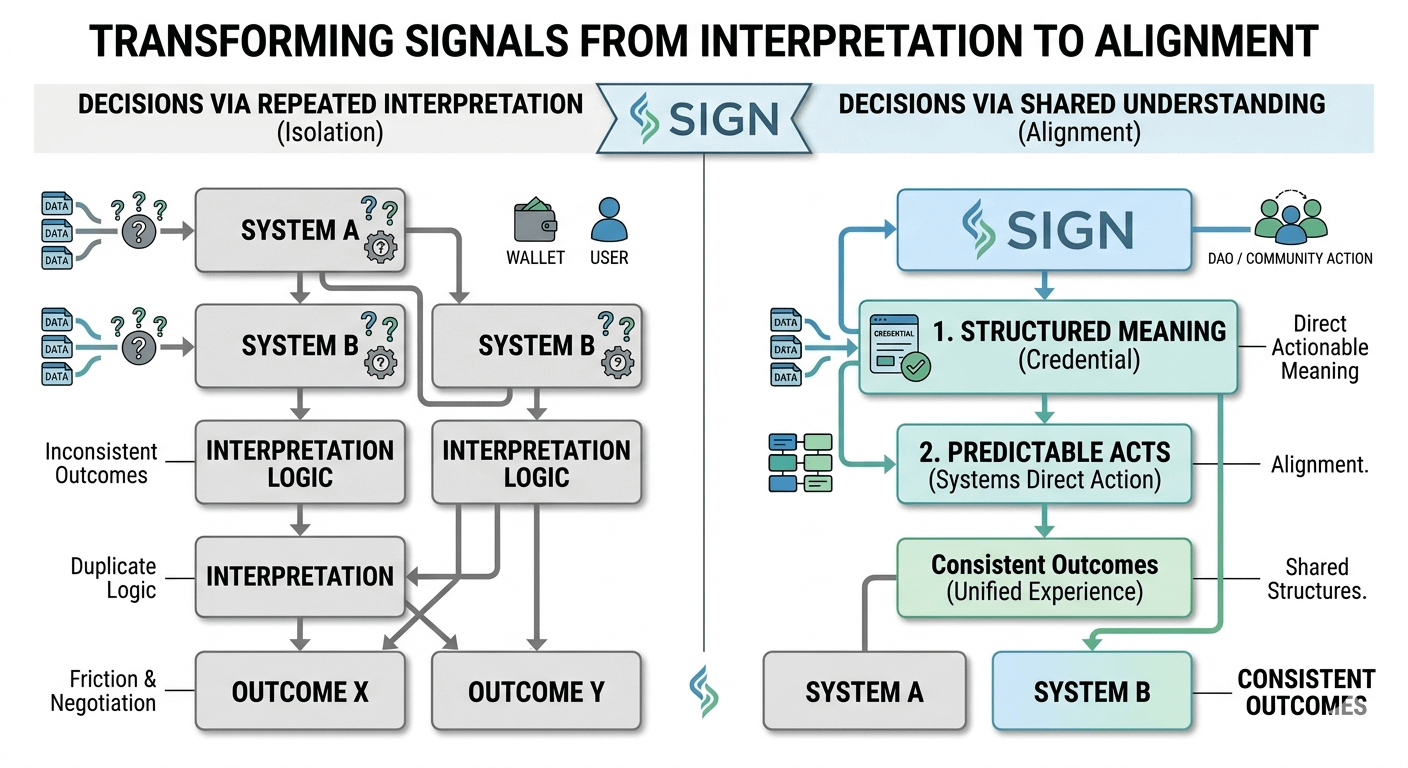
SIGN appears to focus directly on this repetition.
Instead of improving how systems make decisions, it changes how decisions persist.
In most environments today, decisions are temporary.
They exist at the moment they are made, but they don’t travel well. When another system needs them, it has to recreate them.
SIGN introduces a different structure.
Decisions don’t just happen.
They become something the system can recognize again later.
This is where credentials play a different role.
They are not just records of activity.
They represent decisions that have already been made about that activity.
So when a system encounters a credential, it doesn’t need to start from zero.
It doesn’t need to reinterpret the signal.
It can rely on the fact that the evaluation has already happened.
That removes a layer most systems quietly depend on.
Re-decision.
And that changes how coordination scales.
In most ecosystems, growth increases repetition.
More systems means more independent evaluations. Even if the logic is similar, it gets implemented separately. Over time, small differences appear.
SIGN moves in the opposite direction.
It reduces how often systems need to evaluate the same thing again.
Decisions become reusable.
That reuse has a compounding effect.
Consistency improves.
Outcomes align more closely.
Coordination becomes less dependent on constant verification.
And something subtle starts to happen.
Systems stop behaving like isolated environments making their own judgments…
and start behaving like parts of a shared structure that already understands certain outcomes.
That shared understanding is what most systems are missing.
Not because they lack data.
Not because they lack logic.
But because they lack a way to carry decisions forward without rebuilding them.
SIGN is working at exactly that layer.
It doesn’t try to eliminate decision-making.
It reduces how often it needs to happen.
And when systems stop re-deciding everything from scratch…
they don’t just become faster.
They become more aligned.
Because coordination stops being about repeated evaluation…
and starts being about building on what has already been decided.
@SignOfficial #signdigitalsovereigninfra $SIGN