
There is a strange pressure that comes with proving yourself online. Not the loud kind. The quiet kind. The kind that sits in the background every time a wallet connects, every time a token claim opens, every time a system asks, in its own cold way, “Are you really who you say you are?”
That pressure gets heavier when the system has no memory for context, only for rules. A human can make sense of nuance. A blockchain usually cannot. It sees the address, the signature, the transaction, and then it moves on. Clean, sharp, permanent. But people are not clean. People arrive with history, mistakes, borrowed identities, and half-finished trust. That is the part crypto still struggles to hold.
I noticed this in the way users behave around verification. They hesitate, then overcompensate. They share too much, or they avoid the process entirely. Both reactions make sense. When a system asks for proof, but does not explain how that proof will live afterward, it creates a small tension that never fully goes away. That tension changes how people participate. It makes them cautious. Sometimes it makes them disappear.
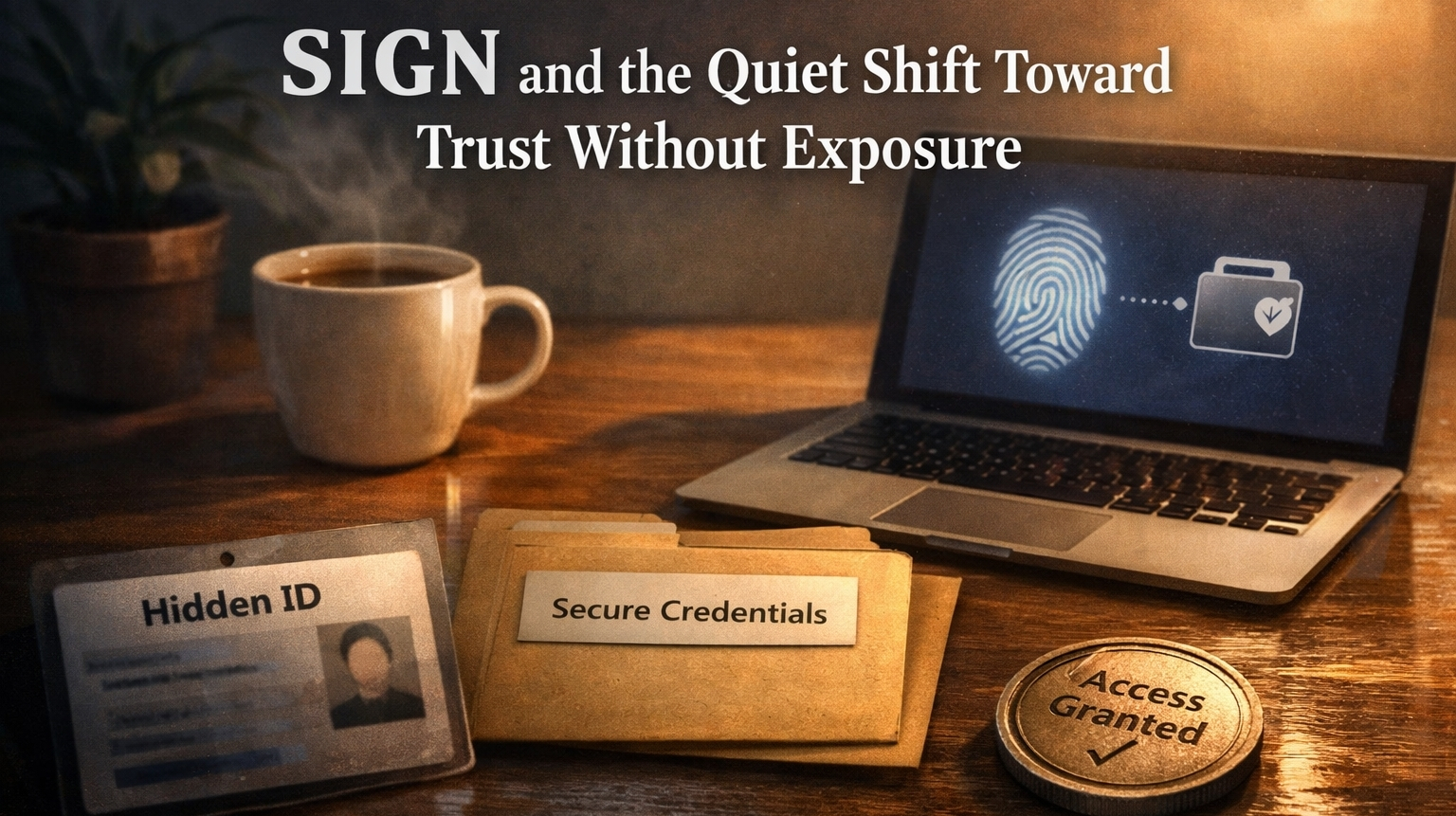
That is where SIGN started to feel meaningful to me. Not as a loud answer, not as a shiny new product, but as a response to a gap that has been sitting there for a long time. SIGN, the global infrastructure for credential verification and token distribution, seems built around a simple realization, trust in crypto should not always mean exposure.
It felt a bit quiet at first, which I actually liked. No dramatic posture. No pretending that identity suddenly becomes easy once it touches blockchain. Instead, the idea is more grounded. If credentials matter, then they should be verifiable. If token distribution matters, then it should be organized. But neither of those things should force users into unnecessary visibility.
That distinction matters more than it first appears. A credential is not just data. It is a claim about a person, a status, a right, a place they earned, or a role they hold. In most systems, proving that claim means handing over the underlying information. Once that happens, the user loses a bit of control. The system may do its job, but the person behind the proof carries the risk.
SIGN seems to work from a different instinct. Verification should be possible without turning identity into a free-for-all. That is the part that stayed with me. It is not only about privacy in the abstract. It is about dignity, convenience, and reducing the friction people feel when they know they are being asked for more than they should give.
The same logic applies to token distribution. Crypto has always loved the idea of fair access, but the reality often gets messy. Bots appear. Sybil behavior creeps in. Real users get buried under systems that cannot tell the difference between honest participation and organized abuse. Then projects start adding more checks, more rules, more friction. It becomes a loop.
SIGN sits in that messy middle and tries to make it cleaner. Verified credentials can become a gate, but a smarter gate, one that does not depend on blind trust or endless disclosure. That makes distribution feel more intentional. Less random. Less vulnerable to noise.
I think that is why this kind of infrastructure matters. Not because it sounds big. Not because it is trying to own the conversation. But because it solves a problem that users feel before they can name it. They want to participate without feeling stripped down in the process. They want to prove enough, not everything.
There is a real human story inside that. People do not mind verification when it feels fair. They mind being exposed for no reason. They mind systems that ask for honesty but offer no restraint in return. Crypto has spent years removing middlemen, which is useful, but sometimes the middleman was also the buffer. Without that buffer, every interaction feels more direct, and more harsh.
That is why credential infrastructure is not boring. It is not a back-office detail. It is one of the places where the next stage of crypto either becomes usable or stays awkward. A good system disappears into the experience. It lets the user feel recognized without feeling watched.
SIGN seems to understand that balance. It is not trying to make identity bigger than it is. It is trying to make it safer to use. And in a space where too many things still feel improvised, that is a serious shift.
What I keep coming back to is this, maybe crypto is slowly learning that trust does not have to mean overexposure. Maybe the better systems will be the ones that let people prove who they are, claim what they earned, and still keep a little of themselves untouched.
That feels like the direction things are moving. Not toward total visibility. Not toward total secrecy either. Just toward systems that understand how people actually behave, and how much easier participation becomes when proof does not always have to feel like surrender.
@SignOfficial
#signdigitalsovereigninfra $SIGN
