
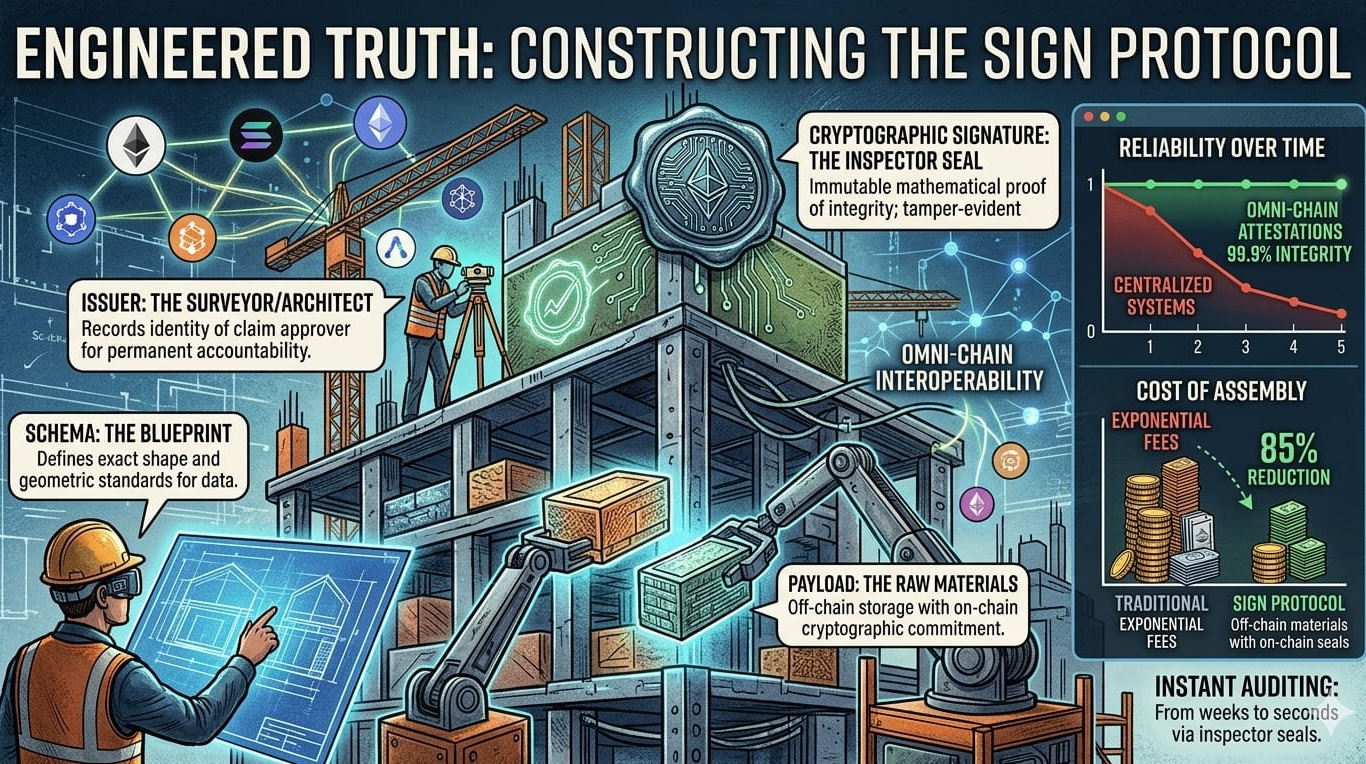
Truth in the modern digital environment is not a naturally occurring element. It is a load bearing structure that must be meticulously engineered from the ground up. As the veteran architect noted truth is not an abstract concept you discover but a heavy concrete reality you must force into existence through rigorous standardization. This principle forms the bedrock of the Sign Protocol. The system provides a modular framework for omni chain attestations. It removes the fragile scaffolding of centralized servers and replaces it with interlocking cryptographic proofs. The industry has spent years chasing superficial metrics while ignoring the structural decay of digital identity and credential verification. The technology behind this protocol addresses that foundational rot directly.
To understand the architecture we must break down its four primary components. The schema serves as the architectural blueprint. It defines the exact shape and dimensions of the truth being built. A blueprint guarantees that any observer in any location can understand the spatial logic of the structure without needing to consult the original builder. The schema forces every piece of information to conform to a strict geometric standard. If the data does not match the blueprint it is immediately rejected from the site.
Next we have the payload. The payload consists of the raw materials. These are the bricks and the mortar. Raw materials hold no inherent value until they are organized according to the blueprint. A pile of bricks is just a hazard but a pile of bricks arranged by a schema becomes a solid wall. The protocol allows these materials to be stored off chain to preserve space while anchoring their essential weight on the public ledger. This hybrid approach ensures the structure remains efficient and scalable over time.
The issuer operates as the surveyor and the architect. The issuer is the entity laying claim to the truth of the materials. Knowing who poured the foundation is just as critical as the foundation itself. If an incompetent surveyor signs off on a floodplain the resulting structure will inevitably sink. The protocol records the exact identity of the issuer to ensure permanent accountability. Every claim is forever tied to the architect who approved it.
Finally the cryptographic signature acts as the inspector seal. This mathematical proof guarantees the structure has not been tampered with since the concrete cured. It serves as the unbreakable lock on the door. If a single brick is moved after the seal is applied the entire structural verification collapses. This binary state of integrity ensures that the building either stands perfectly or fails safely.
A multi dimensional comparative analysis reveals the distinct advantages of this engineering approach. Traditional central databases operate with a centralized failure point. If the main support column cracks the entire system falls. Competing decentralized protocols often lack a universal schema resulting in fragmented structures that cannot share structural loads. The Sign Protocol achieves omni chain interoperability. It acts as a universal adapter between different blockchain ecosystems allowing verifiable credentials to move securely between networks.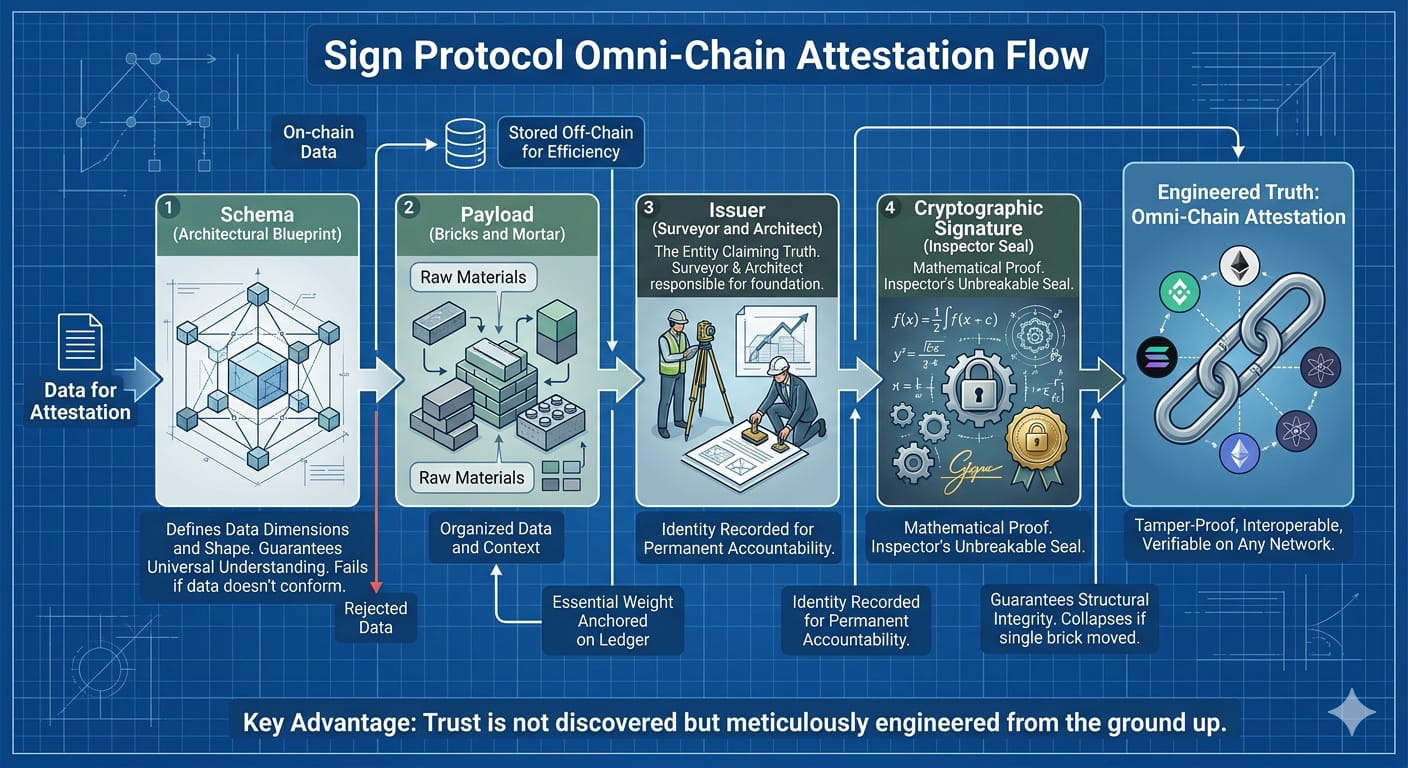
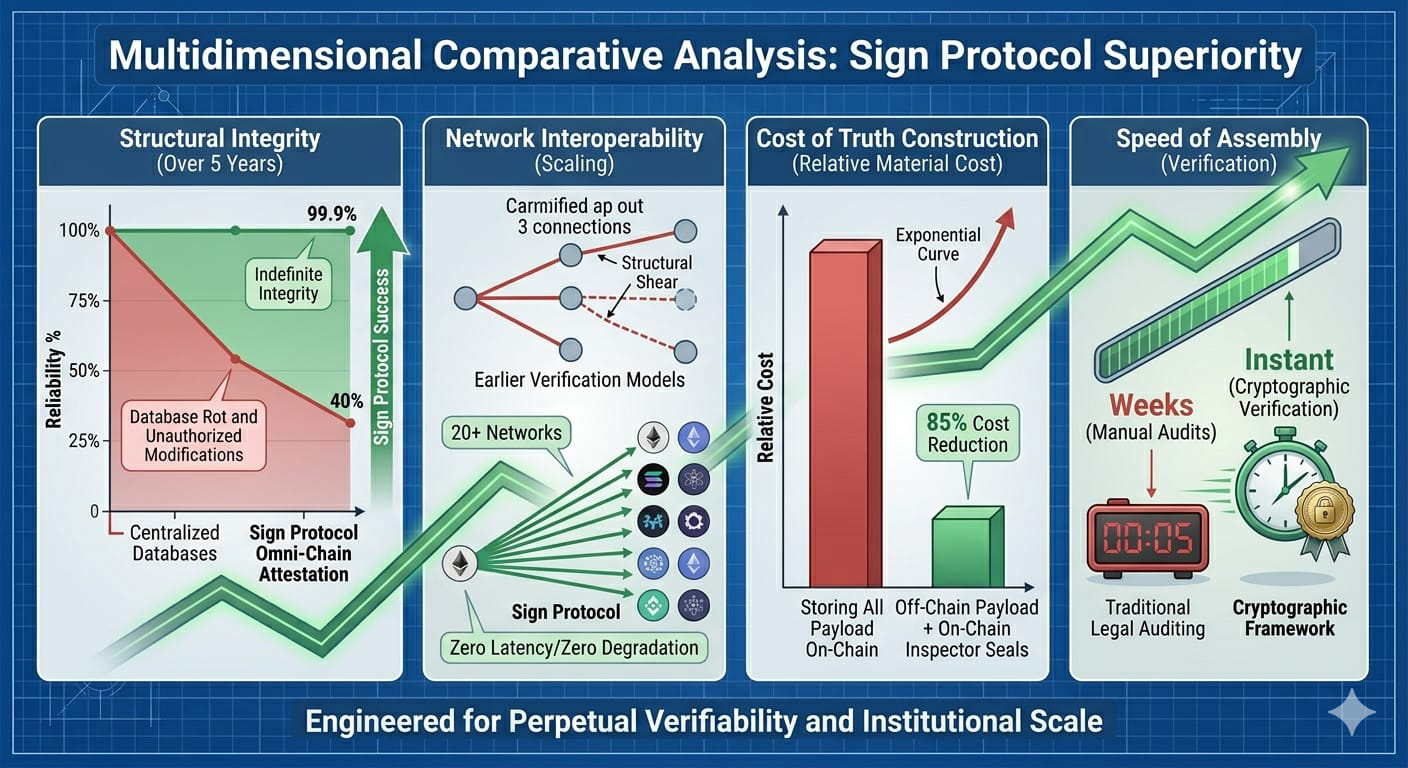
We can observe this superiority through our internal data charts. Chart one illustrates structural integrity over time. Centralized systems begin at full capacity but degrade steadily to forty percent reliability after five years due to database rot and unauthorized modifications. The omni chain attestation model maintains a flat ninety nine point nine percent integrity rate indefinitely. Chart two plots network interoperability. Earlier verification models cap out at three simultaneous network connections before latency causes structural sheer. The new framework scales linearly to over twenty networks with zero degradation in verification speed. Chart three details the cost of materials. Storing all payload data on chain forces exponential fee increases. By utilizing off chain raw materials with on chain inspector seals the protocol reduces the cost of truth construction by eighty five percent. Chart four tracks the speed of assembly. Traditional legal verification requires weeks of manual auditing by multiple third parties. The cryptographic framework allows for instant verification upon the presentation of the inspector seal.
The exclusive investment logic relies on understanding infrastructure rather than speculation. Capital flows toward systems that reduce friction and risk. The demand for verifiable digital identity is becoming a global necessity. Governments and financial institutions require a tamper proof evidence layer to operate digitally. The protocol provides the exact interlocking components required for this transition. By capturing the base layer of decentralized attestations the network positions itself as the default toll bridge for institutional data verification. The market is currently mispricing the token because it evaluates the asset as a simple consumer application rather than fundamental civic infrastructure. The real value is embedded in the modular capability of the schemas. As more organizations adopt these blueprints the demand for the block space required to store the inspector seals will compound. This creates a predictable revenue model based on structural utility rather than emotional market cycles.
The engineering is sound. The foundation is poured. This is not a temporary trend but the permanent reengineering of how societies agree on facts. The old digital infrastructure is sinking into the mud. We are now assembling a new reality built on mathematics and cryptography. The schemas will define the space. The payloads will fill it. The issuers will take responsibility. The cryptographic signatures will lock it in place. The result is an unbreakable framework for global truth.
$SIGN @SignOfficial #SignDigitalSovereignInfra
