
When I started looking more closely at how data actually functions in Web3 systems, one issue kept surfacing again and again: gas fees. Not as a minor inconvenience, but as a structural limitation that quietly prevents many meaningful data use cases from scaling.
Blockchains are often described as trust machines, yet when it comes to handling real-world data—identity, credentials, eligibility, and reputation—they become inefficient very quickly. The problem is not simply cost. It is repetition. The same piece of information is verified multiple times, across different applications and chains, each instance requiring new transactions and new fees. Over time, this creates a system where verifying truth becomes unnecessarily expensive.
In practical terms, this makes many applications difficult to sustain. Identity systems become costly to maintain, airdrops become inefficient to distribute, and any use case that depends on frequent verification struggles to scale. As a result, much of the data that could exist on-chain simply never does.
What caught my attention about Sign Protocol is that it approaches this problem from a different angle. Instead of trying to make each transaction cheaper, it asks a more fundamental question: why does the same data need to be verified again and again?
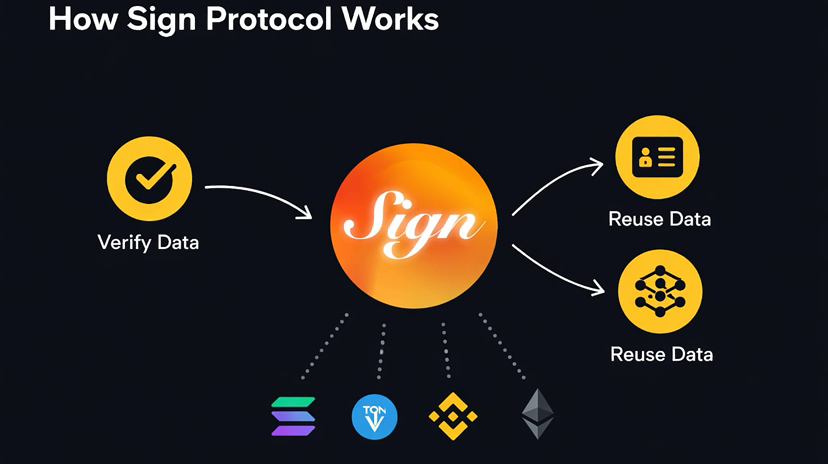
Sign introduces the concept of attestations, which are cryptographically signed statements about data. These attestations can represent facts such as whether a wallet has completed KYC, whether a user is eligible for a distribution, or whether a credential is valid. Once created, they can be reused across applications and even across different blockchains.
This idea of reusable verification changes the cost structure entirely. Instead of paying every time data is used, verification becomes something that happens once and can be referenced many times. In effect, Sign turns verification from a recurring expense into a reusable layer of infrastructure.
To understand why this matters, it helps to look at real-world scenarios. In token distributions, for example, projects often need to verify thousands or even millions of wallets. Traditionally, this involves repeated checks and on-chain interactions, each adding to the overall cost. With a system like Sign, eligibility can be verified once and then reused, reducing both complexity and expense.
The same applies to digital identity. Today, proving identity on-chain often requires repeated disclosures or verifications. This is not only inefficient but also raises privacy concerns. With attestations, a user could prove a specific attribute—such as being over a certain age or belonging to a particular group—without repeatedly submitting full personal data. The verification exists once and can be referenced when needed.
Another area where this approach stands out is cross-chain interoperability. Data is often fragmented across ecosystems, forcing projects to recreate verification processes on each chain. By designing an omni-chain attestation layer, Sign allows the same verified data to be recognized across multiple networks, reducing duplication and friction.
There are also indications that this model is being tested beyond purely crypto-native use cases. Experiments with digital identity systems and public infrastructure suggest that reusable verification could play a role in government-level applications. If that direction continues, the implications extend far beyond airdrops or DeFi, into areas like digital identity frameworks and public service distribution.
From a data perspective, the impact is significant. Large-scale token distributions facilitated through Sign’s tooling have already handled billions of dollars in value, demonstrating that the system is not purely theoretical. At the same time, token supply dynamics, including ongoing unlocks, introduce market considerations that cannot be ignored. Adoption and utility will need to keep pace with supply for the long-term thesis to hold.
What stands out most to me is that Sign is not trying to compete at the surface level of applications. It is positioning itself deeper in the stack, as a layer that defines how data is verified and reused. This makes it less visible in day-to-day user interactions, but potentially more important over time.
In many ways, the core idea is straightforward. Instead of verifying the same truth repeatedly, verify it once and make it reusable. Yet that simple shift has wide-ranging consequences for cost, scalability, and usability.
Gas fees, in this context, are not just a pricing issue. They expose a design inefficiency in how data is handled on-chain. By addressing that inefficiency directly, Sign offers a different path forward—one where verification becomes infrastructure rather than overhead.
After spending time understanding the model, I see it less as a short-term trend and more as a structural improvement. If Web3 is going to support real-world data at scale, it needs systems that minimize repetition and maximize reuse. Sign Protocol is one of the more compelling attempts I have seen in that direction.