
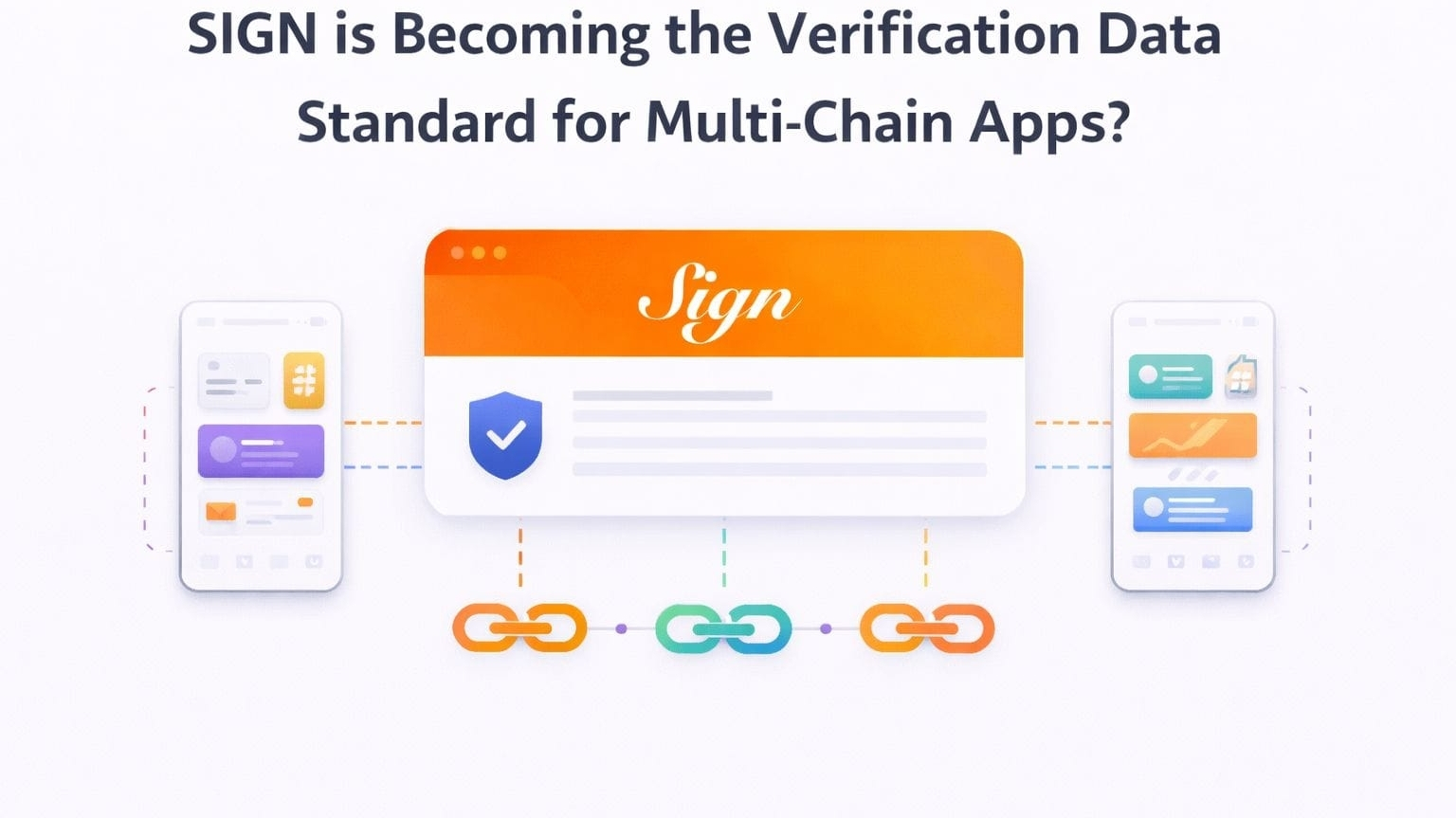
After revisiting how $SIGN approaches multi-chain attestations, it feels like their ambition goes beyond simply making verification easier for apps. What they’re really attempting is much broader: transforming trust into a form of data that can move across ecosystems without losing its meaning.
This comes at a timely moment. In Web3, assets, liquidity, and even user experiences already move fluidly across chains—but trust does not. A wallet verified in one ecosystem, reputable in another, and active in a third often has to start from scratch when entering a new environment. That gap is exactly what Sign seems to be targeting.
The interesting part is that the industry doesn’t lack verified data. What it lacks is a shared way to interpret, validate, and reuse that data across contexts. Many systems already issue credentials—whitelists, KYC badges, contribution records, reputation scores—but these remain isolated truths. They are valid within their own systems, defined by their own rules.
Once taken outside, that data loses clarity. Other apps must reinterpret the schema, reassess the issuer, and re-evaluate the credibility. In that sense, “verified data” is often only locally verified.
This is why Sign’s most important contribution may not be attestations themselves, but the attempt to standardize how claims are described. A claim isn’t just a statement—it includes who issued it, under what criteria, whether it can be revoked, whether it expires, and how it should be interpreted by others.
Without a clear descriptive layer, verified data is just signed information. With a schema, it becomes something closer to a unit of trust that machines can process consistently.
But this leads to a deeper issue. Standardizing data does not standardize trust quality. A shared schema makes claims easier to read and reuse, but it doesn’t guarantee that those claims are reliable. Weak issuers, shallow verification logic, or loose standards can still produce low-quality attestations—just in a more portable format.
In that sense, Sign may reduce friction in trust portability, but it could also amplify the spread of low-quality trust.
There’s also a structural shift to consider. As attestations become easier to reuse, applications may rely more on existing credentials instead of verifying from scratch. While this improves composability, it also concentrates influence among a smaller set of issuers and widely adopted schemas.
At that point, what’s being standardized is not just data—but authority. Sign could evolve from a neutral infrastructure layer into a channel through which authority is distributed and amplified.
Another overlooked challenge is context collapse. An attestation created for one purpose in one app may be interpreted very differently elsewhere. A growth campaign credential might be read as a reputation signal. A compliance-focused KYC badge might be treated as a broader indicator of trustworthiness.
As attestations move across ecosystems, their original context can flatten, increasing the risk of misinterpretation. Portability, in this sense, also makes misuse more portable.
That’s why the real value of Sign won’t be measured by how many chains it supports or how many attestations it records. It will depend on whether it can foster a market that actually cares about the quality behind those attestations—schemas, issuers, and verification standards.
If applications treat attestations as plug-and-play trust signals without examining their origins, the system will prioritize convenience over truth. In that scenario, adoption may grow—but trust itself may not deepen.
So is Sign becoming the standard for multi-chain verification data?
It’s building the kind of primitives that could define such a standard. But whether that standard becomes valuable or risky depends on how the ecosystem uses it—whether it promotes thoughtful reuse of evidence, or passive reuse of authority.
And that’s the more important question to watch:
Is Sign enabling trust to move across ecosystems, or simply enabling authority to scale more efficiently in the form of data?