
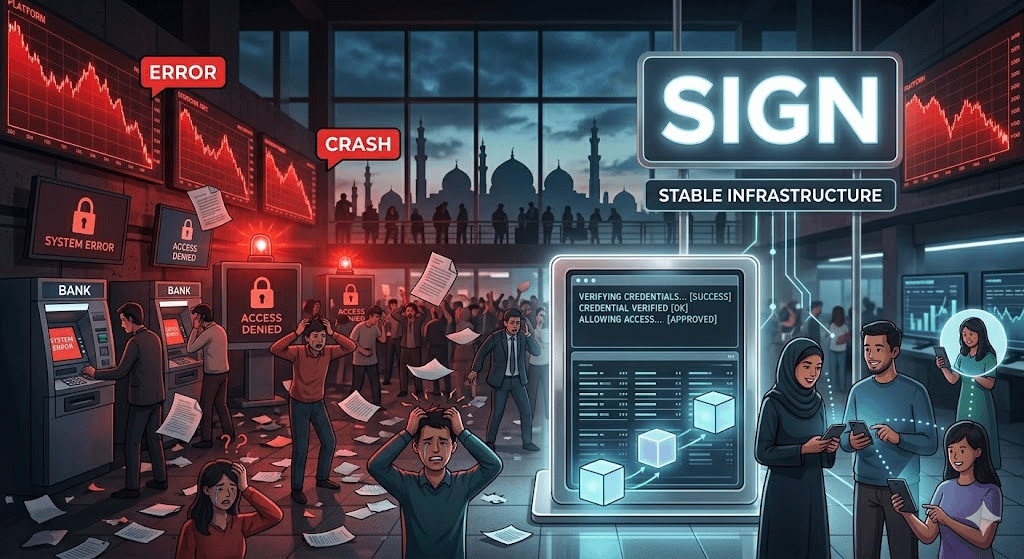
I have been in this space long enough to notice a pattern. Big claims come easy in crypto. Every cycle, there’s a new wave of projects talking about resilience, security, or infrastructure that can handle anything. It sounds good, almost convincing. But when things actually get tested when markets drop, liquidity tightens, or systems come under pressure that confidence usually fades pretty quickly.
So I’ve stopped getting excited by those words. If anything, I pay more attention when something doesn’t try too hard to sound impressive.
That’s probably why SIGN didn’t stand out to me at first. On the surface, it sits in a familiar category verification, infrastructure, distribution. It could easily be another idea that looks solid in theory but never really proves itself where it matters.
But after spending some time on it, I noticed something different. It’s not just an idea on paper. There are actual use cases already in motion. Not massive adoption, but enough to show it’s being used in real workflows. That alone makes me take it a bit more seriously.
At its core, what SIGN seems to be doing is fairly straightforward. It’s trying to make trust and verification more stable across systems. Instead of forcing everything to reset every time you move between platforms or environments, it allows that trust to carry forward in a usable way.
That might sound simple, but in practice, it’s not.
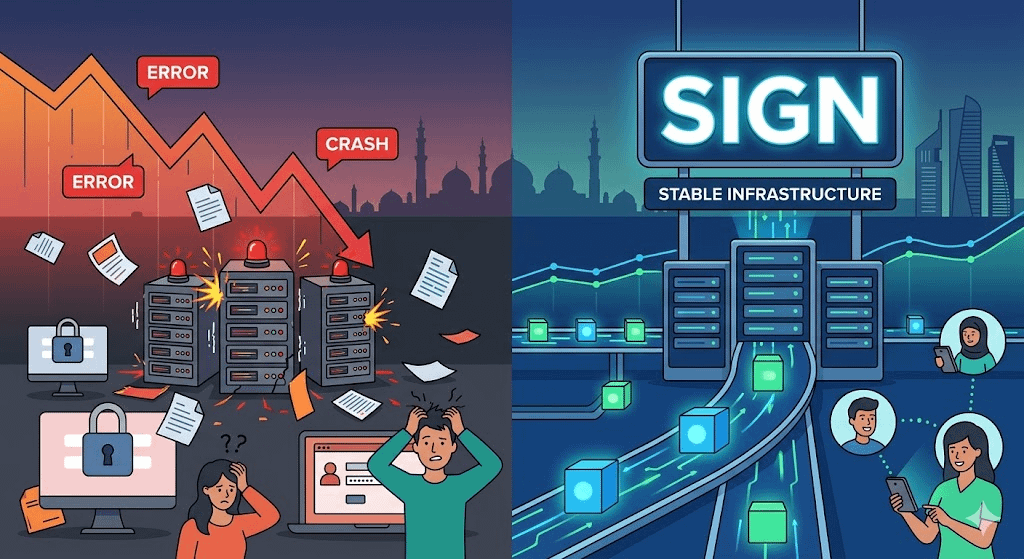
Because systems fail. Not occasionally, but often enough to matter. Banks freeze access. Platforms go down. Markets expose weak assumptions when things turn volatile. And when that happens, anything that depends on repeated checks or fragile coordination starts to break apart. Things slow down. Access becomes uncertain. Trust doesn’t disappear, but it stops being reliable.
I’ve seen that play out more than once, and it changes how you look at infrastructure. It’s not about how something works when everything is stable. It’s about what happens when it isn’t.
That’s where SIGN’s approach starts to make sense to me. It’s not trying to sit on top of the system as another visible layer. It’s trying to sit underneath, closer to the foundation handling how credentials are issued, verified, and reused across different environments.
From what I can tell, it’s already being used for things like token distributions, onboarding, and basic verification processes. These aren’t flashy use cases, but they’re practical. More importantly, they repeat. And repetition is usually a better signal than announcements.
Still, I don’t think this is simple or guaranteed to work.
Building infrastructure that institutions or governments might rely on is a different level of challenge. Adoption is slower. Standards are higher. There’s less room for error. Especially in regions like the Middle East, where different systems operate side by side with their own rules, getting alignment isn’t easy.
Even if the technology works, getting people to trust it enough to depend on it is a separate problem.
So I find myself somewhere in the middle.
I respect what SIGN is trying to do. It feels more grounded than most projects that rely on narratives and short-term attention. There’s a focus on something deeper, something that only really proves itself over time and under pressure.
At the same time, I’m not fully convinced yet.
For me, this is something to watch closely, not something to assume will succeed. If it keeps showing real usage, especially in situations where systems are stressed or disconnected, that would mean more than any claim.
Until then, I’m paying attention, but carefully.
Because in crypto, there’s always a gap between what sounds strong and what actually holds up when things get difficult.
@SignOfficial $SIGN #SignDigitalSovereignInfra
