
Cross-chain attestations are a core capability of Sign Protocol, allowing verifiable data created on one blockchain to be trusted and validated on another. This transforms attestations into portable, interoperable proofs that work across multiple networks.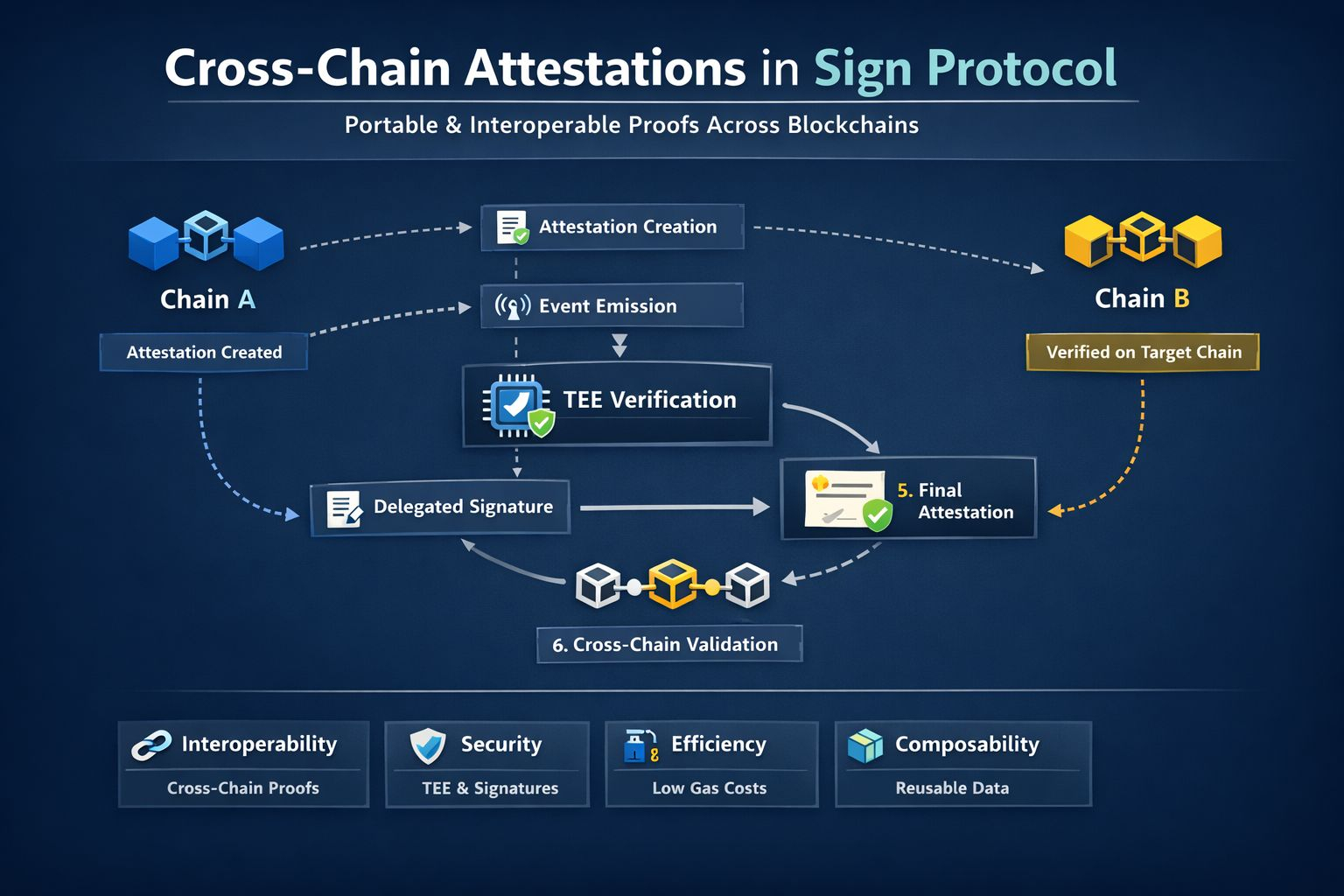
What Are Cross-Chain Attestations?
In most blockchain systems, data is isolated within a single network. Cross-chain attestations remove this limitation by enabling:
Attestations created on one chain
To be verified and reused on different chains
This supports Sign Protocol’s vision of an omni-chain attestation infrastructure, where data is not restricted to a single ecosystem.
Why Cross-Chain Attestations Matter
Without cross-chain functionality:
Credentials remain locked to one blockchain
Developers must duplicate data across networks
Users lose portability of identity and reputation
Cross-chain attestations solve these issues by enabling:
Interoperability between blockchains
Reusable trust across applications
Reduced redundancy in storage and verification
How Cross-Chain Attestations Work
Sign Protocol uses a secure verification approach combining schemas, event data, and Trusted Execution Environments (TEE).
Workflow
Attestation Creation
A cross-chain schema is used to create an attestation
Includes target chain and reference data
Event Emission
Data is stored efficiently and emitted for processing
TEE-Based Verification
Secure nodes fetch and decode the data
Compare it with the original attestation on the target chain
Delegated Signature
A signed verification result is generated
Final Attestation
A delegated attestation confirms whether the data matches
Completion
The attestation becomes verifiable across chains
Key Components
Trusted Execution Environments (TEE)
Secure environments that ensure safe and tamper-proof verification.
Schemas
Standardized data structures that define how attestations are created and validated.
Event-Based Data Handling
Efficient data storage and processing method that reduces on-chain costs.
Benefits
🔗 Interoperability
Enables attestations to function across multiple blockchains.
🔐 Security
Ensures reliable verification through secure computation and signatures.
⚡ Efficiency
Optimizes gas usage by minimizing on-chain storage.
🌐 Composability
Allows reuse of data across different applications and ecosystems.
Cross-Chain vs Traditional Attestations
Feature
Traditional Attestations
Cross-Chain Attestations
Scope
Single blockchain
Multiple blockchains
Portability
Limited
High
Verification
Local only
Cross-network
Interoperability
Low
High
Use Cases
Basic proofs
Advanced multi-chain applications
Conclusion
Cross-chain attestations extend the power of Sign Protocol by enabling trust to move freely across blockchain networks. By combining secure verification, standardized schemas, and efficient data handling, they remove the barriers between isolated ecosystems.
This approach turns attestations into portable and universally verifiable proofs, supporting the development of scalable, interconnected Web3 systems.
#SignDigitalSovereignInfra #blockchain #Web3 #BinanceSquareFamily #Binance