
Honestly, I didn't get it at first. A project doing "blockchain attestation" — okay cool, sounds fancy, but who actually uses this stuff? Then I went through Sign Protocol's actual docs, the S.I.G.N. part — Sovereign Infrastructure for Global Nations — and something clicked. This isn't a tech demo anymore.
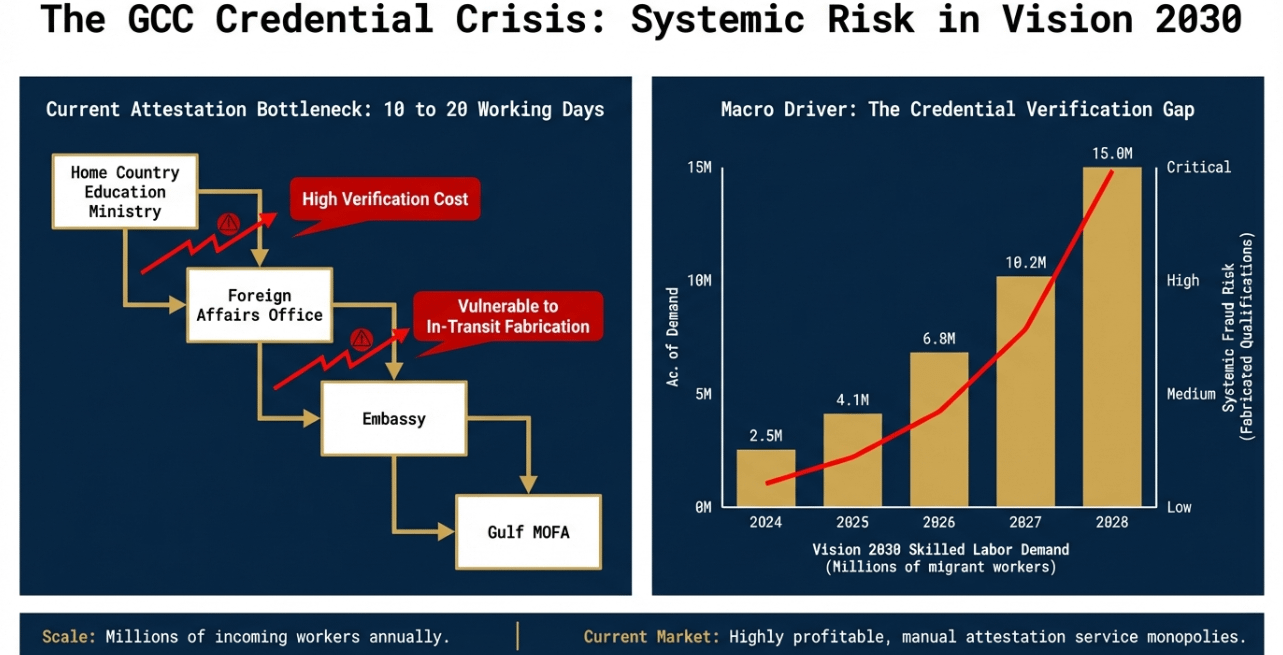
The GCC region — UAE, Saudi Arabia, Kuwait, Qatar, Bahrain, Oman — has a very real, very expensive problem. Millions of migrant workers arrive every year, each carrying a stack of credentials that need to be verified through layers of bureaucracy: home country education ministries, foreign affairs offices, embassies, then MOFA on the Gulf side. The process takes 10 to 20 working days, costs money, and can still be faked at almost any point along the way. This isn't speculation — it's the exact gap that attestation service companies in Dubai are profiting from right now.
And the scale of the problem isn't small. Demand for skilled labor across Saudi and UAE is accelerating with Vision 2030 projects. When demand spikes, you know what else spikes? Fake credentials. There were cases last year — fake doctors, engineers with fabricated qualifications. This is systemic risk, not a fringe issue.
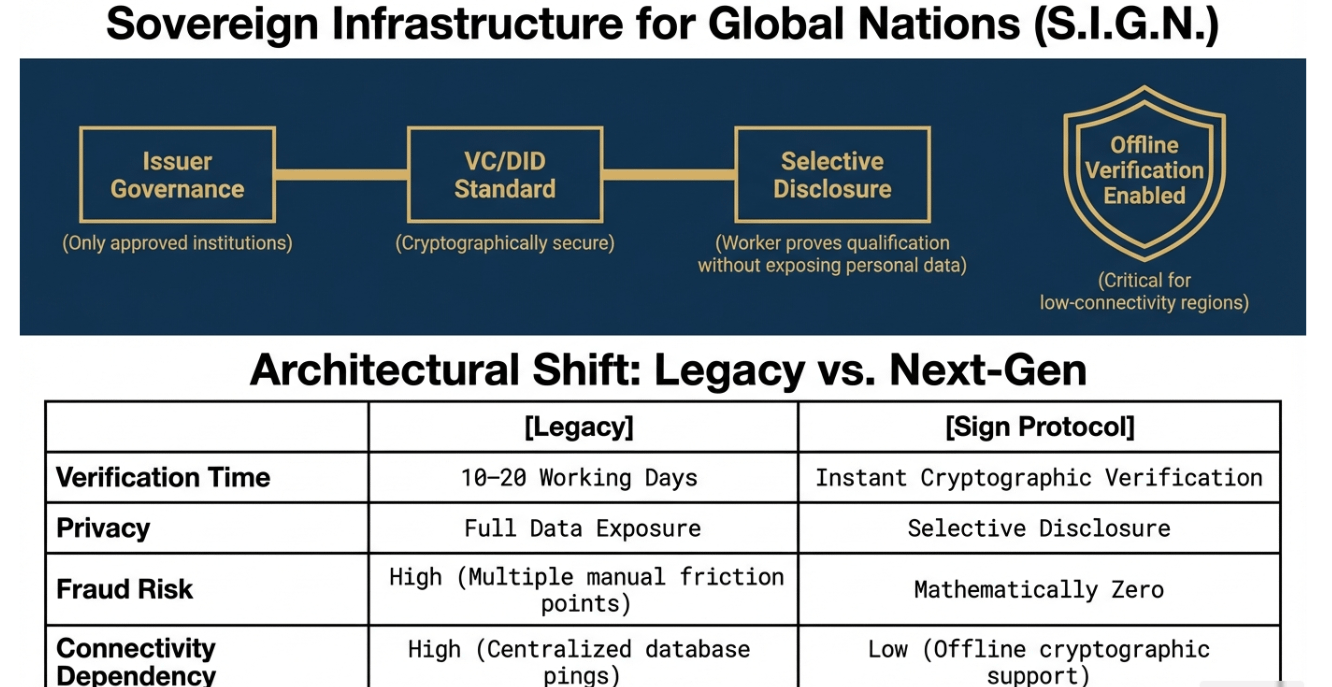
Sign Protocol is betting on solving exactly this pain point. Their New ID System is built on verifiable credentials — VC/DID standards — with selective disclosure, meaning a worker can prove they hold a qualification without exposing all their personal data. Offline verification is supported too, which matters in regions where connectivity isn't always stable. And issuer governance is baked in — only approved institutions can issue credentials, no random minting.
So what's the investment angle here? Not the usual "project doing good things so price goes up" logic. It's something a bit more structural. Most people in crypto price assets based on hype cycles, bull market narratives, influencer momentum. But there's a smaller, quieter category of projects building things where the use case survives even if the market dumps 60%. Sign Protocol looks like it's in that category.
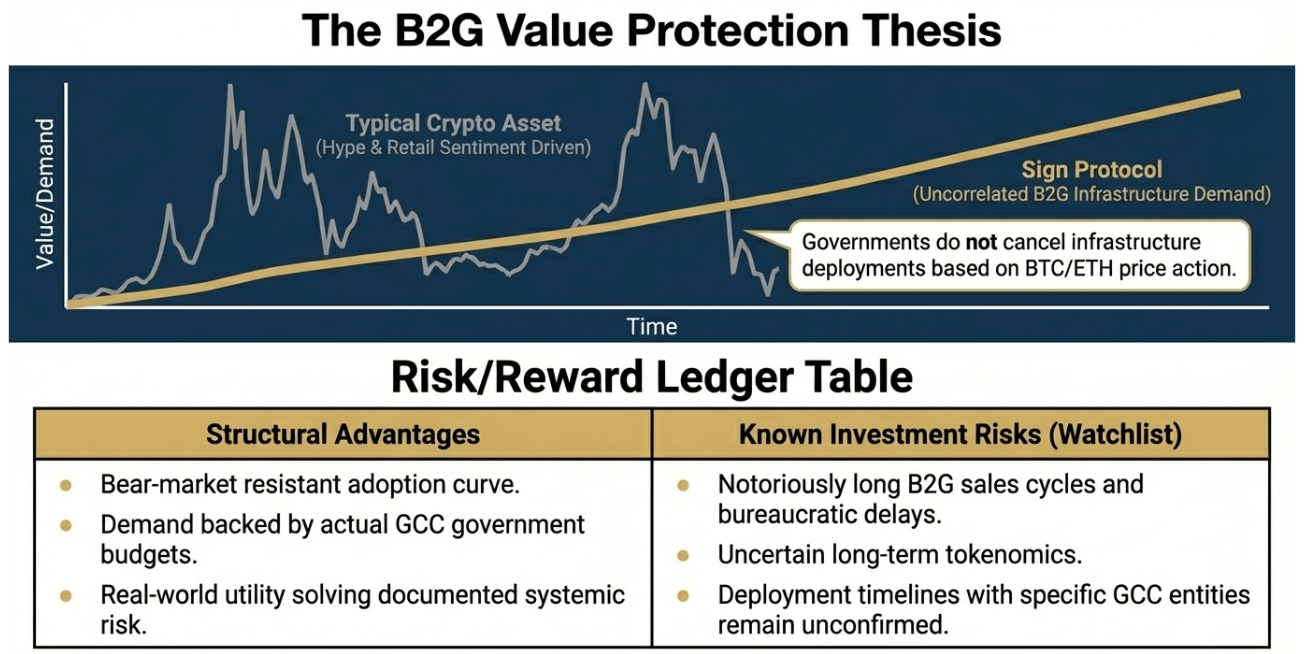
Because demand for credential verification in the GCC doesn't follow Bitcoin's price chart. UAE doesn't wait for ETH to pump before deciding whether an engineer working on a bridge has a real degree. Saudi Arabia doesn't need a bull market to want its administrative education systems digitized. This is real demand, government demand, demand backed by actual budgets.
What a lot of people overlook is the concept of value protection. Everyone loves to think about upside — this coin does x5, that project hits its roadmap next quarter. But in a market where 90% of altcoins approach zero by the end of a cycle, the most important question isn't "will it pump?" — it's "if the market turns ugly, does this thing still have a reason to exist?" For Sign Protocol, the answer seems to be yes, because governments don't cancel infrastructure contracts just because crypto markets are bleeding.
Not saying this is a guaranteed gem or calling anyone to ape in. I'm genuinely uncertain about tokenomics, and the actual deployment timeline with specific GCC governments is still unclear. B2G sales cycles — selling to governments — are notoriously long and prone to delays. That's a real risk worth naming.
But if you're looking for something to balance a portfolio, something with demand that doesn't hinge entirely on market sentiment, something with a real story behind it rather than just a polished whitepaper — Sign Protocol's GCC thesis is worth watching seriously. Not because it'll moon next week. But because it's built on a real problem, and the Middle East has real money to pay for real solutions. @SignOfficial $SIGN #SignDigitalSovereignInfra